
Protein intake: what you need to know
Dietary protein isn’t only a question of how much you get over the course of the day. Just as important are how well your stomach handles it, when you eat it and whether you need a faster- or slower-digesting option after a workout.
The simple truth is that more is not always better. If your digestion grinds to a halt, a large amount of protein stops doing your body much good.
Why does dietary protein matter?
At the gym, people often talk about protein as though the only rule were: eat plenty of it and your muscles will grow. In practice, it is a little more complicated. Some people digest protein-rich foods well, while others experience a heavy feeling in their stomach, gas or even feel ill after just a few larger portions.
That raises a practical question: why eat so much protein that your body struggles to digest it? If your body cannot comfortably process the protein you eat, it does little good for bodybuilders, recreational athletes or regular gym-goers alike.
Protein powders can help, but it is worth reading their labels, too. Some products contain added ingredients that support digestion, or use protein processed in a particular way, such as through hydrolysis. The original article also mentioned probiotics and prebiotics, along with IgG, which is associated with the immune system. The idea is simple: when there is less strain on your digestive tract, your body can make better use of the protein you eat.
Protein and digestion: what actually happens?
Dietary fiber is another interesting topic alongside protein. Soluble dietary fiber can make protein powder creamier, sweeter and more palatable. It also slows the movement of food through your intestines and the absorption of nutrients.
For the average person, this can be a good thing. You stay full for longer and your energy levels fluctuate less. For a bodybuilder or someone who trains and consumes very large amounts of protein, the same effect can become a problem. If you eat again before your previous meal has been digested, you may experience gas, cramps, bloating and an uncomfortable feeling of heaviness in your stomach.
This does not mean you should be afraid of dietary fiber. It comes down to timing and quantity. A larger amount of soluble dietary fiber before bed, for example, may allow protein to be absorbed over a longer period. During the day, however, particularly around training, digestion that is too slow can get in the way.
Protein after training
In 1997, French scientist Yves Boirie and his colleagues conducted a study with an uncomfortable message for the supplement industry. When a protein drink was consumed on an empty stomach, part of it was used for energy, in an amount of almost the same order of magnitude as that used for protein synthesis. In small amounts, the protein powder had a high biological value, but with larger amounts, the effect was no longer so straightforward.
Whey is absorbed quickly. This is both its strength and its weakness. At rest, whey that is absorbed too quickly may be partly used for energy rather than to build muscle tissue. After a workout, the picture is different because muscle cells take up nutrients more readily.
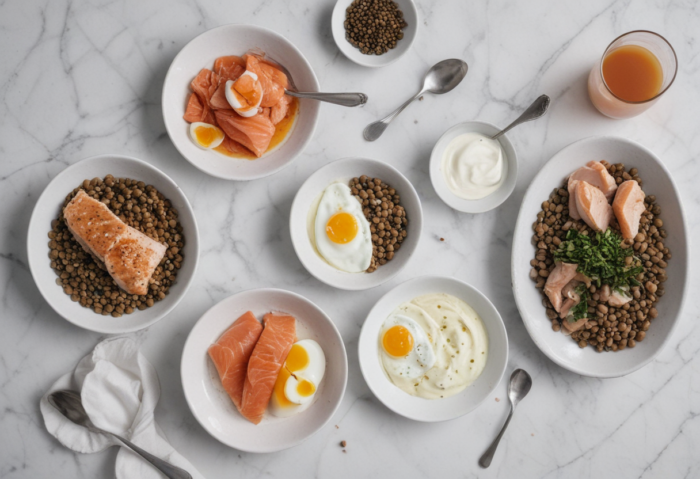
That is why fast-digesting protein can be a sensible choice after training. There is no need to build your entire day around shakes, though. Real food such as quark (curd cheese), eggs, fish, meat or legumes takes longer to digest and helps maintain a steadier supply of protein.
The original article suggested that the best approach would be to consume 75% of your daily protein after training, i.e. within 5-6 hours after your workout. This is a very intense approach and is better suited to someone who trains seriously and can tolerate that load. For a recreational exerciser, it is more important to consistently meet your daily protein needs and keep your digestion working well.
How should you spread your protein intake throughout the day?
If your goal is to build muscle mass, it is worth planning the period after your workout. Your body does not need you to panic, but it does need building materials. A good plan is one you can stick to even when your workday runs long or your workout finishes later than expected.
- Have a protein drink within 1 hour of training.
- Have another protein drink 2 hours after the first.
- 2-3 hours after your second protein drink, eat a proper meal containing the required amounts of protein, carbohydrates, minerals and other nutrients.
- Your remaining meals should provide the protein you need, preferably from slower-digesting sources such as tuna or quark.
This kind of plan is better suited to a mass-building phase. It is not the same as a high-protein, low-carbohydrate diet before a competition. Different rules apply there.
What should you look for in a protein powder?
Start by paying attention to how your stomach responds. If a particular powder causes gas or a heavy feeling in your stomach, that does not mean protein is not right for you. The issue may be the specific formulation, sweetener, dietary fiber content or serving size.
Next, think about timing. Fast-absorbing whey can be good after training. Slower-digesting foods are better suited to the evening or as a snack. If you want to eat a lot of protein at once, your digestion needs to be able to keep up.
Honestly, the best sign is usually simple: you have energy, your stomach is happy, and your next workout doesn’t suffer. If your protein routine starts making life harder, your plan is too rigid.
FAQ: protein in food
What is protein?
Dietary protein is the protein you get from food. Your body uses it for muscles, tissues, and many everyday repair processes. It’s especially important if you train, because the training load breaks down muscle tissue, and your body needs building blocks to repair it.
Is protein powder better than real food?
Not necessarily. Protein powder is convenient and often practical after a workout, but real food provides other nutrients too. A sensible combination of both is usually the best approach.
Why can protein leave your stomach feeling heavy?
There are several possible reasons: too large a portion, eating too quickly, sensitivity to an ingredient, or too much soluble dietary fiber. Start with a smaller amount and see how your body responds.
You can find supplements to your regular diet here: https://turg.fitness.ee/et
Author: FLEX (translated by Mikk-Alvar Olle)
Source: WHO – physical activity.
Come work out! ArtGym




