
Chest muscles: training and exercises
Training your chest takes more thought than you might expect. If you only do the bench press, your lower chest will often grow faster, leaving your overall chest development out of balance.
The simple truth is that you cannot train your chest to become wider or longer, but you can make it stronger, denser and more evenly developed. To do that, you need to choose exercises that give your upper, lower, inner and outer chest the right training load.
Why your chest muscles need special attention
Each side of your chest has two muscles: the pectoralis major and pectoralis minor, the larger and smaller chest muscles. The pectoralis major gives your chest its visible shape. The pectoralis minor lies underneath it, near the upper outer region.
Two things influence the shape of your chest. The first is genetics: your rib cage, height and muscle attachment points determine a great deal. The second is your training history. If you have favored the standard bench press for years, your lower chest may be noticeably more developed than your upper chest.
So what actually happens? An exercise works your whole chest, but the emphasis shifts between regions. An incline bench makes your upper chest work harder. Decline presses and dips emphasize your lower chest. Cable crossovers help you feel your inner chest working more clearly.
How your chest muscles work in different exercises
Your upper chest makes up about a third of the whole muscle. It lags behind in many people because their workout always starts with the flat bench press. Incline presses and incline dumbbell flyes are suitable exercises for your upper chest. If the bench is adjustable, choose a 30-degree incline over a 45-degree incline, because the steeper angle shifts more of the training load onto your shoulders.
Your lower chest makes up two thirds of the whole muscle. It usually develops faster, especially if you do plenty of presses and neglect other exercises. Bench presses, decline bench presses and dips work your lower chest. For decline bench presses, use a bench set to a 30-degree decline.
Your inner chest comes into play more in exercises where your hands come together at the end of the movement. In dumbbell flyes, your hands meet at the top, but by that point there is already less tension on your chest. That is why cable crossovers and pec deck flyes are good choices for your inner chest.
Your outer chest works harder when the muscle is stretched. It generally does not need to be prioritized. If you feel otherwise, you can use a slightly wider grip on barbell presses or add dumbbell flyes.
Choosing the right exercises for your chest
Exercises broadly fall into two categories: compound exercises and isolation exercises. Compound exercises involve several muscles and joints working at once. These include different press variations and dips. Isolation exercises place the emphasis more specifically on your chest. These are mainly different fly variations.
It is not quite accurate to say that presses only build mass and flyes only develop shape. Both can build strength and muscle mass. The difference is more about how the exercises feel: presses let you use heavier weights, while flyes help you learn to control your chest muscles better.
Presses
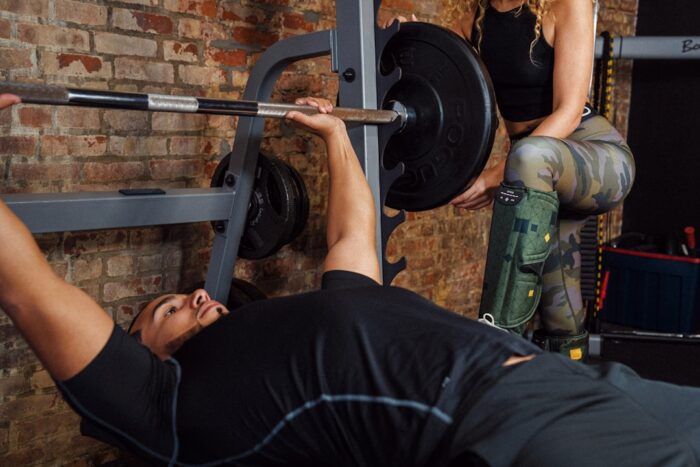
When pressing, lower the weight to your chest, then press it back up until your arms are almost straight. Keep your shoulders and middle trapezius against the bench. Do not let your elbows drift upward uncontrollably. Do not bounce the barbell off your chest, and use a training partner’s help when needed.
The bench press trains your middle and lower chest. Lower the barbell to the lower part of your chest muscles, slightly above your nipples. The incline bench press works your upper chest more. On decline presses, lower the barbell to the lower part of your chest muscles; if you lower it to your upper chest, the exercise becomes more like a standard bench press and loses its specific emphasis.
Dumbbell presses allow a greater range of motion and a better stretch. However, the exercise is also less stable. To avoid injury, choose light dumbbells that allow you to complete at least eight repetitions. The seated machine chest press is safer and a good option for variety, but its fixed movement path does not demand as much control from your body.
Flyes
Flyes with dumbbells, cables or a machine are a good way to isolate your chest. Choose a moderate weight and keep the movement controlled. Too much weight turns the exercise into a matter of shoulder effort and momentum.
Keep your palms facing each other and your elbows bent at about a 45-degree angle. Lower your arms until you feel a strong stretch in your chest, then bring them back along the same path. For cable crossovers, move your arms in an arc and hold for a second at the end to maximize tension.
Incline flyes work your upper chest and are performed on a bench set to a 30-degree incline. Flat bench flyes emphasize your middle and lower chest. Decline bench flyes shift the work even more toward your lower chest.
Chest training FAQ
Can you train only your upper chest?
No. You can shift the emphasis toward your upper chest, but the whole chest muscle still contributes. An incline bench simply makes the upper region work harder.
Do flyes shape your chest?
Flyes do not change your genetically determined chest shape, but they help you feel your chest muscles working and distribute the training load more evenly. They are a good complement to presses.
When should you use a training partner?
A training partner is a sensible choice for heavier presses, especially on a decline bench, where reracking the barbell can put your shoulder at risk.
We teach you how to train your chest muscles correctly! ArtGym
Author: Mikk-Alvar Olle, translated from Flex




