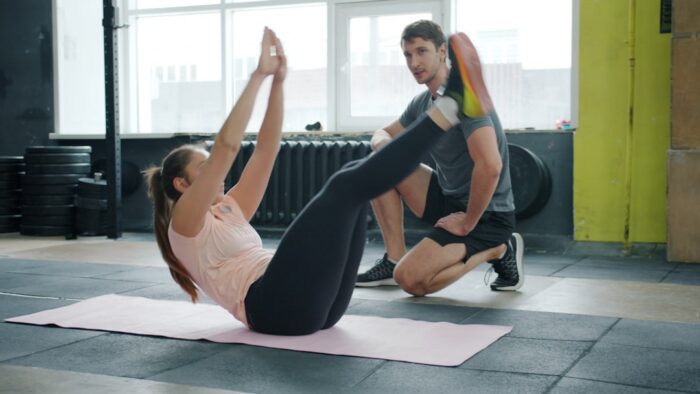
Ab training: a simple, smart plan
Ab training doesn’t have to mean half an hour of nonstop leg raises and sit-ups. A smarter approach is to choose exercises that work your entire core without letting your lower back and hip flexors take on all the training load.
The simple truth is that doing hundreds of reps every day won’t give you visible abs on its own. Training, nutrition, cardio and rest all need to work together.
Why does ab training need a plan?
Your abs aren’t one small muscle you can endlessly push to “feel the burn.” Your core consists of several parts: the rectus abdominis, the internal and external obliques, and the transversus abdominis. The rectus abdominis is the muscle behind what we call a 6-pack. Your obliques help you rotate your torso and bend to the side. The transversus abdominis lies deeper and helps keep your abdomen engaged, for example when you deliberately breathe out.
Once you understand this, your training starts to make more sense. You don’t need to work your abs just to tire them out. The aim is to engage the right area at the right time. Some exercises place more demand on your lower abs, others on your upper abs or obliques. You don’t need to chase complete isolation, but feeling the muscles work matters a lot.
How should you structure your ab training?
Start with your goal. If you want a stronger, toned core, choose moderately challenging exercises and aim for around 25 reps. If you want more pronounced abs, choose a harder variation and keep the rep count lower. A good range is 12-20 reps. The final reps should be difficult, but your form needs to stay solid.
If you can only manage 10 reps, the exercise may be too difficult for you right now, or you may be moving too quickly and losing control. If you do more than 30 reps and still don’t feel your abs working much, the exercise is too easy. Slow the movement down, maintain tension and focus on actually contracting your abs.
Start with your lower abs
Lower ab exercises are often the most demanding because your hip flexors tend to take over. It makes sense to put them at the start of your workout, while you still have the focus and strength. Choose an exercise where you feel your abs working, rather than just your hips or lower back. Do at least two sets and don’t rush your reps.
Move on to your obliques
Be honest about what you want from training your obliques. Do you want them to be stronger, provide more stability or become noticeably bigger? Very heavy oblique training can change your body shape. Twisting sit-ups and movements that bring your elbow toward the opposite knee usually provide a good training load for your obliques, as long as you aren’t simply flailing around and relying on momentum.
Finish with your upper abs
Sit-ups and controlled trunk flexion work well for your upper abs. Don’t let your abs relax completely at the end of each rep. To make the exercise harder, change the position of your arms or legs. Moving your hands from beside your knees to behind your head increases the training load. Raising your legs off the floor to a 90-degree angle also makes the movement harder.
Ab training and recovery
Your abs work every day, helping you maintain your posture and stabilize your core. That doesn’t mean you need to train them separately every day. If you don’t train your legs or chest every day, why should your abs be an exception?
Your abs often recover faster than larger muscle groups, but they still need rest. If they’re still sore from your last workout, give them time. A practical rule is to leave around 48 hours between harder ab workouts. Three times a week is enough for many people, provided you do your sets properly instead of just going through the motions.
Variety helps, too. You can start with your lower abs on one day, your obliques on the second and your upper abs on the third. Another option is to do three sets as a circuit: one for your upper abs, one for your lower abs and one for your obliques. As your muscles get stronger, add weight or choose a more challenging exercise. Doing the same movement with the same rep count all the time eventually becomes nothing more than a habit.
Ab training, food and cardio
The most frustrating part? Strong abs don’t automatically mean visible abs. If there’s a layer of fat over them, your hard work stays hidden. This isn’t a punishment or a mystery; it’s simply how your body works.
That’s why good ab training goes hand in hand with sensible nutrition and endurance training. You don’t have to live on chicken breast and a sad lettuce leaf, but what you eat each day needs to support your goal. If you want your abs to be more visible, your energy balance needs to allow for that. If you want a stronger core, your training needs to be challenging enough and consistent.
Honestly, the best ab training plan is one you can stick to for several weeks in a row. Choose exercises you can perform with controlled technique. Maintain tension throughout your reps. Don’t rely solely on the burning sensation. And remember: one bag of chips won’t undo a workout, but consistently poor eating habits make a visible 6-pack very hard to achieve.
FAQ
Can you train your abs every day?
You can, but you usually don’t need to. If your training is truly demanding, your abs need recovery time, too. Around 48 hours of rest between harder workouts is a sensible starting point.
Can you train your lower abs separately?
You can’t isolate them completely, because the rectus abdominis works as a whole. However, exercises that involve raising your lower body can place greater emphasis on your lower abs.
How many reps are best for your abs?
It depends on your goal. Around 25 reps works well for a toned core with good muscular endurance. To work your muscles harder, stay in the 12-20 rep range and choose an exercise that makes the final reps difficult.
Give your abs hell! ArtGym
Author: M&F Abs; translated by renita Hunt