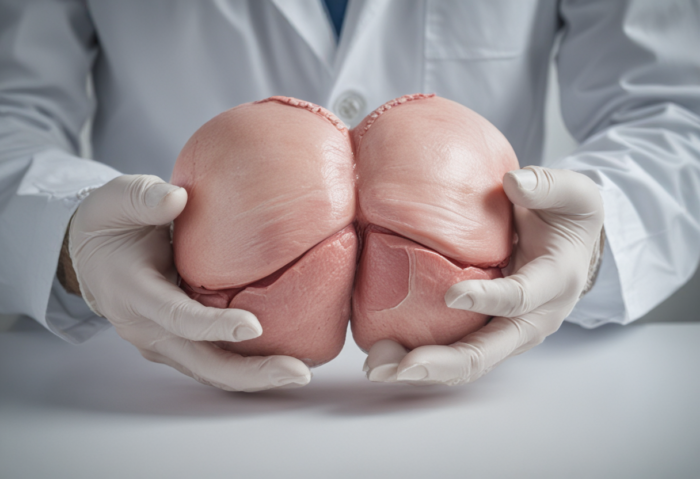
Breast implants: over or under the muscle?
Breast implants raise plenty of questions among fitness athletes — especially women who have drastically reduced their body fat percentage and lost breast volume in the process. The right choice can mean a natural-looking result and a continued career, while the wrong one can lead to lasting complications. Here is what you should know before meeting your surgeon.
Why do surgeons recommend placing breast implants under the muscle?
Christinas Clinic worked with the Estonian Bodybuilding and Fitness Federation, and their message is clear: placement under the muscle should always be preferred whenever possible. The reasons are both aesthetic and practical.
The thicker the layer of tissue surrounding an implant, the more natural it looks. Women who have trained in fitness for a long time and kept their body fat percentage low often have a very thin layer of glandular and fatty tissue. If a breast implant is placed over the muscle — essentially just beneath the skin — the skin cannot conceal it adequately. The implant’s shape and edges remain visible, with rippling in more severe cases.
The thinner the covering tissue, the more noticeable the rippling. There is also a risk that implants placed too close together will lift the skin between the breasts — a condition called symmastia. This is aesthetically troubling and difficult to correct.
Breast implants over the muscle: risks and compromises
So why are implants placed over the muscle at all? It usually comes down to three concerns.
The first is that the implant might slip out of its pocket. This can indeed happen — and is often the result of incorrect surgical techniques. Placing an implant under the muscle requires greater skill and a surgeon with specific experience operating on athletes.
The second is the risk of anatomical implants rotating inside the body. Christinas Clinic therefore recommends shape-adapting ergonomic implants instead, which are currently available in Estonia from Motiva (link). These are designed so that rotation does not distort the result.
The third concern is stabilization: the implant needs time to settle into place undisturbed. Returning to training too soon can prevent it from dropping into the correct position.
Preparation and healing, step by step
An implant can only be placed under the pectoral muscle if the muscle is flexible enough. An overly tight muscle pulls the implant upward after surgery and prevents it from settling into the correct position, leaving the nipples too low. You therefore need to reduce the training load on your pectoral muscles before surgery and stretch your joints regularly.
The healing timeline is as follows:
- 1 month — general healing. If the clinic confirms that everything is progressing as expected, you can cautiously resume training.
- 3 months — you must not put strain on your pectoral muscles. No press movements whatsoever, not even dumbbell presses.
- Half a year — the implant’s main stabilization takes place during this period.
- 1 year — the implant has fully settled into place by this point.
After surgery, you need to review your entire training program with your personal trainer. After 3 months, you can gradually start involving your pectoral muscles again, but heavy weights and intense presses are no longer an option. Frankly, every female fitness athlete faces a choice here: train to build a man’s chest or have surgery to create a woman’s breasts. You cannot have both.
One important detail: implants placed over the muscle generally cannot be repositioned without removing excess skin. It is therefore worth choosing placement under the muscle from the outset and finding a surgeon experienced in operating on fitness athletes. This is the only way to achieve natural-looking breasts and the feminine proportions that judges also look for.
FAQ — frequently asked questions
Can a breast implant placed under the muscle later be moved over the muscle?
Generally, no — at least not without surgery to remove excess skin. That is why the initial choice matters so much.
How long must you avoid training your pectoral muscles after surgery?
At least 3 months. The implant’s main stabilization takes half a year, and it takes up to 1 year to settle fully into place.
What should you look for in a surgeon as a fitness athlete?
You should definitely choose someone with specific experience operating on fitness athletes. The muscles, tissue structure and recovery needs of a trained body differ significantly from those of the average patient — your surgeon needs to understand this.
Author:Turg.Fitness.ee
Come work out! ArtGym