
Bodybuilding history: the world champion and the sport’s origins
The bodybuilding world champion was not originally just an athlete posing on a stage. Munich in 1955 showed well how lifting, strength figures and physique contests still went hand in hand.
This story looks at where athletic gymnastics, or bodybuilding, came from, why Eugen Sandow and Tommy Kono were so important, and how the sport eventually reached Estonia.
Bodybuilding world champion: it began in the weightlifting hall
In the autumn of 1955, Munich hosted another weightlifting world championship. The American Paul Anderson made his debut on the international lifting stage and, with his unprecedented strength, brought a clear breakthrough in the heavyweight class. Next to his 170 kg body weight, however, a very different sight drew attention.
At the event that followed the world championships, men took the stage with broad shoulders, narrow waists and strikingly proportioned muscles. The International Weightlifting and Bodybuilding Federation (FIHC) organized a contest to find the athlete with the most beautiful physique. By today’s standards it was a bodybuilding competition, but the world of the time still saw it as a sideline of weightlifting.
Posing was preceded by physical tests. The world’s leading lifters, M. Namdjou, T. Kono and others, were exempt from them and received the maximum score without competing. That proved decisive. The winner was declared to be Tommy Kono, a Hawaiian representing the United States and a fresh five-time weightlifting world champion. His 8 world championship gold medals and 26 world records in three body weight classes were joined by 4 trophies from physique contests organized by the FIHC.
So what actually happened? A bodybuilding world champion could also be a top lifter at the same time. The sport had not yet been pigeonholed. Strength, health, posture and stage presence formed a single whole.
How did the bodybuilding world champion come about?
Exercises with weights were already known in ancient times. In India, China, Egypt and ancient Greece and Rome, people understood that lifting weights develops strength and muscles. Weights were not lifted only as a one-off test of strength. They were also used for training.
Well known is the legend of the Greek Milo in the sixth century BC. He is said to have carried a calf on his back every day. The calf grew, and so did Milo’s strength. In the end the calf became a bull, and Milo became a famous strongman. At the Olympic Games in 510 BC he is said to have carried a full-grown bull twice around the stadium.
In the late nineteenth century, as the modern sports movement gathered momentum, exercises with weights became especially popular. In France, Germany, Austria-Hungary, the United States, Russia and elsewhere, weightlifting and strength-sport societies sprang up in the 80s and 90s. In Russia, the St. Petersburg doctor Vladislav Krajevski founded the first weightlifting club in 1885. The Estonian strongmen G. Lurich, G. Hackenschmidt and others also trained there for a time.
At first, circus athletes gave momentum to the interest in sport. Their powerful bodies were role models for young people. Training was done with dumbbells, kettlebells and barbells whose ends had spheres that could be filled with sand. At first, giants of enormous strength were admired, but at the beginning of the twentieth century people began to talk more and more about the harmonious development of the body. Physique contests were popular, and first places were also won by Georg Lurich and Georg Hackenschmidt.
Eugen Sandow and body-building
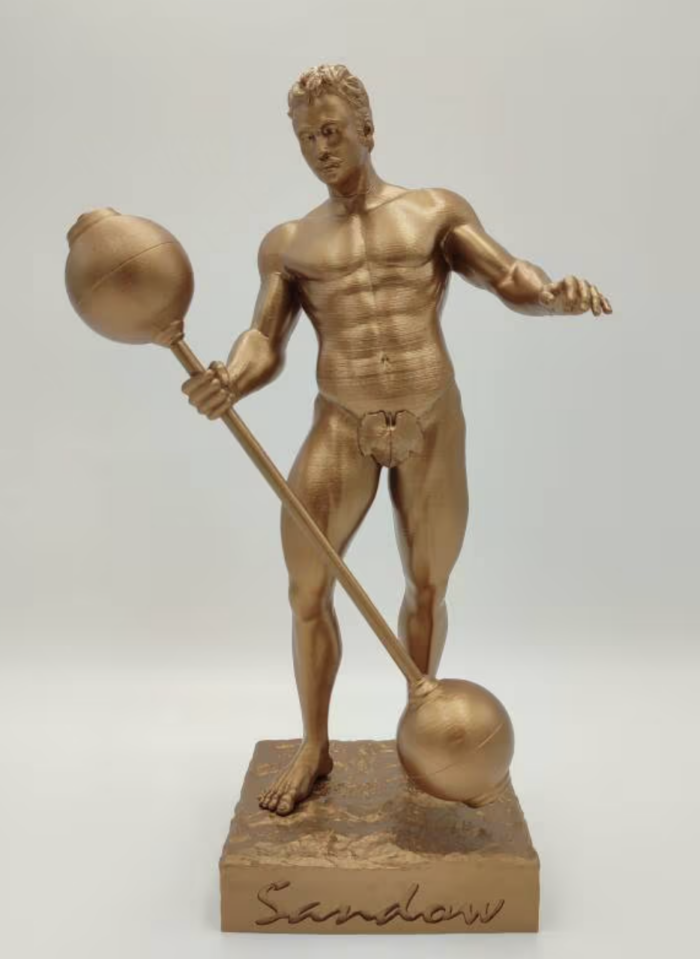
Eugen Sandow is considered the pioneer of bodybuilding. He was born on 2 April 1867 in Königsberg. As a boy, Eugen was skinny and sickly, but training with weights changed his life. He drew up a fixed exercise plan for himself and later went to the studio of strength-training professor Louis Attila in Brussels.
Systematic work gave Sandow great strength and a harmonious physique. At a height of 174 cm he weighed 90 kg. His measurements were impressive: neck 44, chest 122, waist 80, hips 107, thigh 60, calf 44 and upper arm 44 cm. These numbers explain why he became the symbol of the ideal physique of his time.
In 1893, E. Sandow went on tour to America. A year later his teacher Attila also left Europe and opened a studio in New York. The spread of bodybuilding is closely tied to these two names. Sandow knew anatomy, watched the weak and strong sides of his own body, and performed on stage in a way that turned a muscular body into a spectacle in its own right.
After his American performances, E. Sandow opened several athletic schools in England. This is how body-building became the third strength discipline alongside weightlifting and wrestling. At first, though, bodybuilding and weightlifting remained closely linked. Many athletes competed in both. Later, training methods, equipment and goals changed, and the bodybuilder began to differ more and more clearly from the weightlifter.
Bodybuilding organizations and major competitions
Bodybuilding soon became more than a stage display of the physique. It was also seen as a preventive measure against the ailments of the technological age. The FIHC began its bodybuilding activities in 1949. At the FIHC’s first physique contest, the “Mr. Universe” title was won by the American lifter Steave Stanko, who in 1947 had been the first to pass the 1,000 pounds (453.5 kg) mark in the three-lift total.
The winners of the official FIHC contests were: 1949 Steave Stanko, 1950 John Farbotnik (USA), 1954,1955,1958 and 1961 Tommy Kono (USA), 1959 Guy Mierczuk (France), 1963 and 1964 Abdel El Guindi (United Arab Republic), 1965 William March (USA) and 1966 Robert Gaida (USA).
At the same time, two more “Mr. Universe” titles were being contested around the world. Professional bodybuilders belonged to the International Federation of BodyBuilders (IFBB), led by Joseph Weider. It had a modest start in the early 50s, but J. Weider managed to bring a large share of the world’s best bodybuilders into his organization. Larry Scott, Harold Poole, Freddy Ortiz, Dave Draper and others were all IFBB members.
J. Weider’s work had two faces. On the one hand, he brought methodological innovations into training, involving scientists, laboratories and factories, and developing nutritional supplements and exercise equipment. On the other hand, the business side brought with it heavy advertising. Beginners were sometimes promised more than honest training could actually deliver.
In England, “Mr. England” contests began in the thirties. In 1948 the National Amateur Body-Builders’ Association (NABBA) was founded, and it also started to organize “Mr. Universe” contests. The first contest was held in London alongside the 1948 Olympic Games. The winner was the American John Grimek.
American amateur bodybuilders belonged to the Amateur Athletics Union (AAU), founded in 1880. The winner of this organization’s first contest in 1940 was also John Grimek. AAU competitions also required a demonstration of physical abilities. Each competitor could choose a sport; a place in the top six of their own state’s rankings earned the maximum score. In weightlifting, competitors could show their abilities on the spot.
Bob Hoffman and Peary Rader were closely tied to the AAU. Their magazines “Strength and Health”, “Muscular Development” and “Iron Man” promoted both weightlifting and bodybuilding for decades. In the fifties, several hundred thousand people were doing bodybuilding in America alone. From there the sport spread to Europe, the Arab countries, India, Japan and elsewhere.
The bodybuilding world champion and the Estonian story
In the late fifties, bodybuilding gained a foothold in the socialist countries too. The impetus came from an international competition held by the FIHC in Warsaw in 1959, after the weightlifting World Championships. In that same year, 1959, a bodybuilding competition was organized in Poland. At first only the physique was judged; later strength exercises, gymnastics and acrobatic exercises were added.
At the first Polish competitions, A. Jasinski, who weighed 82.5 kg, won several times. He squatted 195 kg and reached a total of 325 kg across the three lifts. By 1962, 250,000 people in Poland were doing bodybuilding. A special magazine, “Sport for All”, appeared. The sport reached the German Democratic Republic, Yugoslavia, Hungary and the other socialist countries. In the German Democratic Republic, it was concluded in 1964 that without competitions bodybuilding would not achieve wider popularity.
In the Soviet Union, the spread of bodybuilding was driven by Georg Tenno, an Estonian living in Moscow. His articles inspired many enthusiasts. The first competition was held in Sverdlovsk in December 1961. The head coach of the USSR weightlifting team, the multiple-time world champion Arkadi Vorobjov, took part in organizing it. The winner was Vladimir Sdobnov.
At the 1966 competition of the best from Moscow’s higher education institutions, the winner was Viktor Haritonov. The best results in the strength tests were: bench press 135 kg, two-arm biceps curl 65 kg, barbell squat 230 kg. In Moscow, Kaunas, Vilnius, Riga, Leningrad and many other cities, athletic gymnastics groups were active and paid courses were run.
In Estonia, too, postwar bodybuilding was born in the weightlifting gyms. As early as 1957, Einar Laigna spread bodybuilding exercises among his training partners at the Tallinn “Spartak” heavy athletics hall. His example was followed by A. Laev, P. Lillep, K. Savi and others.
Later, determined training brought good results for Arne Heinlaid and Andrei Pisk, known as weightlifters, and for the wrestlers Tiit Madalvee, Georg Vassiljev and others. At a competition held in Tartu in May 1966, Arne Heinlaid came out on top among the other enthusiasts from his city. He had bench-pressed 155 kg and squatted 210 kg. The measurements of the 25-year-old in May 1966 were: height 173 cm, weight 79 kg, chest 115 cm, abdomen 79 cm, biceps 43 cm.
In the autumn of that same year, Arne Heinlaid also won first place at a competition in Tallinn. After that, Indrek Otsus, Olev Annus and others began to make their mark in Estonian bodybuilding. The sport developed particularly rapidly in the 1980s. Ain Paavo, Pavel Kossenko and Jevgeni Selnihhin came to the fore, and among the women Merike Madar, Inna Uit and Kersti Põder. In the nineties, Marek Kalmus and Ott Kiivikas rose to prominence.
Estonia’s best bodybuilders and their titles
A simple truth: the history of bodybuilding doesn’t consist of organizations alone. It is brought to life by people and their results.
- OLEV ANNUS — 1973-1979 absolute champion of the Estonian SSR; 1976-1979 unofficial USSR champion; 1986 European champion in the IFBB amateur league; 1987 world champion in the NABBA amateur league; 1987 Mr. Universe in the NABBA professional league; 1991 world champion in the NABBA professional league; 1995 Mr Olympia veterans 5th place.
- AIN PAAVO — Three-time Estonian champion; 1991 European champion in the IFBB amateur league.
- INDREK OTSUS — 1980-1992 ten-time Estonian champion; 1980,1981,1991 absolute Estonian champion; 1991 ILBB European Championships 2nd place.
- INNA UIT — 1990-1991 two-time absolute Estonian champion; two-time USSR champion; 1990 IFBB European Championships 4th place; 1990 IFBB World Championships 10th place; 1991 IFBB European Championships 4th place; 1991 ILBB European Championships overall winner; 1995 IFBB European Championships 1st place; 1996 IFBB World Championships 1st place.
- MAREK KALMUS — 1995 absolute Estonian champion; 5 x absolute Estonian cup winner; 2001 WFF European champion in fitness; 2002 WFF World Championships 2nd place in fitness.
- OTT KIIVIKAS — 1999-2002 absolute Estonian champion; 2001 IFBB World Championships 14th place; 2002 IFBB European Championships 8th place; 2002-2003 absolute Estonian cup winner.
The Mr Olympia title has been won over the years by: 1965-1966 LARRY SCOTT, 1967-1969 SERGIO OLIVA, 1970-1975,1980 ARNOLD SCHWARZENEGGER, 1976,1981 FRANCO COLUMBU, 1977-1979 FRANK ZANE, 1982 CHRIS DICERSON, 1983 SAMIR BANNOUT, 1984-1991 LEE MARVIN HANEY, 1992-1997 DORIAN YATES and 1998-2002 RONNIE COLEMAN.
FAQ: the bodybuilding world champion
What is athletic gymnastics, or bodybuilding?
Bodybuilding is weight training aimed at developing muscles, posture, symmetry and stage form. In the beginning, it was closely tied to weightlifting and wrestling.
Who was an early bodybuilding world champion?
At FIHC contests, one of the most prominent names was Tommy Kono. He was both a top weightlifter and a winner of physique contests, which shows well what the sport looked like in its early days.
When did bodybuilding arrive in Estonia?
In Estonia, bodybuilding exercises began to spread in 1957 at the Tallinn “Spartak” heavy athletics hall. The first competitions in the Estonian SSR were held in Tartu in May 1966.
Author: sent by M.M. Literature used
Source: WHO – physical activity.
Come work out! ArtGym




