In brief:
- Regular neck exercises reduce chronic neck pain by up to 69% in clinical studies.
- Strengthening both the deep neck flexor muscles and the extensors protects the spine and prevents injuries.
- Do the exercises three times a week, starting with a low training load and increasing it gradually.
- If you have neurological symptoms — numbness, tingling in the arms — consult a doctor before exercising.
Neck exercises are an effective way to strengthen the muscles that support the cervical spine and to prevent periods of work disability caused by neck pain. A sedentary lifestyle and long hours of sitting overload the neck muscles and weaken the deep stabilizer muscles. In this guide you will learn which exercises science recommends, how to perform them safely and when to see a specialist.
Why are neck exercises essential for prevention?
Neck pain is one of the most common work-related health problems in the world. According to the WHO, musculoskeletal disorders affect more than a billion people and are one of the main causes of disability globally. By training the muscles of the neck area regularly, you can considerably reduce this risk.
Studies show that the deep neck flexor muscles — musculus longus colli and musculus longus capitis — weaken significantly in chronic neck pain (Falla et al., 2004). Weakness in these muscles disrupts the stability of the cervical spine and increases the load on the joint surfaces. Strong muscles surrounding the neck protect the vertebrae in everyday life as well as in sport — whether it is jump training for basketball players or other contact sports where the neck takes repeated impacts.
Which neck exercises are suitable for prevention?
Isometric exercises for beginners
Isometric exercises — where the muscle contracts without any visible movement — are safe for beginners and suit an office setting. How to do them:
- Press your palm against your forehead, holding your head still for 5–10 seconds (front resistance).
- Press your palm against the back of your head, holding your head still for 5–10 seconds (rear resistance).
- Press your palm against your temple on each side (lateral resistance).
- Repeat each direction 3–5 times, with a 30-second rest between exercises.
Measuring muscle activation with electromyography helps determine which movements train the target muscles most effectively — the article The best exercises based on EMG studies covers this in more detail.
Dynamic strengthening exercises
Ylinen et al. (2003) conducted a randomized controlled trial with 180 female patients with chronic neck pain, comparing three groups: stretching exercises, aerobic training and active muscle training. After 12 months, neck pain had decreased by 69% and disability by 58% in the group that did active strengthening, compared with baseline — a result that stretching alone could not achieve.
Basic dynamic exercises with a resistance band:
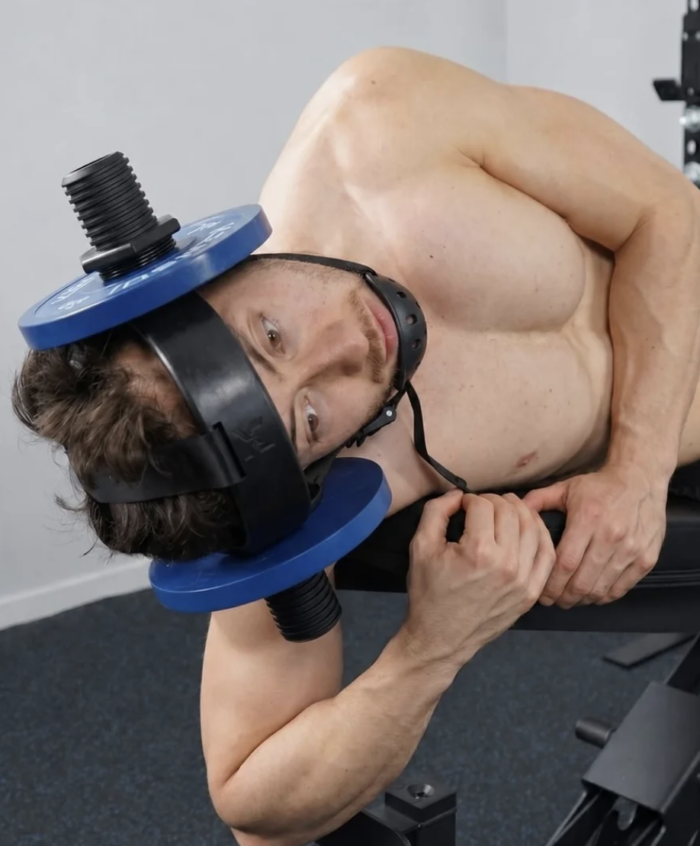
- Neck flexion — lie on your back with the band on your forehead, slowly lift your chin toward your chest and lower it back; 3 × 12–15 repetitions.
- Neck extension — lie face down on a bench with the band on the back of your head, lift your head using the back muscles; 3 × 12–15 repetitions.
- Lateral flexion — seated, with the band beside your head, slowly bend to the side and return; 3 × 10–12 repetitions on each side.
Pilates and deep stabilizer muscle work
Cagnie et al. (2008) showed with functional MRI that low-intensity, controlled neck flexion exercises activate the deep longus colli muscle more effectively than the superficial neck extensor muscles. This is one of the main advantages of the Pilates method — the emphasis is on precision and on the work of the deep stabilizers, not on superficial strength. Pilates exercises on the mat and machines are an excellent way to start structured strengthening of the neck area under an instructor’s guidance.
How can you do neck exercises safely?
Chiu et al. (2005) found that three training sessions a week is the optimal frequency for chronic neck pain, combined with regular mobility stretching. Safety principles:
- Start low — in the first week, use up to 50% of maximum effort.
- Pain means stop — an exercise should not cause pain, only mild muscle fatigue.
- Warm up first — 5 minutes of light neck mobility work before loading the neck.
- Breathe correctly — do not hold your breath during the effort; exhale during the exertion phase.
- Progression — increase the resistance every 1–2 weeks once an exercise has become too easy.
Warnings:
- Do not do strengthening exercises during the acute inflammatory phase or immediately after an injury.
- If you have neurological symptoms — numbness, tingling or weakness in the arms — consult a doctor before exercising.
- People with osteoporosis should avoid high-load neck flexion exercises.
- After neck surgery, supervision by a physiotherapist is mandatory.
When should you see a doctor or physiotherapist?
A medical assessment is necessary if neck pain is accompanied by numbness or tingling in the arms, headaches at the back of the head or balance problems, or if the pain started with an injury. According to the Estonian Health Board, regular physical activity, including muscle-strengthening exercises, should be done for at least 150 minutes a week at moderate intensity.
Supervision by a physiotherapist is especially important for people with chronic neck pain, since an individual approach is more effective than a generic exercise plan. Dedicated, professional-level physical training pays off years later — as Janar Rückenberg’s story illustrates well, who finally had the long-awaited 2011 MMI bronze medal placed around their neck — behind the success of top athletes lie years of systematic physical preparation.
References
- Ylinen J, Takala EP, Nykänen M, et al. (2003). Active neck muscle training in the treatment of chronic neck pain among women. JAMA. PMID: 12672734
- Falla D, Jull G, Hodges P. (2004). Patients with neck pain demonstrate reduced electromyographic activity of the deep cervical flexor muscles during performance of the craniocervical flexion test. Spine. PMID: 15284514
- Chiu TT, Lam TH, Hedley AJ. (2005). A randomized controlled trial on the efficacy of exercise for patients with chronic neck pain. Spine. PMID: 15838480
- Cagnie B, Dickx N, Sieben J, et al. (2008). The use of functional MRI to evaluate cervical flexor activity during different cervical flexion exercises. J Appl Physiol. PMID: 18703757
Frequently asked questions
How often should you do neck exercises?
According to research, the optimal frequency is three times a week, leaving recovery days for the muscles in between. Beginners can start with two sessions a week and increase the frequency gradually.
Do neck exercises help with neck pain?
Yes — Ylinen et al. (2003) found that 12 months of active neck muscle training reduced chronic neck pain by 69% and disability by 58%. That is markedly better than stretching alone.
Which neck exercises are suitable for the office?
Isometric resistance exercises are the most practical — press your palm against your forehead, the back of your head and the side of your head above the ear, holding your head still for 5–10 seconds at a time. You can do them sitting on a chair, with no extra equipment.
Is it okay to do neck exercises when your neck hurts?
In the acute pain phase, you should avoid exercises that load the neck. Mild chronic discomfort is not a contraindication to exercising, but if the pain gets worse during an exercise, stop. If you have neurological symptoms — numbness, tingling — see a doctor before you start exercising.
How does neck strengthening differ from stretching?
Stretching increases range of motion and eases muscle tension, but it does not strengthen the muscles. Strengthening exercises — isometric and dynamic resistance exercises — increase muscle strength and endurance, which matters more for injury prevention.
Let’s get training! ArtGym