
Don’t make the mistake of neglecting these four often-overlooked muscles. Here’s a quick guide to training them to help you stand out from the crowd.
Almost life-size diagrams of a train’s chassis adorned the walls above the mirrors at Gold Gym. The connections between the mechanical components clearly illustrated the complexity of large structures. The beauty was in the details.
The same goes for your physique. It’s often the little things that separate the best from the rest, and if you’re an undersized hardgainer, you can’t afford to cut corners. This article looks at four muscles you’ve probably never trained directly and explains why you should give them a squeeze.
Brachialis (upper arm muscle). This muscle lies beneath the biceps and is visible on the outside of your upper arm. It works with the biceps to flex the elbow, but unlike the biceps, it plays no part in rotating the forearm, as you would during a curl with a twist.
Why bother? The brachialis adds width to your arm. When you flex your biceps, a well-developed brachialis forms an impressive knot on the outside, between the biceps and triceps, adding both density and definition. Since the brachialis already receives a training load during biceps training, does it really need direct work? Yes, because the biceps do most of the work during palms-up curls or curls with a twist. To give your brachialis a chance to develop properly too, add an exercise to your biceps training that specifically targets it.
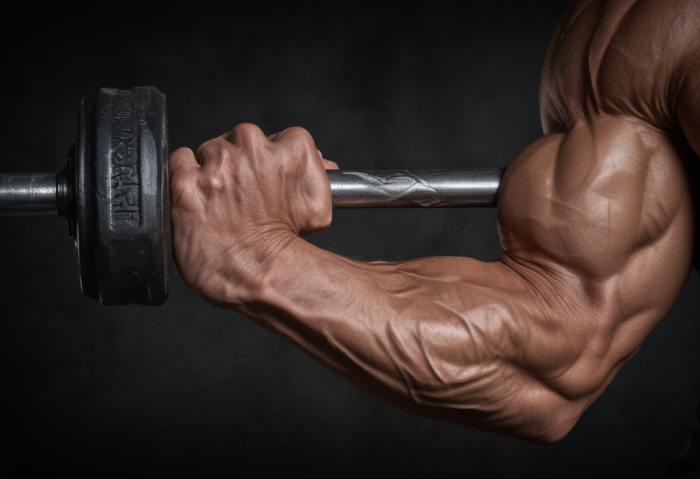
Training. To work the brachialis, use either a palms-down or a thumbs-up grip. For the first option, perform reverse arm curls with a medium-width overhand grip, either standing or on a preacher bench. For the second, use hammer curls, lifting both arms together or alternating them. 3–4 sets of 10–12 reps should thoroughly work the brachialis. Since both exercises also engage the forearm muscles more effectively than underhand curls, they fit well at the end of your biceps training, before your wrist work.
Serratus anterior (anterior serratus muscle). This muscle lies along the side of your rib cage. It consists of muscle bundles that originate on the first nine to ten ribs and extend to the inner border of the shoulder blade, forming a boundary along the side of the chest cavity. When it contracts, it moves the inner border of the shoulder blade forward, raising the shoulder.
Why bother? Visually, the serratus separates your chest muscles from your abs and connects the front and back of your physique. At a low body fat percentage, a well-developed serratus gives you a “finished” look. As with the brachialis, you might assume you’re already training it, in this case through pullovers and straight-arm pulldowns. In fact, these exercises do little for the serratus beyond giving it a good stretch. Contrary to popular belief, bringing your arms forward from an overhead position is not a direct function of this muscle.
Training. Hold your arms straight out in front of you. Now reach farther forward, feeling your shoulder blades move around your rib cage. That’s the serratus’s main function. To reproduce it, perform bench presses with this exaggerated reach. Don’t use it on your maximum-effort sets, but incorporate it into your warm-up sets. As you get stronger, you can also use it on the first sets of a pyramid. You can apply the same approach to push-ups and dumbbell front raises, reaching well forward with your arms.
Sternocleidomastoideus (sternocleidomastoid muscle). This muscle originates at the mastoid process of the temporal and occipital muscles. It runs downward in two bundles: one attaches to the manubrium of the sternum and the other to the sternal end of the clavicle. Its function is to flex, tilt and rotate the head.
Why bother? Unless you need a strong neck for wrestling or American football, you may not train these muscles directly. Some bodybuilders feel their necks already receive enough training load during exercises such as deadlifts and shrugs, quite apart from the growth in their traps. Others, led by Chris Cormier, train their necks hard to build muscle there too. How thick you want your neck to be is your choice, but remember that your neck is the most visible indicator of strength: it shows even when you’re wearing thick clothing.
Training. Some well-equipped gyms have dedicated machines, but if you don’t have access to one, you’ll need to improvise a little. Lie on your back on a bench with your head extending beyond the edge. Secure a weight to your head, using a towel, for example, then lower your head well back before raising it to bring your chin right down to your chest. Repeat the same process lying on each side and on your stomach. Perform 2 or 3 of these giant sets of 4-direction neck movements, doing 12–20 reps in each direction.
Tibialis anterior (anterior tibial muscle). This bulky muscle runs down the front of your lower leg to the inner edge of your foot. It originates on the lateral surface of the upper tibia, runs downward and becomes a strong tendon. When it contracts, it flexes the foot toward the shin, draws the foot toward the midline and turns it inward.
Why bother? There are two reasons to train the tibialis anterior. The first is injury prevention. If you take part in a sport that involves running, you’re probably familiar with shin splints, a common problem caused by a strength imbalance between the tibialis anterior and the calf muscles. This can be a particular problem if you train your calves hard while paying no attention to the front of your lower legs. The second reason is appearance: although it’s a small muscle, it adds depth to your lower leg when viewed from the front, especially if you’re a competitive bodybuilder.
Training. Most gyms don’t have a dedicated tibialis machine, but you can also perform the movement by positioning yourself backward on a leg curl machine. Place your feet beneath the pads and lift your toes toward your shins. You need very little added weight. Do 3–4 sets of 10–15 reps during every calf workout.
Small muscles, big impact. Like the components of a train’s undercarriage, the muscles described above have important roles to play in your physique. Spanning your body from head to toe, all these muscles are also highly visible and could be the key to making your physique stand out from the crowd.
Author: (Gregg Merritt / FLEX)
Come and work out! ArtGym




