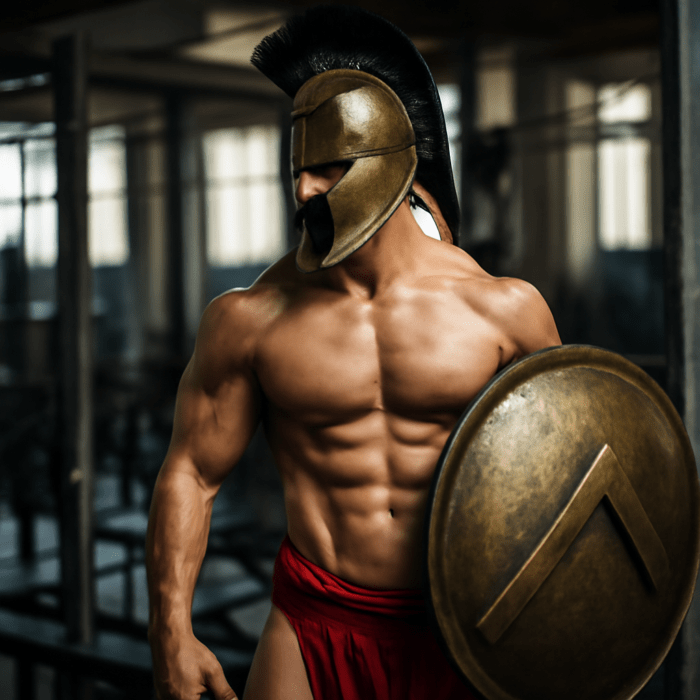
Spartan warriors: strong body and mind
Spartan warriors are not merely a Hollywood myth. This ancient society built a system in which every free man had to be a soldier, and not only with a sword, but in his head and his stomach too. Let’s look at what their everyday life actually involved and what we can learn from it for today’s training logic.
Who were the Spartan warriors
In ancient Greece, Sparta emerged as a city-state in which the entire male citizenry was also the army. While Athens listened to philosophers in the forum, in Sparta real education came through military training. But the myth of the bloodthirsty barbarian is an exaggeration: the records point rather to a society that valued independence, justice and literacy.
Socrates is said to have claimed that, besides Athens, Crete and Sparta are also cradles of philosophy. The level of literacy there was higher than in any other Greek city-state. On campaigns, the men were accompanied by poetry and song, not for fun, but to calm the nerves before battle.
How Spartan warriors trained
The training was called the Agoge and began at the age of seven. A boy left home, entered communal training and stayed there until adulthood. Active service never truly ended, though: a man remained a soldier until the age of sixty.
What was demanded? First, physical fitness. Being overweight was publicly frowned upon, among women as well. Second, endurance: the young often wore a cloak as their only item of clothing, slept outdoors, and their rations were deliberately meager. A man had to endure cold, hunger and pain without complaint.
The third requirement was character. Spartan warriors had to be fearless, but not blinded by anger. Rage was punishable; they fought coldly and with calculation. The mothers’ famous parting words, “come back either with your shield or on it”, underlined that surrender was more shameful than death.
What Spartan warriors ate
Seen through today’s eyes, the Spartan menu was surprisingly sensible. There was plenty of protein and fat, while carbohydrates were kept modest. The bulk of the diet came from meat, dairy products and olives, the same pattern that any rational modern training diet highlights.
- Meat and fish. They ate pork, goat and lamb, as well as wild boar and hare. Variety was important.
- Dairy products. Sheep’s and goat’s milk and the cheeses made from them.
- Carbohydrates. Mainly fruit and barley. Little bread was eaten.
- Fat. Besides meat and cheese, also olives, especially olive oil.
- Wine. It was drunk often, but diluted with water, because getting drunk was improper.
The Spartans also paid attention to medicinal plants. Constant warfare meant that keeping the men healthy was in the state’s interest: fertility and recovery were just as important as skill with the sword. They used, for example, fenugreek, whose Latin name faenum graecum literally translates as Greek hay, and ginger root to maintain general tone.
Moderation was a common thread. Spartan warriors did not eat until they were stuffed or drink until they were drunk. The purpose of eating was to be in shape for the next day, not to fill one’s belly for the sake of pleasure.
Frequently asked questions
Did Spartan warriors train with weights?
Not in the modern sense: there were no barbells or plates. The training was functional: running, wrestling, handling the spear and shield, carrying heavy objects. Strength came from long days outdoors, not from standardized sets.
Would their diet suit people today too?
In principle, yes. Plenty of protein, quality fat, moderate carbohydrates, little processed food. The difference is that our calorie needs today are considerably lower: a Spartan soldier walked and ran tens of kilometers a day.
Why did Sparta’s military supremacy end?
There were several reasons: the number of men declined, the social system did not scale, and the rise of Macedon changed the technology of warfare. But the logic of their way of life, with body, mind and discipline together, has lived on much longer than the city-state itself.
Author: Mikk-Alvar Olle
You’ll find the champions’ meal at ARMUDUST
Come and train! ArtGym