
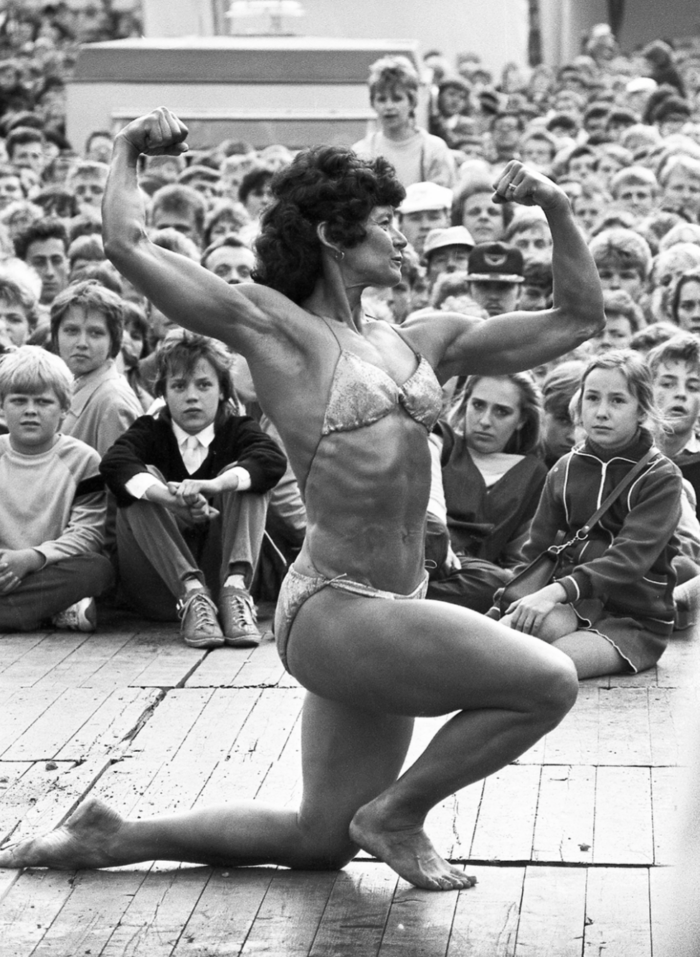
Merike Madar was the undisputed leader in women’s bodybuilding across the Soviet Union from 1987–1990. Her story began at a gym on Tartu maantee in 1984 and took her to the European Championships in Oslo and Leningrad. This is a look back at her journey, at a time when women’s bodybuilding was just taking root in Estonia.
Merike Madar’s journey from gymnastics to bodybuilding
Merike was a member of Estonia’s artistic gymnastics team from 1966–1972. Six years of gymnastics at the highest level gave her a solid foundation: technical skill and a naturally muscular physique, which she says she was born with.
Her move into bodybuilding took time, though. A full 12 years passed before Merike walked through the doors of the Tartu maantee club in 1984. Later known as Flexer, the club was a training ground for Estonian bodybuilding pioneers such as Olev Annus, as well as people working in the arts.
The club’s annual parties were legendary. Well-known actors and singers performed there, and it was on that stage that Merike made her debut, too. Her performance was warmly received. That was how it all began.
A winning streak across the Soviet Union, 1987–1990
Invitations to perform came one after another. She toured Estonia’s “village shindigs,” as Merike herself calls them, as well as the vast expanses of the Soviet Union. Unfortunately, no competitions for women were held in Estonia at the time, so Merike Madar’s competitive career began in Lithuania, a country that has always been a little ahead of Estonia in bodybuilding. Her first supporters came from there, too.
In the spring of 1987, Kaunas hosted its first bodybuilding competition for women, reportedly the first in the entire “great motherland.” Merike Madar won the body weight category up to 57 kg. She still has the certificate to prove it.
The next four years were essentially an unbroken winning streak. Merike won almost every competition she entered, both in her body weight category and overall. Her achievements include overall titles at the USSR Championships and Cup competitions in 1988–1990.
At the time, national team selection was often a political game that hit Lithuanian and Estonian athletes hard. That makes Merike’s results all the more impressive: when someone is head and shoulders above the rest, even politics cannot stand in their way.
Merike Madar in international competition
In June 1988, IFBB president Ben Weider visited the Soviet Union to discuss its membership in the international federation. During his visit, he was treated to a grand competition in Leningrad, to which the top bodybuilders from across the Soviet Union had been invited, including female competitors.
“Mr. Weider liked what he saw so much that he gave me a VCR for my overall victory, which was a big deal at the time,” Merike recalls with a wry smile.
In the autumn of 1988, the Soviet Union became an IFBB member, opening the door, in principle, to the European and World Championships. At the 1989 European Championships in Oslo, Merike competed in the category up to 57 kg and finished 12th. At the same competition, fellow Estonian Kersti Põder placed 14th in the category up to 52 kg, a fact that the history books have so far overlooked.
By the 1990 European Championships in Leningrad, the Soviet team included three Estonian women: Inna Uit (4th place), Kersti Põder (9th) and Merike Madar (10th), all in the category up to 52 kg. Merike did come away with European gold, however, in the team free posing event, where the entire group performed a coordinated routine.
This period also brought victories in Poland, Czechoslovakia, Yugoslavia, East Germany and Finland.
Merike Madar’s comebacks and legacy
1990 was her final year in elite sport. A knee injury sustained during an exhibition performance prevented her from training properly, cutting short her preparations for the next European Championships. The direction women’s bodybuilding was taking also influenced her decision.
“I always wanted to remain a woman and not have to start shaving my beard,” she said in a later interview.
Nevertheless, Merike attracted media attention with unexpected returns to competition in 1992, 2000, 2005 and 2006. Her last appearance, at the Estonian Cup in 2006, ended in victory.
The book “50 Years of Competitive Bodybuilding in Estonia” gives the impression that women’s bodybuilding in Estonia began “from scratch” with the 1990 Cup competition. In reality, the story began earlier, and Merike Madar deserves a leading place in it.
Frequently asked questions about Merike Madar
When was Merike Madar at the peak of her career?
From 1987–1990, she was the undisputed leader in women’s bodybuilding across the Soviet Union, winning almost every competition she entered.
What sport did she take part in before bodybuilding?
Merike was a member of Estonia’s artistic gymnastics team from 1966–1972. This gave her a strong physical foundation for bodybuilding later on.
Does she still compete today?
Not at the highest level, but she has made several unexpected comebacks. The last was a winning appearance at the Estonian Cup in 2006.
Author: Indrek Otsus
Come work out! ArtGym




