
Childbirth and training: a gentle start
Childbirth puts your abdomen, pelvic floor and entire body through a major effort all at once. Training can help afterwards, but only if you start gently and pay attention to how you feel. Your first goal is to help your body feel stable again, rather than chase your previous fitness.
Why does childbirth change how you train?
Right after giving birth, the idea of running may feel strange. Your belly may be smaller, but your abdominal and pelvic floor muscles may not yet work as they did before. This is normal, not a failure.
Päivi Korhonen (26), mother of eight-month-old Verna, gave a frank account of her first run: she only made it as far as the nearby shop. Instead of her usual hour, she managed just 10 minutes. For women who were particularly fit, that first workout can come as a shock because their bodies no longer respond the way they used to.
You also need to account for life with a baby. Night wakings, sleepless nights and breastfeeding drain your strength. Some days, even a short walk is a real achievement. In fact, being kind to yourself is one of the most important training skills you can have at this stage.
How can you stay active while recovering from childbirth?
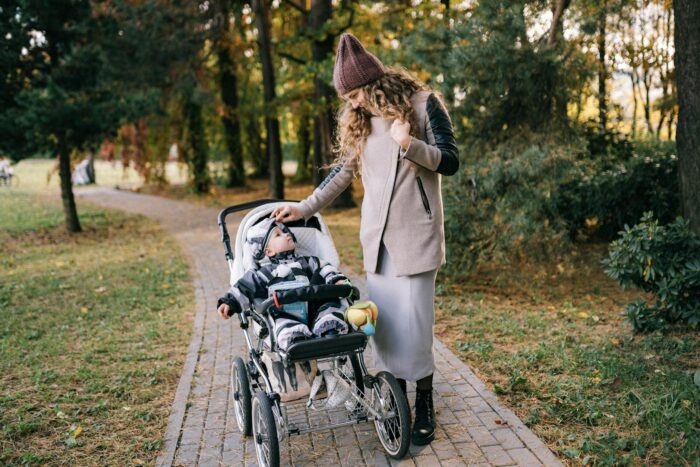
The simple truth is that a little at a time is better than nothing. You can start with short walks with the stroller, gentle cycling and muscle-strengthening exercises at home. Increase your training load and duration according to how you feel, rather than following a calendar or someone else’s pace.
Jaana Vesalainen (30), mother of four-month-old Veera, recalled her first workout after giving birth with a smile. She walked up and down five flights of stairs. She trained her pelvic floor muscles while breastfeeding, as she would otherwise have easily forgotten amid everyday tasks.
That example says a lot. Training does not always have to mean going all out, following a lengthy program or sweating in the gym. Sometimes the best place to start after childbirth is a staircase, a short walk outside or a few deliberate pelvic floor contractions.
Nordic walking and gentle aerobic activity
Before her baby was born, Salla Oksanen (32), mother of five-month-old Lukas, had never pictured herself Nordic walking. Now, a half-hour evening walk became her time for fresh air and a little solitude. For a new mother, it is a gentle way to get used to being active again.
Nordic walking may also help your shoulders and back, which come under considerable strain from carrying your baby and holding feeding positions. The same principle applies to gentle walks: you do not need to move fast, but movement signals to your body that recovery is underway.
Warning signs during training after childbirth
So what is actually too much too soon? If you have recently given birth, you should initially avoid strenuous exertion and high-impact activities such as running and aerobics. If your pelvic floor muscles are not ready, pressure may cause discomfort or leakage.
- Start with short distances and gentle exercises at home.
- Strengthen your core, shoulders, chest and back muscles, as these help you lift and carry your baby.
- Stretch your neck and shoulder muscles, especially if you spend a lot of time feeding or holding your baby.
- Wait to go swimming until your pelvic floor membranes have healed and postpartum discharge has stopped.
- Avoid activities where you could get chilled; the risk is greatest during the month after giving birth.
- After a cesarean section, avoid strenuous abdominal exercises for at least two months.
Caution is especially important after a cesarean section. Your abdominal muscles and tissues have not yet healed from surgery, and intense abdominal training too soon may irritate the incision or even tear it open. If you are unsure, ask at your postnatal checkup before proceeding.
Practical advice for new mothers
Recovery from childbirth varies considerably from person to person. After a normal birth, you can start physical activity when it feels comfortable. After a cesarean section, it is sensible to wait for your postnatal checkup and your doctor’s advice.
Obstetrician and gynecologist Marija-Liisa Rantala emphasizes the importance of starting pelvic floor muscle training early. Strengthening these muscles may help prevent urinary incontinence. Physical activity also stimulates circulation and digestion and helps reduce constipation.
Training has a mental side, too. When home is your workplace, your place to rest and your baby’s entire world all at once, a walk may be your only real breather of the day. Daily physical activity helps you maintain your weight, improve your sleep and build up strength for both your baby and your relationship.
Childbirth and training: FAQ
When can you work out after giving birth?
If your birth was straightforward, you can start gentle physical activity when you feel up to it. After a cesarean section, attend your postnatal checkup and consult your doctor before starting more strenuous training.
Is running suitable right from the start?
Usually not. Running is a high-impact activity and increases the training load on your pelvic floor. At first, walking, cycling or gentle muscle-strengthening exercises are better choices.
What if you have no motivation?
Start very small. One short walk with the stroller, a walk up the stairs or a couple of pelvic floor exercises counts, too. When you are tired, training should support your life rather than become another obligation.
Author: Rosin
Come and train! ArtGym




