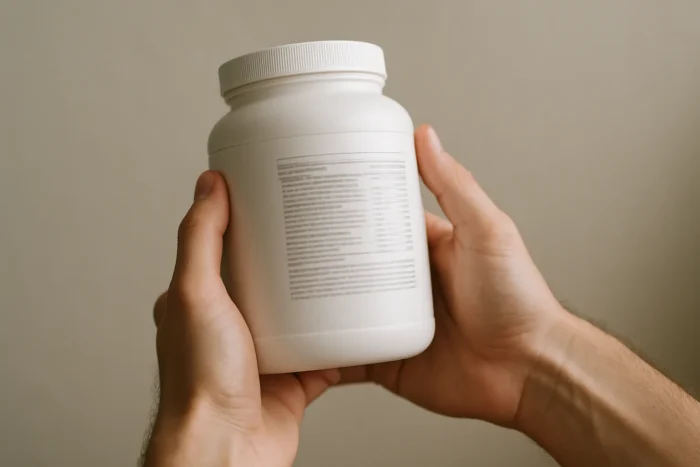
In short:
- A good supplement label shows the exact form of the active ingredient, not just its name — for example “magnesium glycinate”, not just “magnesium”.
- Check the elemental amount and compare the dose with the recommended daily dose.
- Avoid “proprietary blends” and unrealistic claims — these are classic red flags.
- Certifications (GMP, NSF, Informed Sport) and claims worded in line with EFSA are signals of trustworthiness.
The supplement industry is a huge market, and much of it is marketing. The cheapest way to protect yourself is to learn to read what is actually written on the jar. A well-read supplement label filters out a large share of poor-quality products before you even buy. Below are ten practical quality signs to guide you.
What must a supplement label show?
The most important signal is the form of the active ingredient, not just its name. “Magnesium” tells you nothing — “magnesium glycinate” or “magnesium citrate” tells you a lot. The same goes for iron (“iron bisglycinate”) and other minerals. If the form isn’t stated, the manufacturer usually has something to hide, because the form is what determines absorption. For example, magnesium oxide is absorbed at about 4%, while organic forms are absorbed significantly better.
The second important number is the amount of the elemental ingredient. “500 mg of magnesium citrate” is not 500 mg of magnesium — elemental magnesium makes up about 16% of citrate, or ~80 mg. A good manufacturer spells out both numbers. This logic is worth applying to every purchase, and it is explained in more depth in Supplements for athletes.
What are the 10 quality signs on a label?
Use this list every time you buy — online or in a store:
- The form of the active ingredient is stated — not “magnesium”, but “magnesium glycinate”.
- The dose is adequate — compare it with the recommended daily dose; 50 mg of magnesium against a requirement of 300+ mg is marketing fluff.
- The elemental amount is shown — not just the total weight of the compound.
- No “proprietary blend” — where the doses of the individual ingredients are hidden.
- Unnecessary additives are kept to a minimum — colorings and titanium dioxide are not needed; cellulose, magnesium stearate and rice flour are acceptable.
- Certifications are present — GMP is the minimum; ISO 22000, HACCP and third-party marks (NSF, Informed Sport, USP) are pluses.
- The country of manufacture is stated — “made in Germany” is not the same as “developed in Germany”.
- The shelf life is adequate — at least 6 months; with probiotics, check that the CFU count is guaranteed at the time of expiry.
- The claims are realistic — “supports bone health” is normal, “cures osteoporosis in 2 weeks” is a red flag.
- The price per serving is reasonable — divide the jar price by the number of servings rather than looking at the jar price alone.
What are the red flags on a label?
Be cautious if you see a “proprietary blend” with no doses, the words “detox”, “cleanse” or “reset”, claims like “−10 kg in 2 weeks” or “replaces medication”, and a long list of 30+ ingredients in microdoses. “Clinically proven” without a reference to a specific study is also a warning sign. A reliable guide is wording approved by EFSA — it is modest and verifiable.
These principles help you direct your money wisely in the same way a well-built plan helps in training — the latter is covered in the guide Building a training program: the complete guide. Before starting a new supplement, consult a doctor, especially if you take medication, are pregnant or are breastfeeding.
How do you calculate the amount of the elemental ingredient?
Let’s take magnesium as an example. If the jar says “Magnesium 500 mg (as Magnesium Oxide)”, 500 mg is the weight of the whole compound. Elemental magnesium makes up about 60% of the oxide, or ~300 mg, but only about 4% of that is absorbed, or ~12 mg. The same product as glycinate may show a smaller number on the label, but because absorption is many times better, more active ingredient actually reaches your body. The takeaway: always look at the elemental amount AND the form together — a number without the context of the form is meaningless. This one skill sets a quality supplement apart from most of the products on the shelf and helps you avoid paying for fancy packaging instead of the actual active ingredient.
How can a supplement label help you save money?
A well-read supplement label protects you not only against poor quality but also against overspending. When you compare the form, the elemental amount and the price per serving, you quickly see that a more expensive jar can actually be cheaper per day — and vice versa. That makes every purchase an informed choice rather than an impulse driven by packaging design or promises. The very label that many people never read is actually the cheapest tool for making a smart purchase.
References
- EFSA — nutrition and health claims register (approved wordings).
- NSF International / Informed Sport — third-party supplement certification standards.
- NIH Office of Dietary Supplements (2023). Dietary Supplement Label Database. https://ods.od.nih.gov/Research/Dietary_Supplement_Label_Database.aspx
- Fitness.ee science-based supplement guide (ebook “Vitamins and supplements: what actually works”).
Frequently asked questions
Why does the form matter more than the name on a supplement label?
The form determines absorption. For example, magnesium oxide is absorbed at only about 4%, while organic forms such as glycinate and citrate are absorbed significantly better. “Magnesium” with no form listed says nothing about absorption.
What is a “proprietary blend” and why avoid it?
A proprietary blend shows the total weight of the mixture but not the doses of the individual ingredients. It is a common way to hide microdoses of expensive ingredients, so you don’t know how much of each ingredient you are actually getting.
How do you calculate the real price of a supplement?
Divide the price of the jar by the number of servings; don’t just look at the jar price. A cheap jar with few servings can cost more per day than a larger package.
Which claims on a label are red flags?
It’s best to avoid the words “detox” and “reset”, claims like “−10 kg in 2 weeks” or “replaces medication”, and “clinically proven” with no reference to a study. Modest wordings approved by EFSA are the trustworthy ones.
Come work out! ArtGym