
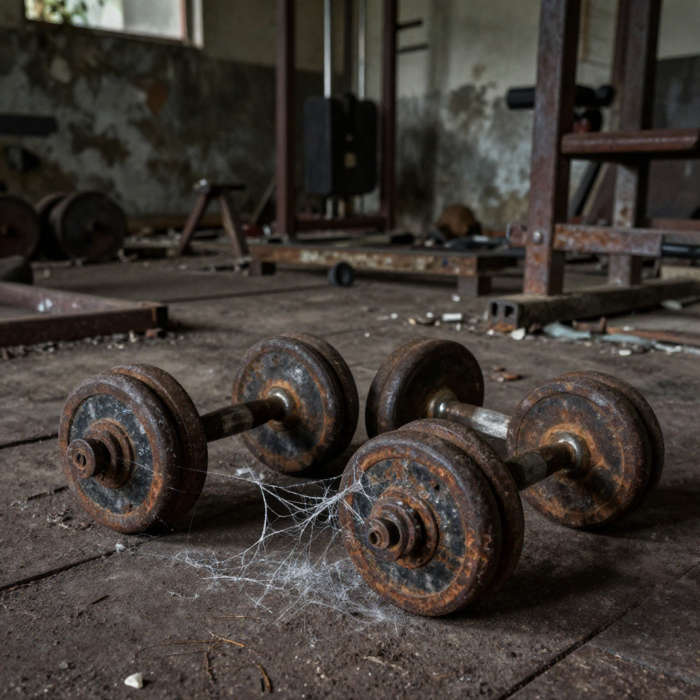
Bodybuilding is dead
“Sometimes a journalist or writer is a messenger for the devil himself.” So said the publisher of a men’s magazine once. And he was right. Some things simply have to be said. Admittedly, speaking so bluntly often hurts people and causes offense. Yet despite their outward indignation, people often recognize that things really are exactly as described.
Take competitive bodybuilding, or rather, what is left of it. There is a lot that goes unsaid when people talk about bodybuilding, but I am going to say it anyway. Why? Because it is the truth, and denying the truth or keeping quiet about it is as good as lying.
The truth is that bodybuilding as a competitive sport is dead. By now, it is hardly a great secret that top professional bodybuilders use utterly abnormal quantities of steroids and growth hormone to look the way they do. Steroids have been part of bodybuilding since the 1950s or the early sixties. I cannot give you an exact date, but more specifically, it dates back to when John Ziegler, the doctor for the US weightlifting team, invented synthetic testosterone (methandrostenolone). I think that was in 1956, and today we call the substance Dianabol. It did not take bodybuilders long to discover it.
Arnold used steroids. Zane used steroids. Lou used steroids. All the famous old-school heroes used steroids. Back then, though, things were still under control, and the whole scene was worth admiring and following. When the pros spoke, amateurs listened: they had something worth hearing. Today, things are very different. Drug use no longer has any limits. The pros hardly ever come off their cycles anymore. The drug combinations, cycles and doses have reached a point where, frankly, today’s top bodybuilders no longer look human. Then there is Synthol, an oil-like substance injected into lagging body parts. Milos Sarcev, widely regarded as one of the smartest professional bodybuilders, nearly died as a result of using Synthol.
Some get calf and pectoral implants. Gluteal implants are no strangers to the scene, either. Hell, at least the old-school guys stuck to steroids and built real muscle, but saline solutions, Synthol and implants?
Of course, we must not forget the excessive liposuction procedures and gynecomastia surgeries. I have nothing against these things in themselves, but having them done for a bodybuilding competition crosses every line and defies reason. Those lines were crossed long ago.
These people, pumped full of drugs, cut up by surgeons and bloated with the breakdown products of toxic substances, serve as the standard, as role models and even as symbols of healthy living for hundreds of thousands of teenagers. Ads for supplements in bodybuilding magazines try to make us believe that all of this is possible by taking these products. Shameful!
A couple of years ago, I was walking through an airport terminal with a well-known professional bodybuilder. He was panting and gasping so badly that I had to ask whether I could help by carrying his luggage. He looked as though he might collapse at any moment and lie writhing on the floor, gasping like a fish out of water. Is this the “picture of health”? Here was a man who had graced the cover of every major bodybuilding magazine. A man whose photos we had seen captioned “Health and vitality” could barely walk under ordinary circumstances without gasping for breath. This same professional bodybuilder, who had posed at numerous GNC-sponsored events emblazoned with the slogan “Live well,” could barely hold his head up, and simply carrying his travel bag raised his blood pressure so much that his face was bright red.
Is this an athlete? Is this the “star,” the “elite,” the “dream” or the “idol” of our sport (bodybuilding)? No, this is a dead man walking, a side effect (of steroids). I was embarrassed. I am embarrassed because I train at the gym myself, eat more protein than usual and write for a training website. As a result, the average person would almost certainly put me in the same category as this balding “athlete” who can barely stand and is gasping for air.
Bodybuilding as a source of motivation or inspiration is dead, too. For a start, more and more people no longer want to look like the pros. Most people look at today’s professional bodybuilders with disgust; they feel no desire to take up the sport, no inspiration or motivation to look like them. In his day, Arnold’s physique inspired generations of men, millions of them, to lift weights. The inhuman creatures we now see onstage at the elite level, however, send people running away from gyms. We all wanted to look like Arnold did in the seventies, and we still do. But does anyone want to look like today’s Mr. Olympia winners, with bellies distended by growth hormone and thighs so abnormally thick that they chafe until they bleed when they walk? There are probably people who do, but do they have any idea what achieving that look would demand of them?
Every day, our editorial office receives piles of letters from 17-year-old boys who want to know just one thing: how can they look like that, or what must they do to get as big as their favorite professional bodybuilder? What do we tell them? We are walking on thin ice. Do we tell them the full, harsh truth about life among the world’s bodybuilding elite? The abnormally high drug doses and cycles that demand staggering sums of money, the numerous health problems, the role of genetics and, surprise, surprise, even prostitution? If we do, we risk these young men never picking up a weight at all. That is the last thing we want.
But if we sell them the fantasy of the Weider dream and tell them that anyone can become Mr. Olympia through hard work and unwavering discipline, we risk leaving these young people bitterly disappointed after a few years of struggling. Those who have the work ethic and discipline will soon discover that not everyone can become Mr. Olympia, certainly not naturally. Genetics matter, and even taking all manner of substances in large quantities may not get you to the level you aspire to.
Should we tell an eager 17-year-old that it is definitely worth spending thousands of dollars a week on steroids, breaking the law every day in the process, giving up virtually everything else in life and selling your life to this “sport”, all so that one day you might, for example, take third place at Mr. Salt Lake City?
I do have to point out how pathetic it is to see former professional bodybuilders, after a couple of years of “fame,” standing around at fitness expos, waiting and hoping someone will come over, talk to them and buy an autographed photo from their glory days.
Why don’t we tell young bodybuilding enthusiasts a little about both sides of this “world” and then let them decide for themselves? That would probably be the right thing to do, wouldn’t it?
And women’s professional bodybuilding? It died years and years ago, although its “stinking corpse” remains unburied, its foul stench still causing considerable confusion. How many women have been put off picking up weights because of these chemical monsters? Meanwhile, these women-men or men-women go around speaking at various shows and deny ever having used anything. Sadly, modern women’s professional bodybuilding has done us the “favor” of driving women away from gyms in droves. Women’s professional bodybuilding deserves disgust and contempt. This “stinking corpse” needs to be embalmed and buried as soon as possible. I hope the stench disappears quickly after that, too.
I love the gym and lifting weights. I love building my body, and I enjoy helping others pursue the same goal. I admire those with the work ethic, perseverance and discipline to train and compete naturally at the amateur level. Several members of our own editorial team (tnation) have challenged themselves, got into contest shape, entered local amateur competitions and walked away with trophies. I am not criticizing or insulting that level of competition or that ambition. Yet they, along with many other intensely dedicated bodybuilders, all say the same thing: bodybuilding as a sport has spiraled out of control, especially at its highest levels. Things have gone too far, and this has killed authentic bodybuilding. When you go to Arnold’s Fitness Weekend, there is no tremendous rush to watch the bodybuilding competitions. The people who go are those who want to see carnival freaks or have never seen anything like it in person before.
In fact, weight training as a way to look good and improve your health is growing in popularity. As annoying as beginners can sometimes be, I like seeing gyms full of them. I like seeing women find their way into the gym, overcome their fear of weight training, start training and eventually come to love it.
Whether it is powerlifting, Olympic weightlifting, strongman or simply lifting weights, these are all good things and I truly love them, but competitive bodybuilding at the highest level is, sadly, dead.
It died when Arnold retired. It died when Zane and Draper stopped competing. It died when Corey and Rachel stepped off the stage. It died when simple steroid use turned into abuse. And although it could be revived, for some reason nobody is even trying. Who knows, perhaps everyone is better off this way??
Rest in peace!!!
Translator’s note: an intriguing piece this time. Although the article dates back to 2002, it probably rings even truer today than it did then. Unfortunately, I have to agree with much of what the author says. I have experienced the disappointments described in the article myself. I vividly remember getting my first copies of “Atleet” and seeing the photos of professional bodybuilders from the USA. Back then, they featured men such as Paul Dilett, Shawn Ray, Dorian Yates, Mike Matarazzo, Lee Haney, Porter Cottrell, Kevin Levrone, Vince Taylor, Flex Wheeler, Mike Francois, Lee Priest, Nasser El Sonbaty and, of course, Arnold and Lou Ferrigno, among others.
I spent years living that Weider dream myself, and there is no denying how deeply disappointing it was to discover that perseverance and hard work alone could not make me look like that.
I would add that much the same can be said of strongman. The weights lifted at top competitions (World Strongest Man and Arnold Classic) have long been beyond ordinary human capabilities and clearly exceed the limits of natural ability. Strongman has simply escaped much of the uproar and scrutiny so far because bodybuilding’s end result—an abnormally enlarged human body—is far more conspicuous than what happens in strongman! To my mind, the two are actually much the same. Quite a few things could be said about powerlifting, too. All these bizarre federations, double-ply bench press shirts, the lack of drug testing and half-tonne bench press records have long overshadowed the very essence of authentic, natural weight lifting.
I should also mention that the original article raised another point about bodybuilding. I felt it was best to leave it untranslated because it is simply childish, and similar parallels could be drawn with quite a few other sports. Specifically, it claimed that bodybuilding was also a gay thing, but I find that unsupported and childish. Don’t you?
Translation: Janar Rückenberg
Source: Turg.Fitness.ee
Come work out! ArtGym




