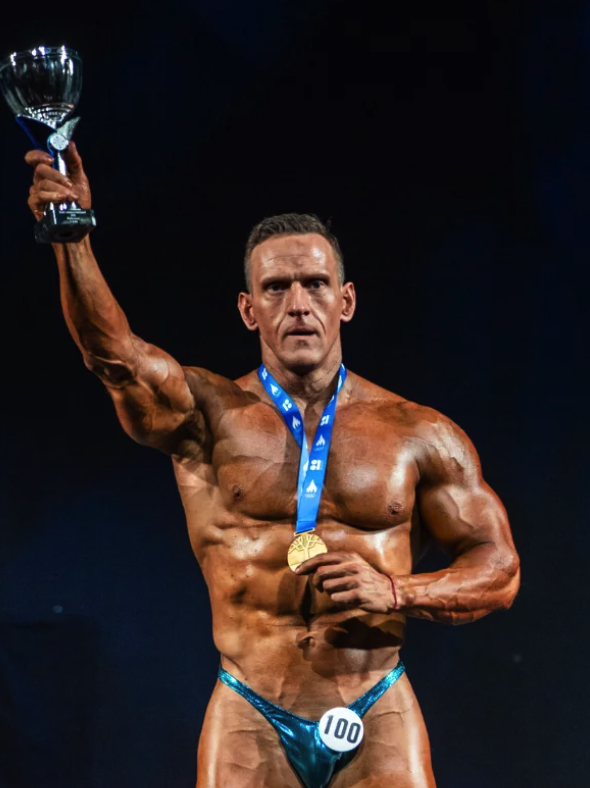
IFBB European Bodybuilding Championships 2002: protocol
The IFBB European Bodybuilding Championships 2002 protocol is archive material from the European Championships held on 17 – 20 May 2002. It lists the men’s weight classes, the pairs results and, from an Estonian perspective, one important placing: Ott Kiivikas finished 8th in the Men < 90 kg class.
Why is the IFBB European Bodybuilding Championships 2002 protocol interesting?
Old competition protocols are not just rows of names and points. They show who stood at the top of European bodybuilding at the time, which countries were strong, and how tight the competition was even below the final places.
In the 2002 protocol, athletes from Russia, Poland, Ukraine, Belarus, Slovakia and the Czech Republic stand out especially often. For Estonian readers, the key name is Ott Kiivikas, who reached a high 8th place in the Men < 90 kg class. It was a time when Estonian bodybuilding was only beginning to attract wider international attention.
IFBB European Championships results in the men’s weight classes
The results below are preserved in protocol form. Place shows the final ranking, name the athlete, country the nation represented, and points the sum of the judges’ scores. The lower the point total, the better the result.
Men < 65 kg.

Place - Name - Country - Points
1. Sergei Sobolaev, Ukraine 21
2. Vladimir Krishtof, Slovakia 25
3. Anatoly Masimov, Azerbaijan 33
4. Leonid Kolemagin, Russia 38
5. Andrey Aksamit, Belarus 40
6. Daniel Zumbach, Switzerland 58
*
7. Kamil Majek, Poland 35
8. Igor Stasev, Belarus 43
9. Frantisek Horak, Czech Republic 43
10. Peter Kovacik, Slovakia 50
11. Fabio Oberti, Italy 55
12. Francisco Ruiz Galvan, Spain 58
13. Jerry Young, France 65

Men < 70 kg.

Place - Name - Country - Points
1. Tomasz Blaziak, Poland 10
2. Vadim Vlasov, Belarus 20
3. Thomas Nuhn, Germany 39
4. Ricardas Siska, Lithuania 43
5. Robert Archman, Czech Republic 45
6. Costel Torcea, Romania 56
*
7. Ioan Moldovan, Romania 35
8. Andrea Assotes, Cyprus 39
9. Massioma Leccese, Italy 47
10. Serkan Budak, Turkey 48
11. Dimitar Zhechev, Bulgaria 54

Men < 75 kg.

Place - Name - Country - Points
1. Laurent Dumoulin, Belgium 19
2. Ruslan Jabrailov, Russia 20
3. Alexander Gorbunov, Russia 23
4. Richard Zandt, Slovakia 40
5. Hynek Neuzil, Czech Republic 50
6. Robert Kastner, Germany 60
*
7. Mihaly Lakatos, Hungary 34
8. Vugar Verdiyev, Azerbaijan 39
9. Vladimir Shkaruba, Belarus 46
10. Stoycho Kuzmanov, Bulgaria 48
11. Serif Armutcu, Turkey 55
12. Laurent Dumoulin, Belgium 60
How to read the IFBB European Championships protocol
In bodybuilding, nobody counts kilos on the bar or finish times. Athletes are compared on stage: symmetry, muscle mass, conditioning, proportions and presentation all come together as a whole. That is why the points gap can be small while the difference in placings still looks clear to the audience.
The asterisk in the protocol separates the finalist places from the places that follow. This old formatting may look clumsy today, but it is valuable from an archive point of view. It shows how results were published back then.
Men < 80 kg.

Place - Name - Country - Points
1. Dimitry Poliakov, Russia 14
2. Hubert Olborski, Poland 16
3. Vasilij Remezov, Ukraine 31
4. Sergey Meleshko, Belarus 45
5. Sener Cinouglu, Cyprus 45
6. Ishtvan Szilagyi, Hungary 66
*
7. Dimitry Kayava, Belarus 39
8. Mario Feuser, Germany 41
9. Peter Kokoshka, Slovakia 48
10. Roman Spacek, Czech Republic 48
11. Bilal Chakir, Turkey 49
12. Negovan Jovanovic, Yugoslavia 64
13. Alexei Sergheev, Moldova 66
14. Viatsheslav Koshev, Belarus 67
15. Ruslan Ahayev, Azerbaijan 71
16. Valeri Ivanov, Latvia
17. Aris Eyubov, Azerbaijan

Men < 90 kg.

Place - Name - Country - Points
1. Alexandre Bilous, Ukraine 13
2. Bogdan Shchotks, Poland 18
3. Viatcheslav Burnekov, Russia 27
4. Petr Soukup, Czech Republic 44
5. Dmitry Soushko, Belarus 55
6. P.A. Konstedt, Switzerland 57
*
7. Ronald Ullram, Austria 43
8. Ott Kiivikas, Estonia 43
9. Olaf Govedarov, Germany 49
10. Georgiou Christos, Cyprus 49
11. Stanley Raiman, Netherlands 52
12. Bert De Boer, Netherlands 57
13. Devidas Grinskis, Lithuania 58
14. Kimmo Salo, Finland 66
15. Roman Kronberger, Austria 69
16. Christian Russ, Romania
17. Emmanuel Buchin, France
18. Venanzi Di Bernando, Belgium
19. Hassan Raddoui, Italy

Men > 90 kg.

Place - Name - Country - Points
1. Evgeniy Mishin, Russia 14
2. Dariusz Karpinski, Poland 24
3. Lubos Cerny, Czech Republic 34
4. Manfred Petautsching, Austria 44
5. Radoslav Slodkiewicz, Poland 50
6. Mario Ondris, Slovakia 56
*
7. Alexei Shabounya, Belarus 31
8. Vadim Mitriushin, Ukraine 36
9. Dimirij Salik, Ukraine 47
10. Bernat Scorus, Hungary 52
11. Gedrius Gailunas, Lithuania 53
12. Petru Ciorba, Romania 64
13. Alexandre Sergheevich, Moldova 64
14. Arvidas Mickus, Lithuania 66
15. Georgi Dimitrov, Bulgaria 74
16. Veli-Pekka Niskanen, Finland
17. Stanimir Darvarov, Bulgaria
18. Muammer Gokmen, Turkey
Pairs results and the overall picture
The pairs scoring gives the protocol a different rhythm. Here it was not just one athlete being judged, but how well the partners suited each other on stage and worked together. Poland was especially strong in this category: 1st and 2nd place both went to Polish pairs.
Pairs (man-woman)

Place - Name - Country - Points
1. Halina Kunicka, Poland 17
   Dariusz Karpinski
2. Joanna Krupa, Poland 23
   Bogdan Szczotka
3. Jitka Necasova, Czech Republic 32
   Lubos Cerny
4. Aurelia Grozajova, Slovakia 42
   Mario Ondris
5. Irena Drahozalova, Czech Republic 44
   Petr Soukup
6. Irina Muntean, Romania 59
   Christian Russ
*
7. Simona Coppolino, Italy 37
   Hassan Raddoui
8. Florina Visan, Romania 39
   Costel Torcea

Total participants 109
The IFBB European Championships protocol and the Estonian mark
Looking at the whole competition at a glance, the total of 109 participants says a lot. This was not a small local tournament but a deep, European-level contest. For Estonia, the name that stands out most in the protocol is Ott Kiivikas, Estonia, with 43 points and 8th place in the Men < 90 kg class.
Archives like this help us see where today’s bodybuilding culture came from. Behind the names are years of work, a strict contest diet and stage condition that had to be brought out on the right day. A simple truth: the protocol is dry reading only at first glance.
FAQ
What kind of competition were the IFBB European Bodybuilding Championships 2002?
It was the IFBB European Bodybuilding Championships, and the protocol dates from 17 – 20 May 2002.
How does scoring work in bodybuilding?
In the protocol, a lower point total generally means a better placing. Judges assess the athletes’ condition, proportions, presentation and overall impression.
Was an Estonian athlete in the protocol?
Yes. Ott Kiivikas represented Estonia in the Men < 90 kg class and took 8th place.
Author: https://kulturism.ee/
Source: WHO – physical activity.
Come work out! ArtGym