Physical education and the confusion over standards
Physical education is back at the center of a dispute: should standards disappear, or simply be renamed? When we talk about learning outcomes, goals and swimming ability, then frankly, the standard isn’t going anywhere. The real question is how to use it sensibly.
The debate picked up speed after an article titled the new physical education curriculum declares meeting standards taboo. Reading it, you can’t decide whether to laugh or cry. If standards are taboo, yet the curriculum still contains goals and learning outcomes, how do you keep the two apart?
Why physical education needs clear standards
A standard doesn’t have to mean a cold table in which a child becomes just a number. A standard can also be a simple agreement: what we want students to be able to do by the end of the lesson, where we’re heading, and how we’ll notice progress. When a student has to learn to dribble a ball, improve their running technique or cope safely in the water, there is already some yardstick in place.
A learning outcome is essentially an expected result. It is a goal, a skill level or a criterion. We can call it something softer, but the substance stays the same. When we say a child should be able to do something by the end of a school stage, we have created a standard. It’s a simple truth: without a target, you can’t assess whether any movement learning has happened either.
That doesn’t mean everyone has to be the same. An Estonian school class has very different children in it all at once. One picks up an exercise quickly, another needs more time. The teacher has to take that into account.
How physical education should be assessed
Assessment doesn’t have to be a punishment. Done well, it helps show whether a child made an effort, whether they progressed and whether they reached the skill that was practiced. If one student reaches the goal fully, another three quarters of the way and a third halfway, the teacher needs some way to describe that honestly.
If we say everything is purely individual, a new question arises immediately. On what basis do we then write shared learning outcomes into the curriculum? How can Jaan and Jüri have the same school-stage expectation in math, history and physical education if the objective side has been set aside entirely?
In practice, a teacher needs both. You have to take the student’s development into account, but you also need a clear target. If the objective measure disappears completely, assessment becomes too vague. If individuality disappears, assessment becomes unfair. The sensible path lies between the two.
What a teacher actually sees in the lesson
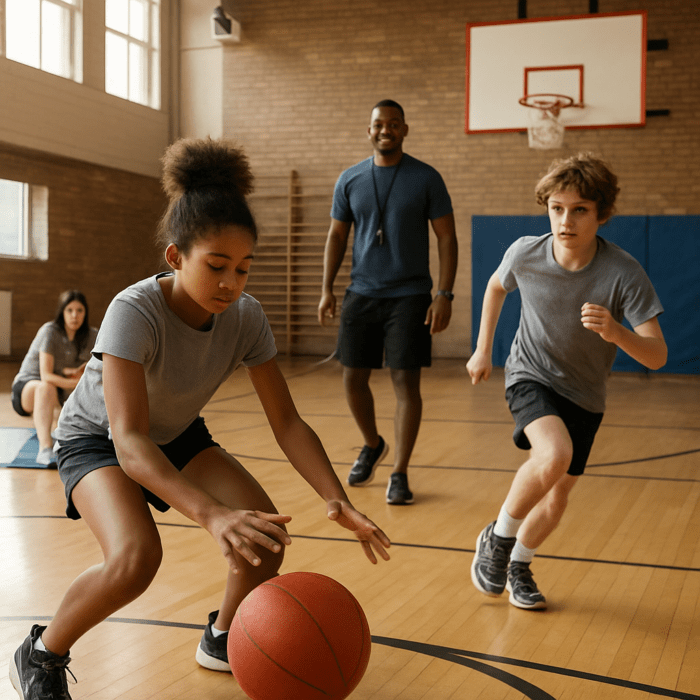
In a physical education lesson, the problem isn’t that everyone doesn’t always do the same amount. They don’t. A good teacher adjusts the training load, gives tasks of varying difficulty and watches who needs encouragement, who needs to be held back and who needs more precise technique. That is individuality, not the complete absence of standards.
The contradiction shows up most clearly in the example of swimming instruction. The updated curriculum describes skills a child must be able to perform: jumping into the water, swimming on the front and on the back, diving and getting out of the water. The same topic is also explained in an overview of implementing the updated movement education curriculum.
So what actually happens? In swimming, a standard is suddenly perfectly fine, because safety demands a clear skill. But when we talk about jumping, running, throwing or a strength exercise, the word standard somehow becomes suspect. That is the weak spot of the debate. If a skill matters, there has to be a criterion to describe it.
Physical education needs honest language
In my view, there’s no need to make an enemy of standards. What’s needed is honest language. When we talk about a learning outcome, we say it’s an expected skill. When we assess progress, we say what the progress consisted of. If a child made an effort but hasn’t reached the goal yet, that too can be described clearly and humanely.
Physical education should teach movement skills, body awareness, effort and responsibility. A slogan saying there are no standards isn’t enough for that. Neither is a table on its own. The teacher’s job is precisely to find the balance between them. But you can’t find balance when one side is pretended out of existence.
FAQ: physical education and standards
Does a standard mean all children have to be the same?
No. A standard can be a description of a skill, not an order to do everything at exactly the same speed or strength. A teacher can assess both the result and the progress.
Is individual progress a suitable basis for assessment?
It is, but on its own it isn’t enough. Without a shared target, assessment becomes too subjective and it’s hard for a student to understand what is expected of them.
Why is the swimming instruction example important?
Because the criteria there are very clear. If swimming requires specific skills to be described for safety reasons, you can’t claim that movement education doesn’t need standards at all.
Author: Janar Rückenberg
Come and train! ArtGym