
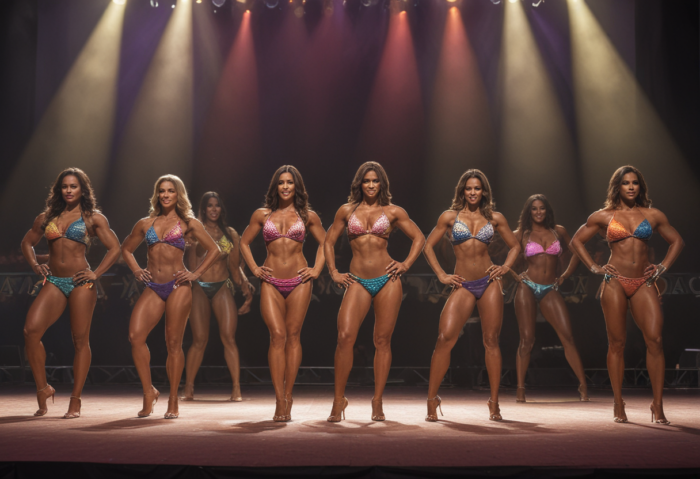
This is a series of articles about competing in bodybuilding, bodyfitness, athletic fitness and classic bodybuilding. In the previous article we talked about posing and why it matters, but we can’t pose without clothes! So what should you wear on stage? In the third part of the guide we continue our journey toward the stage and perfection by diving into the world of competition outfits. Whether you’re a beginner or already a veteran, there’s something here for everyone.
Competition outfits
Kilos of sparkling crystals and expensive fabrics. Leotards, bikinis and ordinary posing trunks. V-cut and round cut, low-rise and high-rise. Yellow, lavender, blazing red and so on – every color is represented. A wet look, satin, velvet, and on top of that, problems with attaching crystals and with outfit sizes. Welcome to the world of competition outfits!
“What should I wear on stage?” is a question that every athlete preparing for a competition has to find the best answer to. Finding the perfect competition outfit is far from an easy task, which is why problems with it come up so often – it is either hugely underestimated, ignored or misunderstood altogether. Male competitors in particular tend to have little interest in different fabrics, and would be perfectly happy to wear the same blue Speedo swim trunks on stage that have been lying in the closet since last beach season, or to order some random posing trunks online without much thought, which then fit only if they’re lucky. Most female competitors, on the other hand, absolutely love beautiful outfits decorated with crystals. Unfortunately, though, many of these women who love competition outfits end up looking like a Christmas tree or a British princess on stage, forgetting the true meaning and purpose of a competition outfit. So what are they, and why are these expensive scraps of fabric so important? What should you wear on stage? How do you find the competition outfit that suits you best?
That’s what they’re made for…
The whole process of choosing a competition outfit, and of answering all the questions that come with it, should be based on its purpose. When I once asked this question at a seminar, one male competitor shouted: “To cover my private parts!” Of course certain body parts must be covered on stage, and it’s even written in the rules, but that wasn’t the answer I was hinting at. The answer I wanted to hear was that competition outfits affect the illusion you create. In other words, the main purpose of a competition outfit and the choices you make about it is to give the best possible impression of your physique. In fact, the decisions you make about those little pieces of fabric play a big role in creating the illusion – they determine what impression people get of your structure, body lines, frame, proportions and symmetry. By making the right decisions about your outfit, you can show off your best body parts and, on the other hand, keep your weak spots hidden. That is the main purpose of a competition outfit – to give the best possible impression of your physique and create the illusion you want.
Your competition outfit also determines your overall look on competition day. Although the most important thing to keep in mind when preparing your outfit is its effect on the impression you make, a polished overall look matters too. It’s also important that what you’re wearing actually suits you. An outfit that fits you well and matches your body perfectly makes you feel more confident, more comfortable and prouder on stage, and helps you stand out in the lineup.
All in all, the competition outfit you present on stage is definitely a very important part of you as a whole. It matters to all of us, regardless of gender and the category we compete in, because the outfit plays a role in creating the illusion. Of course, though, a competition outfit has no magical powers. If you’re in poor shape, then no, unfortunately you can’t turn into someone like Andreas Münzer just by pulling on a pair of magic posing trunks. By making the right decisions about your outfit, however, you can make sure you look and feel great on competition day. Finding the perfect outfit is no substitute for the hard work and effort you have to put into your body, but combined with perfect posing, it ensures that you show the results of your work in the best possible way.
Now that we know what a competition outfit is for, let’s start our journey to finding the right one for you!
Rules to follow
The first thing we need to find out is what kind of outfit we need. The best source for that information, surprise, surprise, is your federation’s rulebook. Because the rules can differ significantly between federations and are occasionally changed, it’s always worth checking the latest version.
So what do we need? As mentioned, it depends on which federation you compete in, as well as your category and gender. Under the rules of the International Federation of Bodybuilding and Fitness (IFBB), to put it briefly, male competitors must wear simple posing trunks regardless of the competition category. Women competing in bodybuilding or classic bodybuilding (CBB) need a 2-piece outfit; women competing in bodyfitness need a black 2-piece outfit in the first round, a leotard in the second round and a 2-piece outfit again in the final round. Athletes competing in fitness also need a separate outfit for their free routine.
Now that we know what kind of outfit we need, our next step is to find out what it has to look like, or more precisely, what it is allowed to look like. To look our best on stage, we have to make detailed decisions about the outfit, but the rules set firm limits that must be followed and kept in mind. A federation’s rulebook contains plenty of provisions on different details – the cut, color, material, size and how the crystals may be attached. Note that what is allowed in the prelims may not be the same as what is allowed in the final. Whether you make your competition outfit yourself, buy a used one from someone or ask a seamstress to make a new one, remember to follow the rules. Your outfit is checked at the weigh-in before the competition, and the head judge takes a rather critical view of it. If you’ve ignored the rules, you won’t get through the check, and in the worst case you won’t be allowed to compete at all.
Now that you know which outfit you need for competitions and you’re familiar with the rules that govern it, you still have a few more details to decide on: size, cut, color, fabric and rhinestone placement. The rules do set certain limits, but we still have quite a lot of say ourselves. Let’s continue on our way to finding the right competition outfit, looking at what matters in these details and why.
Size matters!
The right size is the most important thing about your outfit, and there are several reasons for it. First, size, and how much of your body is covered by fabric, plays a big role in creating an illusion of your physique. Choosing the wrong size can work against you. Here are a few simple examples: an outfit that is too small cuts in too much and makes your body look softer; one that is too big ruins your body lines; an outfit that is too short or too long for your body throws off your proportions; and a back that is too small on bikini bottoms or posing trunks makes your glutes look bigger, especially if their shape isn’t at its best. Second, an outfit that is too big or too small simply looks bad, can be very distracting and leaves a poor impression. On top of that, knowing that your outfit fits you well and is the right size means no embarrassing moments on stage. You can stand there with confidence, knowing your chest isn’t going to fall out of your bikini top. Size matters!
Because of these illusion effects, many competitors try to play tricks with the size of their outfit. If you do that, make sure you can leave a positive impression of your physique and not the opposite. I often hear girls say they want to show off their glutes more and choose a smaller outfit for that. Excuse me? Of course you can show more of your backside, but that isn’t the main purpose of competing, and as I said, if you aren’t in your best shape, a smaller outfit makes your glutes look wider, bigger and softer. So if you want to use tricks to make a better impression, keep the relevant and important judging criteria in mind, and make sure the tricks help you look better rather than worse. If you’re a woman with narrow collarbones, a narrow upper body and not the biggest chest, you can create the illusion of a slightly wider upper body by choosing the smallest possible top, one that covers only the bare minimum of your upper body and chest. That’s an example of a smart trick when it comes to size.
The basis for deciding on size, and on how much of your body is covered, is of course the rulebook that sets out the minimum dimensions for outfits. Most federations, including the IFBB, require everyone who wears a competition outfit, men and women alike, to have posing trunks or bikini bottoms that cover at least ½ of the gluteus maximus muscle. This is the minimum size requirement we have to take into account. Once we’ve established that we need to follow these rules, it’s also good to follow another guideline: the outfit should simply suit you and your body lines, like all the clothes you normally wear. A well-fitting outfit means there are no hanging or excess pieces of fabric, and no body part that should be covered is squeezing out from anywhere. It doesn’t cut deeply into your skin, and it matches the length and shape of your body. Nothing is overly covered; it simply fits you and your body well, and flatters you.
How can you be sure you get the right size, and the one that really suits you? If you choose a completely new outfit and work with a costumier, it’s your job to make all your measurements clear to them and to keep them up to date during your diet. A good costumier will ask you to keep them informed and will show you how to take your measurements. Also make sure the costumier knows your federation’s rules, and if necessary, tell them which tricks you plan to use with the outfit’s size to make your body look better. If you get a used outfit from someone, don’t buy it before you’ve tried it on. Everyone’s body is unique, and it doesn’t happen very often that a competition outfit made for someone else fits you perfectly. If you decide to buy a used outfit, be prepared to alter it yourself as needed.
Cut
It isn’t enough to decide what to cover and how much of your body to cover; how it is covered matters too. The shape of the fabric over your body also plays an important role. Once you have the right size, the cut is actually what deserves the most attention in a competition outfit. The ideal cut helps you create the illusion you want of your body. Regardless of category or gender, that undoubtedly means the illusion of a good X-frame, a small waist and a solid V-shape. On the other hand, a bad cut can ruin your physique. As I said, we need an outfit that shows off our X-frame the most, gives the impression of the smallest possible waist and creates the illusion of a good V-shape. Depending on your body lines, frame, symmetry, proportions and structure, you can solve this in several different ways. It’s useful to remember that our bodies are extremely different, and that is exactly why we have to make different decisions when choosing a cut. The basic advice to give about competition outfits is this: don’t forget the V-shape and the X-frame!
A widely used, correct and safe choice for posing trunks and women’s bikini bottoms is a V-cut, both at the front and the back, with a mid or rather high rise at the waist. A V-cut and a high rise are the combination that usually creates the most attractive picture of your waist. At the same time, let’s not forget that our bodies are different. Sometimes the best option may be a rounded cut with a low waist, for example if nature has given you an extremely small waist that no outfit could possibly spoil, but, on the other hand, let’s say your legs are too long compared to your upper body. In that case, the low rise would make your proportions look better.
For women, the cut of the bikini top matters too. There’s no single best cut to recommend here, since it depends on your upper body, above all on the size of your bust. If you compete in bodyfitness, the most important decision is choosing your leotard, because it covers more of your body than anything else you wear. It helps to make sure the leotard creates a V-shape, meaning it’s wider at the top and narrower at the bottom. It’s generally best to avoid leotards that are very narrow at the midsection. Girls think this makes their waist look slimmer, but in fact it creates the opposite illusion.
I can’t stress enough how important individuality is when choosing a cut. Every body is different, so we can’t give one-size-fits-all advice. To be sure you find the cut that suits your own body, take the time to think it over calmly, consult a costume designer and/or go and learn more about the subject. When choosing a cut, use the analysis you’ve made of your own physique: what to highlight and what to put in a better light. If you plan to buy a secondhand outfit, buy it from someone whose frame, structure, body lines, proportions and symmetry resemble your own, and be prepared to make alterations to it. And don’t forget the X-frame and the V-shape!
Color and material
Now that we’ve found the best size and the best cut for your competition outfit, all that’s left is choosing its color! This choice can’t be rushed either. I wouldn’t play the lottery with color, because color changes the overall impression very strongly. The rules do limit your choices to some extent here, too. For example, the IFBB rules state that bodybuilders must wear non-distracting colors, and that classic bodybuilders and bodyfitness competitors must wear plain black in the first round. Otherwise, you have thousands of colors to choose from, but check the rules first!
So what should you choose, and why? There are several good tips worth keeping in mind, and I’ll start with what to avoid. It’s useful to pick a shade that creates a strong contrast with your skin tone. Colors such as beige, copper and brown may well be represented in Vogue, but in a competition that judges the beauty of the physique they’re not worth discussing at length. These colors simply look too dull. On stage they can ruin the look of your body and cancel out every other decision you’ve made about your outfit so far. So when you start choosing a color, forget every shade similar to your own skin tone. If you do take the risk and go for brown or beige anyway, use the darkest possible shade and apply plenty of rhinestones to the outfit.
So we say a big no to colors similar to your own body tone. What next? More negatives. It’s also best to avoid very strong colors and shades that can irritate the judge and distract their attention from your body. These are usually shades that also show poor taste. A good example is any neon color. Yellow isn’t worth wearing on stage either. I also recommend avoiding the biggest mistake you can make: combining different colors in a single outfit. It can create a very surprising illusion, can also be distracting, and draws attention away from your body. White is also worth thinking about several times. In some cases it can turn out well, but keep in mind that you’ll also be wearing makeup on stage. The contrast can be too strong with a white outfit, and on top of that white fabric is easier to stain and therefore easier to ruin.
So which colors are suitable? You should choose a color that suits you as a whole and at the same time stands out well. But as I wrote earlier, nothing that is too distracting or chosen in poor taste, and don’t settle on shades similar to your own body tone. You still have a very wide range of options. Whatever color you choose, never take the lightest shade of it. Light shades also look dull, and you won’t be able to stand out in them. Once you’ve chosen a suitable color, taking the points above into account, pick the darker version of it. If you choose blue, for example, don’t take light blue, go for dark blue instead! Black has recently become a popular choice. It’s certainly a safe choice for everyone, especially for male competitors, since there’s not as much covered surface on their bodies. And it works perfectly. For women’s outfits, especially leotards, black is a color to be careful with. Although black really is an ideal choice, stage backdrops are usually very dark too, and if a large part of your body is covered in black fabric, as it is with a leotard, you can easily blend into the background, so to speak. You can avoid this by adding plenty of rhinestones to your leotard.
Experienced and skilled costume designers can also give good advice on colors, so it’s worth discussing the topic with them. Another question where you can trust a costume designer’s knowledge and instinct is the fabric and material of the outfit. Which fabric to choose depends first and foremost on what you like best yourself. In general, the choice of material doesn’t matter all that much. Still, don’t forget to check the rules when choosing the material, too. For example, in the prelims of IFBB classic bodybuilding and bodyfitness, you’re required to wear fabric that is matte (non-shiny). After reviewing the rules, make your decision together with the costume designer. The one big “no” here is fabric with a wet look, which risks making you look softer than you really are.
Shine like a professional – applying the rhinestones
Our competition outfit is almost ready. We now have the outfit we need, one that suits us perfectly in every way: its cut, size, color and fabric ensure that we look great and get the most out of the outfit. All that’s missing is the sparkling rhinestones, that is, the decorating of the outfit. That fun is reserved for women only, as most amateur federations, including the IFBB, don’t allow men’s posing trunks to be decorated in any way. For women, too, limits on the use of rhinestones are set by several amateur federations (including the IFBB) – usually only finals bikinis and leotards may be decorated. But if you’re an IFBB professional, step boldly into the world of gemstones!
Some women add 3000 crystals to their outfit, some use fewer, and some barely use any at all. Some look like Christmas trees on stage, with a huge number of sparkling crystals covering their outfit, which makes the garment quite expensive. Is that really necessary? It depends on what you want, how much you want and what your means are. The fact is that how much your suit or bikini sparkles won’t help you win a contest if you don’t have the physique to go with it (i.e., the best one on stage). On the other hand, if the competition in the lineup is very tough and the differences between competitors are minimal, then without crystals you may not stand out enough compared with the others. No, the judges are not there to judge your outfit. Sparkling crystals won’t take anyone to victory. But it’s all an illusion! If you blend into the background and don’t catch the eye in the lineup, you simply won’t be noticed, and that matters a lot! All in all, you don’t need tons of crystals to succeed, especially at the amateur level, but make sure that the combination of color, material, fabric and crystals – whether many or few – puts you in a standout position. Some women adore crystals, while others don’t seem to find them that important. If you want to shine like a pro and can afford expensive bikinis and suits, then go for it!
Whether you’ve added hundreds or thousands of crystals to your outfit, there are a couple of important things you should try to keep in mind. Embellishing your outfit must serve the same principle we’ve already talked about many times: it has to help you create the desired illusion and definitely not ruin it. A common mistake is getting carried away turning the outfit into a pretty flower of crystals while forgetting the main purpose of the outfit and its embellishment. Remember that the placement of the crystals must follow the lines of your outfit, such as the bottom of a V-cut bikini. The crystals should further emphasize what you wanted to highlight with your choice of cut, not make it insignificant. Well-placed crystals should be distributed so that there are more at the top and fewer at the bottom, to powerfully bring out the illusion of an X-frame. Also check that you don’t ruin your symmetry with the crystals – there must be as many on the right side of your outfit as on the left, otherwise the two sides of your physique will look different, and that is exactly what we want to avoid at a physique competition, isn’t it?
New vs used
We need the perfect outfit. Where do we get it? Several times in this article I’ve mentioned the costume maker, new outfits and used ones. It’s common for competitors to sell their outfit after wearing it just once. Used outfits tend to be cheaper than ordering new ones from a costume maker. You can also rent an outfit. It’s your choice whether you buy or rent used competition outfits or get brand new ones. You decide how much money you spend on competition outfits and how much effort you put into it. If you only take part in regional competitions and don’t want to spend excessively, a used outfit is a perfectly reasonable choice. But wearing used outfits is risky, because every body is different. A competition outfit that suits Nicole Wilkins may not suit you just as well. That’s why you must always try outfits on before buying or renting them, and be ready to alter them too – the cut, the size, the crystals…
I always recommend getting a new outfit made exactly for you and your body. The bigger the competitions you enter, the more important this is, because as the level rises, the differences between competitors get smaller and you need to be ideal in every way to succeed. When ordering a new outfit, make sure you look and feel perfect in it and that you get as much benefit from it as possible, precisely because it has been made for you and your body.
A good costume maker can be hard to find. Any costume maker can make a competition outfit and decorate it lavishly with crystals. But there aren’t many who can make an outfit that is ideal in every respect, and do so for people with different bodies. Take a look at the candidate costume makers and find out which competition outfits they have made before and for whom. Talk to them and pay close attention to their philosophy of outfit making. Usually the best choice is the very same costume makers who, besides doing their work well, are also competitors and judges – they know what matters!
Summary
Although outfits aren’t the most important thing at physique-judged competitions and the judges aren’t there to assess your outfit, the competition outfit you wear on stage is still part of our look and part of the illusion we are trying to create. That is why outfits matter so much on competition day, and why the time spent finding the ideal one pays off. Throughout the process you must follow your federation’s rules. Otherwise you are free to choose the outfit that suits you, but to look your very best, it must have the right size, cut, color, material, fabric and suitable embellishment to match your physique – your symmetry, structure, proportions, body lines and frame. Just as every body is different, competition outfits and the choices that come with them are individual. Whether you choose a used outfit or have a costume maker create a new one, start working on it early, at least 12 weeks before the competition, and be diligent in making the related choices. We wish you success in choosing your competition outfit!
Author: Anne Pietilä” translated by Andra King
Come and train! ArtGym




