Carbohydrates: a practical choice for muscle lovers
Carbohydrates are not the enemy on a bodybuilder’s menu. The real question is when to eat them, which source to choose, and how to make that energy work for your training and recovery.
Atkins once made the fear of carbohydrates familiar to the masses, but in the gym your body can’t run on fear alone. If your goal is muscle, strength and feeling better, it’s worth looking at carbohydrates soberly rather than following the latest fad.
Why do carbohydrates matter for training?
On a hard leg day, it becomes clear fast. When the tank is empty, even an easy set drags. Carbohydrates give your body the fuel it needs most for strength training, sprinting and a longer active day.
That doesn’t mean every meal has to be a big pile of pasta. The simple truth: amount, timing and source all matter. Some foods suit the time before a workout better, some the time after, and some a calm lunch or dinner.
Bodybuilders are used to calculating calories and counting carbohydrates. For the average person, it’s often enough to have a clear carbohydrate source, a protein source and something fresh on the plate. If you train regularly, don’t automatically cut carbohydrates down to zero.
Carbohydrates and the right timing
After a workout, your body wants something that digests more easily and helps restore your energy stores. That’s why some starchy foods suit the post-workout window better than very high-fiber options.
Before a workout, the food should be familiar and light on the stomach. Frankly, the worst choice is the one that looks perfect on paper but leaves you feeling heavy in the gym. Experiment calmly and see what works for your body.
On a quieter day, or several hours before a workout, you can choose a more slowly digested carbohydrate source. Then dietary fiber works in your favor: you stay full for longer and your energy doesn’t crash as sharply.
Muscle-friendly carbohydrates
Potato
1 medium (boiled)
159kcal
4g protein
36g carbohydrates
0.2g fat
4g dietary fiber
A boiled potato is simple, honest food. It contains folic acid and, if you eat it with the skin on, potassium too. Potatoes digest fairly easily, so they work well after a workout when you want to eat something ordinary rather than just drink a shake.
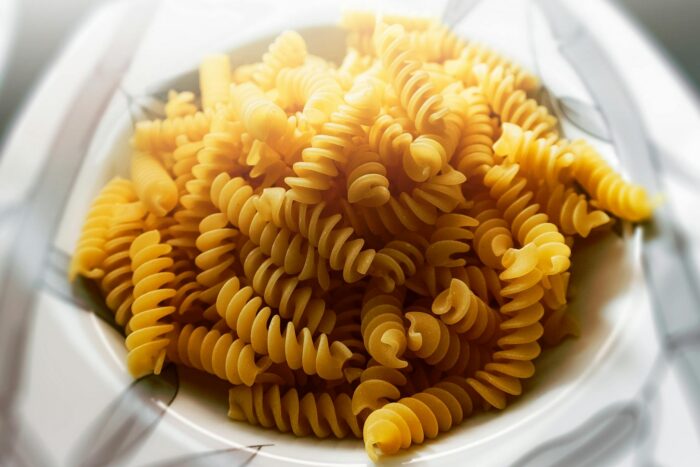
Whole-grain pasta
1 cup low-fat
174kcal
7g protein
34g carbohydrates
1g fat
4g dietary fiber
Whole-grain pasta is a good choice when you want to stay full for longer. Because it digests more slowly, it may not be the best option for everyone right after a workout. If you want a quicker, lighter meal, you can mix it with regular pasta. A tomato sauce adds flavor and gives the dish lycopene.
Brown rice
1 cup (cooked)
218kcal
5g protein
46g carbohydrates
2g fat
4g dietary fiber
Brown rice is an unrefined, higher-fiber choice. It works well for lunch or dinner, especially when there’s still time before your next workout. Right after training, some people may find it digests too slowly, so it’s better used at other times.
Sweet potato
1 medium (boiled)
165kcal
4g protein
38g carbohydrates
0.2g fat
6g dietary fiber
Sweet potatoes also digest more slowly. They suit an everyday meal well when you want steady energy. Sweet potatoes contain beta-carotene, which is associated with supporting immunity and recovery. It isn’t a miracle food, but it is a very solid choice.
Couscous
1 cup (cooked)
176kcal
6g protein
36g carbohydrates
0g fat
2g dietary fiber
Couscous can look like a whole-grain food, but usually it isn’t. It’s made from the same raw material as regular pasta. That’s exactly why couscous works well for variety and can be a convenient choice after a workout.
How to make carbohydrates work for you
Don’t choose carbohydrates by calories alone. Also look at how the food behaves in your stomach. If brown rice makes you feel heavy before a workout, it isn’t the best choice for you at that moment. If potatoes make you feel good and don’t get in the way of movement, use them with confidence.
Pay attention to portion size too. The same food can be very good or completely too much, depending on how much you eat and how active your day is. In winter, when you move less, the amount can be smaller. In summer, when you rack up more steps and workouts, your body may need more energy.
So what actually happens? When a carbohydrate fits the timing and the amount, it supports your training. When the amount goes beyond what you need, your body stores the excess. So the question isn’t whether carbohydrates are good or bad. The question is how you use them.
FAQ
Do carbohydrates make you fat?
No single food makes you fat on its own. Body weight mostly follows your overall energy balance. If you consistently eat more than you burn, you gain weight. As long as the amount fits, carbohydrates can be a perfectly normal part of your diet.
When is the best time to eat carbohydrates?
Carbohydrates play their clearest role around your workout. Before training they provide energy, and afterwards they help replenish your stores. Slower-digesting options work better when a workout doesn’t follow right away.
Is brown rice always better than white rice?
Not always. Brown rice provides more dietary fiber and works well as an everyday staple. After a hard workout, an easier-to-digest option may suit some people better.
Source
Source: Muscle & Fitness, Jordana Brown
Translated by: Aktivist
Source: Süsivesik
Come and train! ArtGym