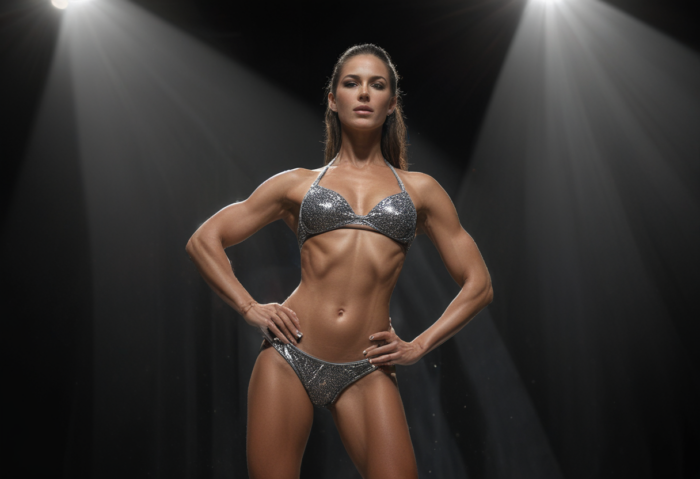
Choosing a competition suit for fitness
A good competition suit isn’t just pretty — it supports your physique on stage and boosts your confidence. Color, cut and embellishments all influence how the judges see you. Here is a practical guide to help you find the right competition suit.
The rules: what the federation requires
Before you buy anything, check the rules of the federation whose competitions you plan to enter. For example, the NZFBB (The New Zealand Federation of Bodybuilding) requires the suit to cover at least 50% of the lower body, while NABBA (National Amateur Bodybuilders’ Association) does not. Ignoring the rules can end in disqualification, so doing your homework is a must.
Choosing the color of your competition suit
Pick a color you feel comfortable in. Mid-tone and darker shades — blue, green, red, pink, purple — look good on stage. They don’t reflect the harsh stage lighting or blend into your tan.
Some colors cause more problems on stage than others:
- Light shades (white, yellow, silver, very light pink or blue) — they’re hard to keep clean and they reflect the stage lighting, which makes your physique look smaller.
- Colors that blend into your tan: orange, brown, gold. Your outline disappears on stage.
- Black — known for its slimming effect in everyday clothes, and on stage it can make you look smaller too. Think it through before you decide.
Style and cut of your competition suit
There are more options than you might think at first glance — different tops can be combined with different bottoms. You can find inspiration in international fitness magazines such as Muscle and Fitness, Oxygen and Muscle Media.
Bikini tops:
- Underwired, triangle, padded or a combination of these.
- Women competing for the first time often prefer supportive tops — they reduce competition-day nerves.
- Triangle tops with a special clasp (a so-called bikini bite) may fit your shape better.
- If you want gel inserts, they can be attached inside the top so that no one on stage will notice — they work well for achieving a natural look.
- The cups of the top shouldn’t sit too close together — this makes your ribcage look narrower.
Bikini bottoms:
- Full coverage, French cut, G-string at the back and V-cut at the front, low cut or ruched front — there’s no shortage of options.
- Skin that has been stretched by major weight loss or pregnancy can be disguised with a less tight cut that suits your shape better.
- Full coverage can make the bottoms look visually larger — don’t rule out the French cut.
- A high-cut front can make you look shorter, especially if you have narrow hips or an hourglass figure.
- If you’re especially lean and muscular, a modestly fitted suit lets your physique do the talking.
Embellishments, shoes and jewelry
Embellishments are where you can truly express your style. Diamantés, crystals, pearls, sequins — you mix them yourself. Using paler tones on the edges with a stronger base color creates a slimming effect. Clear tones on the edges help define your outline when the base color might blend into your tan. A simple suit with no embellishments is just as valid a choice — there is no single right solution.
Shoes: the most important rule — you must be able to walk and pose in them. Practice before the competition, because practice is everything. As a general rule: the higher the heel, the better. The exception is if you’re especially tall in your class — then you can choose a lower heel. Straps that fasten around the ankle tend to visually cut across the leg and make the ankle look thicker: unless they’re an unobtrusive color, it’s worth avoiding them. Special competition shoes can be expensive, but they aren’t essential.
Jewelry: less is more. Earrings and perhaps a bracelet or a ring — that’s enough. Necklaces can hide the contour of your ribcage, and anklets visually cut you in half, just like shoes with ankle straps.
Hair: long chignons are popular and look thick and glossy on stage. If you tie your hair up, choose a hair accessory that matches the style of your suit — sparkly clips or a flower that goes with the suit and the backing music. Some people use sparkly hairspray. At some point you may be tempted to invest in every single detail — but don’t overdo the finishing touches.
Honestly, all of this can get expensive, especially considering that you’ll wear a competition suit only once or twice a year. It’s worth checking the secondhand market: a good second-hand find is entirely possible. If you prefer the easier route, many fitness shops sell ready-made suits straight off the rack.
FAQ: competition suit and stage
Does the color of your competition suit really matter?
Yes. Darker, saturated shades show up better on stage. Light colors reflect the stage lighting and make it harder for the judges to assess your physique.
Are special competition shoes essential?
No. What matters is that you can walk and pose in them with confidence. Practice matters more than the brand or price of the shoe.
Does the suit affect your result?
You aren’t scored directly on your suit, but it is part of the overall impression. Good preparation, including a suitable suit, gives you extra confidence, and that clearly shows on stage.
Translated by: Aktivist
Source: WHO – physical activity.
Come and train! ArtGym