
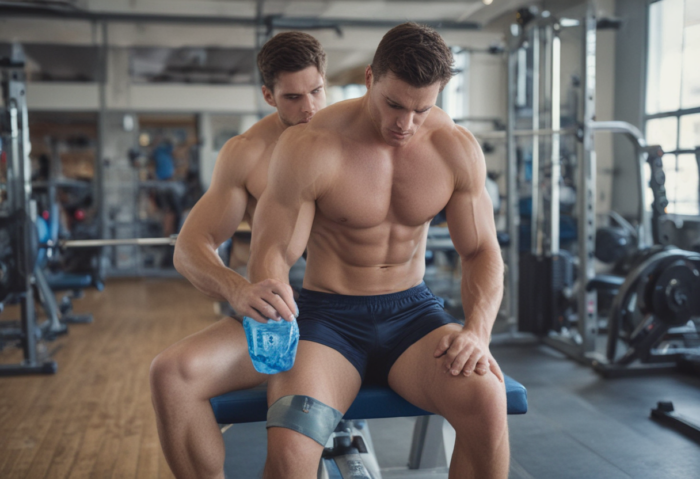
Relieving injuries with heat and cold
Relieving an injury starts with a simple question: should you apply cold or heat? If your ankle swells up during a workout, it’s no time to experiment. If your neck has been stiff for a long time, heat may be the better choice.
Why do cold and heat work for injuries?
Cold and heat don’t do the same thing. Ice slows blood flow and helps limit swelling and the inflammatory response. That’s why it suits a fresh, or acute, injury, such as a sprained ankle, wrist or elbow.
Nicholas DiNubile, assistant clinical professor in the department of orthopedic surgery at the University of Pennsylvania in Philadelphia, explained a simple principle in the original article: if you apply ice right away, bleeding and swelling are reduced.
A common guideline is the 24-hour rule: ice for the first 24 hours, then heat. Frankly, that’s too rigid. If the injury is still swollen and acute after 24 hours, keep using ice. Heat comes into play once the acute inflammation has passed and the muscle or joint needs to relax.
For injuries: when should you choose ice?
Ice suits new injuries and sudden pain. Use it when the area is swollen, hot, tender or has just taken a blow. If you suspect serious damage, don’t move the injured body part and seek medical help. The same applies if the condition doesn’t start to improve within a couple of days.
- Sprained ankle, wrist or elbow
- Split lip
- Bruises
- Shoulder muscle tear
- Tendinitis
- Muscle pain
- Knee pain after a workout
- Neck pain
- Joint pain after a workout
- Shin pain or lower-leg pain after a workout
- Pain on the outer side of the elbow, also known as tennis elbow*
- Bursitis*
- Insect bites and stings
*Chronic conditions that can sometimes be eased with ice or ice massage.
Limit ice to 20 minutes per session. Holding it on longer can damage the skin and tissues. If needed, you can reapply ice every hour. If you use a gel ice pack, put a thin damp towel between your skin and the pack. On the hands, where circulation is more limited, use ice in 10-minute sessions only.
For an acute injury, combine ice with rest, compression and elevation. Try to keep the injured area at heart level or above your head. And one important point: never use ice before training. A numb area won’t warn you in time when the training load is too high.
Which kind of cold should you use?
- Crushed ice in a bag conforms well to the body part and cools evenly.
- Rubbing with an ice cube suits a small area, such as a finger, hand, elbow or foot. Make circular motions for 5-10 minutes.
- Gel ice packs are convenient, but they can be colder than they first seem.
- First-aid ice packs are a good option when there’s no freezer nearby.
- A bag of frozen peas works too, because it molds well to the body. Label the bag after use so it isn’t used as food later.
When does heat help?
Heat speeds up circulation, helps stiff muscles relax, reduces spasms and can improve mobility. It’s used more for long-term complaints: back pain, chronic neck pain, sciatica, stiff hands, shoulder pain and stiffness, menstrual pain and osteoarthritis.
Warmth can also suit the time before training, when the problem is stiffness rather than fresh inflammation. For example, a stiff knee or shin pain/lower-leg pain may be better tolerated with warmth before you move. But if the area is swollen, red or inflamed, skip the heat.
Watch the temperature closely. Hotter pads, especially above 40 C, shouldn’t stay on for longer than 20-30 minutes per session and up to 2-3 times a day. Warm pads may in some cases be left on for up to eight hours, but don’t lie directly on a heating pad or fall asleep on it.
For menstrual cramps, a warm pad can go on the lower body or lower back. People with nerve and circulation problems, such as diabetics and older adults, should talk to a doctor before using heat therapy. If the pain lasts for several days, see a doctor.
Practical heat products and ointments
- Gel heat packs stay warm longer, but they can split after repeated use.
- Packs filled with rice or other grains can be heated in the microwave, but they need a clean cover.
- Electric heating pads are convenient, but they can get too hot.
- Paraffin pads suit the hands/wrists, feet and elbows, but they require separate equipment.
- ThermaCare wraps give off heat for at least eight hours and come in different versions for the lower body, neck to arms, menstruation and knees. The price mentioned in the original story was $2.20 to $3.47 each, depending on the model.
You can also make a simple heat pack yourself: put cooked rice in a clean sock and tie the end shut. A knee-high sock makes a longer pad for the neck or another stiff area. If it gets too hot, let it cool down before use.
Muscle rubs can create a feeling of cold or heat. Some products containing salicylate may relieve pain and help against inflammation, while menthol tends to just mask the pain. Capsaicin gel may work more slowly and is intended mainly for use in arthritis.
An important line to draw: don’t use an ointment to hide pain before a workout. If a new injury hurts, choose ice and rest. If an old pain gets worse, don’t push through it.
FAQ: relieving injuries
Is ice or heat better?
For a fresh, swollen and inflamed injury, choose ice. For long-lasting tightness and muscle stiffness, heat often works better.
Do you always have to switch to heat after 24 hours?
No. If the injury is still acute and swollen after 24 hours, keep using ice. The clock matters less than the state of your body.
When should you see a doctor?
If the pain is severe, moving is difficult, the swelling is growing or the injury doesn’t improve within a couple of days, seek professional help.
Author: Külmageel
Source: WHO – physical activity.
Come and train! ArtGym




