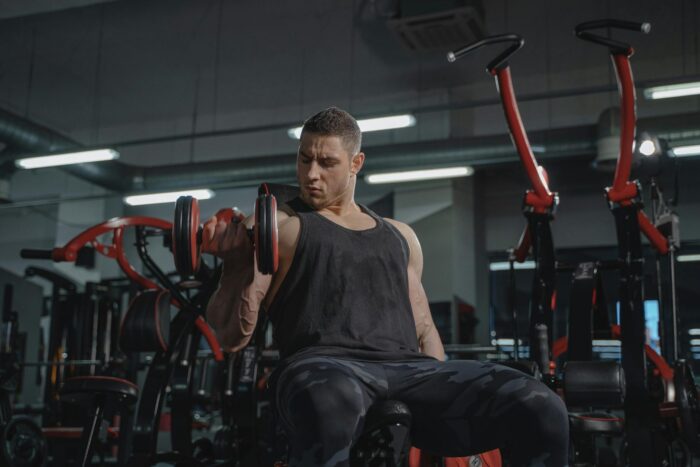
10-week training cycles for bodybuilders
In the traditional approach, where you compete only once a year or even less often, “mass” phases drag on pointlessly long and become monotonous, serving more as an excuse for low-intensity training and an unhealthy diet, mainly to avoid hitting a plateau.
Lifters know that training with heavy weights and low reps for a long time is the surest way to hit a plateau. That’s why 2-3-month cycles are usually used, during which the weight increases and the volume decreases
(i.e. the sets and rep count).
Bodybuilders’ training cycles could also be 2-3 months long, each with its own specific focus. Within a cycle, the training load can fluctuate both between individual sessions and between weeks. You can also use a wide variety of training methods and techniques, but everything must help you reach the goal of the cycle.
It’s important to remember that you can’t squeeze different goals into one cycle! Don’t try to lose 10 kilos of fat, add 5 kilos of muscle and set personal records in a 10-week cycle.
Below are 5 different cycles. They don’t have to follow one another – you can pick the ones that best match your goals.
Cycle 1: increasing body weight
Half-jokingly, you could say that half the work is eating. The goal can be to add 2.5-5 kilos in 10 weeks. Anything more is unrealistic and would mostly mean adding fat. For training, use low reps, heavy weights and basic exercises. Reduce the overall training volume and the so-called isolation exercises.
Cycle 2: reducing body weight
As in the previous cycle, the key here is proper nutrition. Just as you can’t avoid gaining some body fat in the weight-gain cycle, you shouldn’t expect to keep 100% of your muscle mass in this one. Some loss is unavoidable.
We don’t recommend losing body weight faster than 4-5 kilos over 10 weeks – that would mean too much muscle mass loss. Aerobic training load is very important: at least four days a week for 20-60 min. There’s no point in making big changes to your weight training; increase the work volume (repetitions) and add more isolation exercises.
Cycle 3: increasing quality muscle mass
This process is naturally slower than simply gaining or losing body weight. Adding about 1 kg in 10 weeks is a good achievement, and the change in appearance is noticeable. This cycle is well suited to intensified work on weak muscle groups.
Cycle 4: reaching contest shape
The goal of this cycle is to reach peak shape for contest day. Excess fat and water must go, while as much muscle mass as possible must be kept. Diet and aerobic training load are decisive. Some bodybuilders don’t change their weight training significantly, essentially keeping the same training all year round. Still, concessions in the weights used are unavoidable because of the diet. Toward the end of the cycle, intensification techniques are used: rest breaks of 15-20 seconds, supersets and extended (rather than heavy) sets, all in the interest of muscle definition.
Cycle 5: recovery
Necessary after a pre-contest cycle, but it can also be used after other strenuous cycles. Length: 1-10 weeks. In a shorter form it can be active rest; in a longer form, light training emphasizing high reps. This kind of cycle also suits the period after illness or injury, and times when overtraining is suspected.
A recovery cycle in training doesn’t call for any special nutrition rules. You should follow the same principles as during most of the year (except perhaps the pre-contest period).
They would be the following:
– Food must cover your daily energy expenditure as precisely as possible. Overeating gives you nothing (except fat)
– Of total calories, protein should cover 15-20% (an easier norm to follow is 1.5 g/1 kg), carbohydrates at least 50% and fat 25-30%
– Your diet should be varied, include fresh fruit and vegetables and, ideally, a multivitamin supplement (but not a “horse dose”)
Train here: ArtGym
Author: FLEX ref. I.Otsus
Source: WHO – physical activity.