Bigorexia and bodybuilding: control over your body
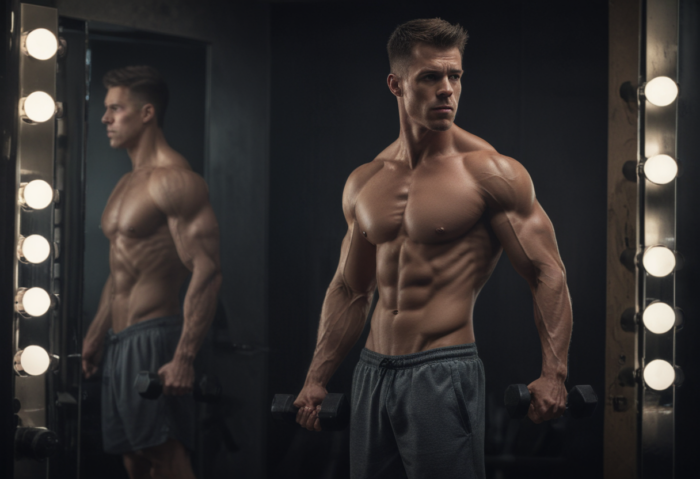
Bigorexia is more than simply wanting to look bigger and stronger. It begins when your reflection, training and food start to run your life, and you still feel small even when others see a strong, muscular body.
Bodybuilding requires discipline. The problem begins when discipline turns into fear: fear of being too small, too soft, too ordinary. That is precisely what the central idea of the original article captures so well.
Why bigorexia develops in bodybuilding
Anorexia has long been associated primarily with women and the desire to lose weight. In bodybuilding, a different phenomenon with similar roots was already being discussed in the 1980s and 1990s: instead of wanting to shrink away, a person wants to keep getting bigger.
Pope, Katz, Hudson 1993 called this phenomenon reverse anorexia. Taylor 1985 used the word bigorexia. The Estonian term for muscle dysmorphia also describes it well. The idea is simple: you have a distorted perception of your body and believe you still do not have enough muscle.
This is not the same as simply wanting to get into better shape. Many people train, make more conscious food choices and feel better as a result. With bigorexia, improving your physique brings no peace of mind. Every measurement seems too small. Every missed workout feels like a failure.
Writing as a former bodybuilder, Fussell 1991 described the feeling that even a very large, muscular body was not enough. This observation matters because, from the outside, someone may appear strong, confident and in control. Inside, however, they may feel constantly dissatisfied.
How bigorexia changes behavior
Pope et al. 1993 surveyed bodybuilders and found that 8 % of participants still considered their muscles inadequate, even though these were already very large men with highly developed musculature. Some wore oversized clothing even on hot summer days to look bigger or conceal their sense that their bodies were not good enough.
In the same study, 2.8 % of bodybuilders had previously had anorexia nervosa. By comparison, it was noted that only 0.02 % of all American men had experienced anorexia. These figures should not be taken as a simple answer, but they show why researchers began to look more closely at the relationship between bodybuilding and body perception.
Blouin and Goldfield 1994 compared bodybuilders, martial artists and runners. They assessed body dissatisfaction, the desire to lose weight and a strong drive to get bigger. Bodybuilders showed the greatest dissatisfaction with their bodies. They also showed more traits associated with bulimia than the other groups.
This study also had limitations. The runners’ average age was 37.9 years, compared with 27.6 years for the martial artists and 26.6 years for the bodybuilders. The bodybuilders also had the lowest level of education. These differences may affect the findings, but they do not make the underlying question disappear.
So what actually happens? Training becomes the yardstick by which you judge your entire self-worth. If your chest is not growing, it is a bad day. If your weight drops, panic sets in. If someone makes a comment, it can keep running through your mind for weeks.
Eating patterns can become rigid
Pasman and Thompson 1988 studied professional bodybuilders and runners and recorded more eating disorders and extreme eating habits than in a control group. In the world of bodybuilding, food can become as strictly regulated as a training plan.
The example in the original article is telling: one bodybuilder’s weekly diet included 70 eggs, 14 cans of tuna, 5 kg of beef, 5 kg of chicken breast, 30 liters of skim milk, 4 loaves of bread, 4 packets of brown rice, pasta, potatoes and as much fruit as would fit in a shopping cart.
That quantity alone does not establish an illness. Athletes with a high training volume do eat more. The warning sign is when eating becomes inflexible, social relationships suffer and every bite feels like either a victory or a failure.
The sense of control can take over your life
Dobbins 1997 wrote about a bodybuilder’s desire to control their metabolism. Yates’s 1999 brief review also emphasized the need to control the body. Schwarzenegger and Hall 1982 described Arnold’s belief that he could shape his body very precisely in the way he wanted.
In a healthy approach to sport, control is a tool. With bigorexia, it becomes a prison. You do not rest because you are afraid of losing your physique. You skip a birthday party because the food you eat will not be available there. You ignore pain because all you can think about is your next workout.
Bigorexia warning signs and practical help
Klein 1985 described bodybuilding as a highly individualistic sport. That suits some people well: your body, your work, your responsibility. But if you become increasingly withdrawn, stop spending time with friends and family, and live only for your workouts, it is worth pausing.
Fussell 1991 described how dedication to bodybuilding led to work, friends and family being pushed aside. This is more than simply a high level of commitment. It is a sign that training has begun to make your life smaller.
Low self-esteem often lies beneath the surface. A bodybuilder may appear confident on the outside while feeling inadequate on the inside. In 1995, Men`s Health relayed Klein’s idea that the more insignificant you feel inside, the harder you may work to appear powerful on the outside.
Steroid use is one of the most serious risks. The original text emphasized that the desire to keep getting bigger can dull your awareness of danger. When rapid change starts to feel like the only way out, the risk is high. Steroids can affect hormonal balance, mental health and organ function.
A practical truth: if training makes your life better, that is usually a good sign. If training starts to consume your life, you need help. The first step can be an honest conversation with a coach, your family doctor or a mental health professional. The aim is not to take sport away from you, but to restore a healthier relationship with your body.
There is no shame in seeking help. Bodybuilding takes strong willpower, but that does not mean you have to suffer alone in silence. Sometimes the hardest exercise is simply saying: my body is not the problem, but my thoughts about it have become too loud.
FAQ: bigorexia and bodybuilding
Does bigorexia mean bodybuilding is bad?
No. Bodybuilding can teach consistency, body awareness and discipline. Bigorexia develops when building a bigger body becomes an obsession and you no longer ever feel good enough.
How can you tell dedication from a problem?
Dedication leaves room for the rest of your life. A problem takes that room away. If workouts, food and your reflection start to damage your relationships, sleep, work or studies, it is no longer simply a disciplined fitness routine.
When should you seek help?
It is worth seeking help when the fear of being small drives your decisions, a rest day causes intense anxiety or steroids seem like a necessary step. Talking to someone early can prevent greater harm.
References
This article is based on Bianca Hitti’s Reverse Anorexia in Bodybuilders and the authors cited in the original: Pope, Katz, Hudson 1993; Taylor 1985; Fussell 1991; Blouin and Goldfield 1994; Pasman and Thompson 1988; Dobbins 1997; Yates 1999; Schwarzenegger and Hall 1982; Klein 1985; Men`s Health 1995.
Author: Janar Rückenberg
Source: WHO – physical activity.
Come and work out! ArtGym