Animal strength in the world of horse pulling
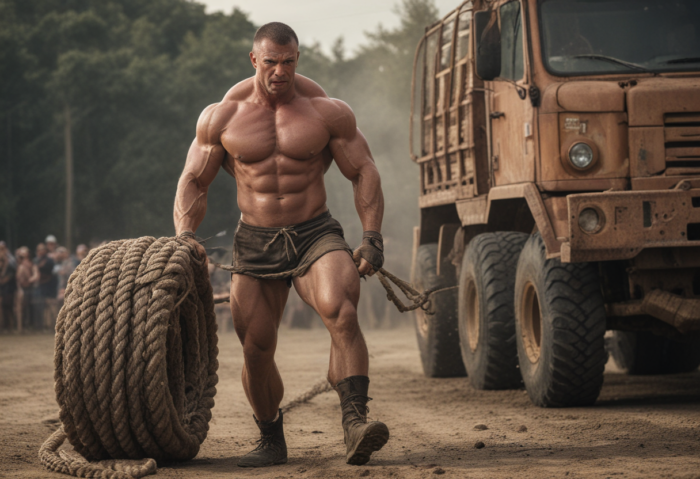
Today I’m writing about something interesting, or… let me start by saying that I sometimes surprise myself with the strange or curious things that impress me. A few days ago, I was browsing online and discovered an impressive, powerful spectacle of a sport that I had never heard of before. Of course, I could have guessed that such a competition existed, but this was the first time I had actually come across it. I’m talking about horse pulling. No, no, people don’t pull a horse or horses. The “athletes” are the horses themselves, pulling extraordinary weights. I don’t know why, but watching what these magnificent animals can do with such enormous loads is an incredibly powerful and impressive sight for me. I don’t know why it fascinates me so much. Perhaps it’s because I’ve spent half my life—even two-thirds of it—seriously involved in lifting and moving weights. That’s probably it. What adds to the appeal is that, for the past couple of years, I’ve been doing something similar to these magnificent animals myself… sled pulling. Knowing the weights I pull and seeing what these animals can do certainly makes me feel feeble. There’s a reason we sometimes tell someone they have “the strength of an animal.” The depressing thing is that humans really have nothing to match it. Of course, I realize we have all sorts of other important advantages, but when you compare our physical abilities with those of animals, including their strength, we really are a sorry lot.
Animal strength and horse pulling
But back to horse pulling. What exactly is it? I’ll be honest: I don’t understand the rules 100%, though I have a rough idea. But that isn’t really important, as you’ll see if you watch the accompanying videos. What these animals do is simply astounding. To give you a brief introduction to the sport, here are a couple of lines I’ve translated from www.horsepulling.com:
It all began early in the last century, when farmers started competing against each other—or, more accurately, pitting their horses against each other—to see whose horse could pull more, whose was stronger and could move a heavier load from a standstill. At first, these were informal contests between farmers, but the “craze” soon spread and organized competitions followed. Initially, farmers competed with their regular workhorses, but before long, horses were being raised, fed and trained specifically for weekend pulling competitions.
So horse pulling is a sport in the fullest sense of the word. The horses do most of the work, of course, but ultimately it is a team effort.
The best horses train specifically for competitions every day. Their muscles and tendons need to be in condition and ready for heavy loads. In general, their training and daily routines are much like those of human athletes—powerlifters. They train and prepare for competitions in exactly the same way. Quite a few people mistakenly believe this is cruel to animals and harmful to the horses. For horses like these, constant running and endurance training would be more harmful—ask any veterinarian. Draft horses are bred specifically for short bursts of heavy pulling and high training loads. Besides, look at how proud they are after a successful pull. Look at the pride in their gallop when they are unhitched from the load afterward. So quite the opposite is true: the horses aren’t being mistreated; they like it and enjoy it.
Naturally, nutrition is crucial to achieving such power and strength. Oats provide energy, and vitamins and minerals are important too, of course. And then there is plenty of hay. At least twice a day, the horses are also given special protein supplements along with their hay.
These draft horses generally have their manes trimmed and excess hair clipped from their legs and ears. Their owners do this to show off the horses’ cleanliness and muscular appearance.
This is not a sport you can make a living from, and the horses’ owners are usually ordinary working people who look after their horses alongside their main jobs.
Competitions usually bring friends and families together. People catch up and make new acquaintances, and of course there are spectators with no direct connection to the sport. It is always exciting to see new competitors, both horses and owners.
http://www.horsepull.com/sport%20of%20horsepulling.htm
Translator’s note: What follows is an assortment of facts about the sport, gathered from across the internet in no particular order.
Among the most powerful and strongest draft horses are Belgians, which weigh a little over one tonne. They are usually chestnut with flaxen manes. Historically, these were farm horses, and a small number still do farm work today, but the breed has become popular primarily for competitive pulling. Their strength is immense. At the National Western Stock Show, a pair of Belgian horses pulled 17,000 pounds, or 7700 kg, over a distance of 2.18 m. The horses themselves weighed a combined 2200 kg.
http://en.wikibooks.org/wiki/Adventist_Youth_Honors_Answer_Book/Nature/Livestock
Taking part in this sport is very expensive: there is the cost of the horses themselves and the equipment, while training and caring for the horses also requires an enormous investment of time and money.
These pulling competitions come in various formats, and the rules differ somewhat between states and countries (Canada and the USA). In New England, for example, horses pull a so-called stone boat loaded with rocks. Sleds are also used, and pulling force is sometimes even measured with a special dynamometer.
The first round usually requires the competitor to pull a load over a set distance. This starting load must be pulled within 5 minutes, with 3 attempts allowed during those 5 minutes. The load must cover the set distance in one continuous pull. If the competitor and their pair of horses succeed, they qualify for the next round, where the load is heavier. Weight is added to the stone boat until just one team qualifies for the next round, making them the winner. In New England, the usual pulling distances are 190 cm and 3.80. In Maine, teams have 5 minutes to pull a predetermined load, and the result is decided by how far they manage to pull it in those 5 minutes.
Translator’s note: competition rules vary by state. While looking up the rules for this sport, I also frequently came across a pulling distance of 27.5 feet, or 8.4 meters.
Whatever the format, these pulls require good horses, good conditioning and teamwork.
http://www.easterndrafthorse.com/horsepull.htm
Translator’s note: horses also compete in weight classes. They are weighed without equipment before the competition. Horses must not be beaten or verbally abused. Each team has three attempts at each load. Depending on the state, the driver or owner may also have two helpers, who must not urge the horses on during the pull. Horses mainly compete in pairs and individually.
All in all, these are truly impressive animals. Impressive strength. My respect for them has grown enormously. Just think how much these animals have actually done for people over the centuries and millennia. We owe them a great deal!
To finish, here are some links to competitions and impressive pulls. It is an incredible sight when these mighty animals dig in and get moving, their front ends rising and their hindquarters dropping so close to the ground… and what strength they exude:
http://www.youtube.com/watch?v=xwsUhW71zio&feature=related
http://www.youtube.com/watch?v=ivyOuHyWxe8&feature=related
http://www.youtube.com/watch?v=oAkBzdU0MEg&feature=related
http://www.youtube.com/watch?v=gXnGZYRphYo&feature=related
http://www.youtube.com/watch?v=-4B0p1ep8dw
If you are interested, you can find more videos by searching YouTube for HORSE PULL or HORSE PULLING.
Just as we strength athletes often use the squat, press or deadlift as a benchmark, these horses test their strength through this sport. Amazing stuff!
I reckon it would be “cool” to see these horses take off without a load while the support crew tries to hold them back :). That has probably happened too.
Translated by Janar Rückenberg
Come and work out! ArtGym