Body Fitness rules for stage competitors
Body Fitness is a discipline in which judges assess not only your physique on stage, but also your overall presentation, posture and style. The 2002 rules set out how competitors enter the stage, what they wear and the criteria judges use to make their decisions.
The distinction is simple: Body Fitness does not include a fitness routine. There is no acrobatic performance. The aim is an athletic, feminine appearance, with a well-trained body, well-defined proportions and a confident stage presence.
Body Fitness and its categories
Body Fitness competitors are divided into two height categories: up to and including 164cm, and over 164 cm. This allows judges to assess athletic physiques among competitors with more similar body types.
The competition consists of three stages. If a category has a large number of entrants, prejudging takes place before the final to identify the strongest competitors.
- Prejudging round I in two-piece bikinis.
- Prejudging round II in one-piece swimsuits.
- The final in two-piece bikinis.
Prejudging takes place when a category has more than 15 competitors. All competitors in the same category are brought on stage in numerical order and arranged in a single line. The line is then divided into two equal groups: one moves to the right-hand corner of the stage and the other to the left-hand corner. The center of the stage remains clear for individual callouts.
- Competitors must wear two-piece bikinis.
- All competitors in the category are brought on stage together in numerical order and arranged in a single line.
- The line is divided into two equal groups, with one moving to the right-hand corner of the stage and the other to the left-hand corner.
- Groups of no more than five competitors, in numerical order, are led to the center of the stage in turn to perform four quarter turns.
- After the quarter turns, competitors form a straight line again in numerical order and leave the stage.
If there are more than 21 competitors, judges select the top 15 by placing an X next to their numbers. If there are 16-21 competitors, judges eliminate 1 to 6 competitors, also marking them with an X. Only 15 competitors advance to the first round of prejudging.
Body Fitness: round I attire and procedure
The attire requirements for round I are very specific. The aim is to give judges as consistent a basis as possible for assessing physique, proportions and stage posture, rather than to showcase an elaborate costume.
- Bikinis must be opaque and consist of two pieces.
- Bikinis must be black.
- Bikinis must be made of conventional fabric; plastic, rubber and similar materials are prohibited.
- Bikinis must have a matte finish and must not sparkle.
- Bikinis must not feature embellishments, ruffles or prominent trim.
- Bikinis must cover at least half of the buttocks and provide full coverage at the front.
- High-heeled shoes must be worn during this round. Shoes must be black, in a classic style, with closed heels and toes. Sole thickness must not exceed 6.35 mm, and heel height must not exceed 127 mm. Platform shoes are strictly prohibited.
- Hair may be styled.
- Jewelry is prohibited, except for a wedding ring and small earrings without dangling elements.
- The chief organizer has the authority to decide whether a competitor meets the requirements.
The stage procedure for the first round is simple but precise. All competitors in the category enter the stage in numerical order. They stand in a line, move into groups as required and then move to the center of the stage.
- All competitors in the category are brought on stage together in numerical order and arranged in a single line.
- The line is divided into two equal groups, with one moving to the right-hand corner of the stage and the other to the left-hand corner.
- Groups of no more than five competitors, in numerical order, are led to the center of the stage in turn to perform four quarter turns.
- The groupings and quarter turns help judges decide which competitors to call out for comparisons with one another.
- Judges may submit individual requests to the stage marshal. At least three and no more than five comparisons must take place at a time.
- The stage marshal and head judge have the authority to amend or reject judges’ individual comparison requests if necessary.
- Each judge is entitled to at least one individual callout request.
- All competitors take part in at least one comparison.
- At the end of the last comparison, all competitors form a single line again in numerical order and leave the stage.
- Quarter turn to the right.
- Quarter turn to the rear.
- Quarter turn to the right.
- Quarter turn to the front.
To determine the results of round I, each judge ranks the competitors individually. No two competitors may be given the same placing. Of the scores awarded by the nine judges, the two best and two worst are discarded. The remaining scores are added together to produce the round I subtotal and standings. All ties are broken using the Relative Placement method.
How is Body Fitness judged?
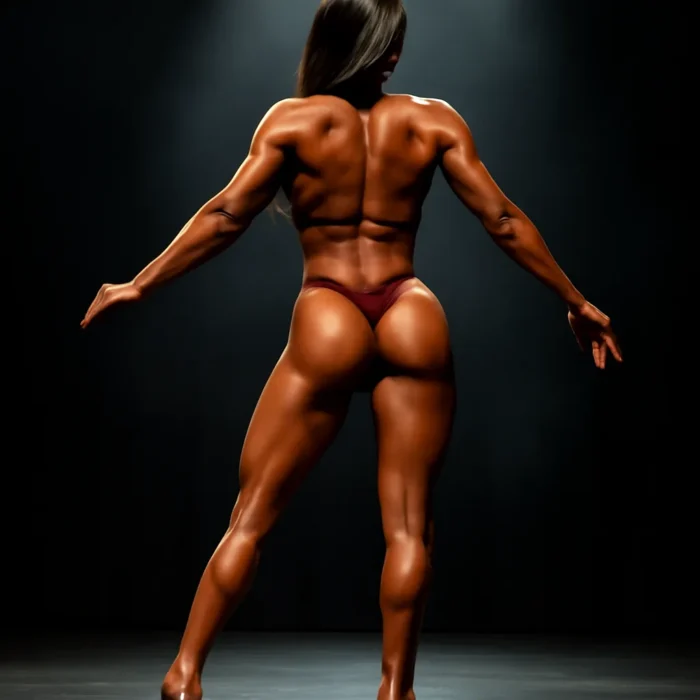
Judging begins with the overall impression. Judges assess the complete package from head to toe: hair, face, physical development, muscle shape, proportions, skin condition, posture, grace and confidence. It is about more than comparing muscles. On stage, every element needs to work together.
The physique is assessed for muscle tone. Muscles should be rounded and firm, with a low body fat percentage. However, the physique must not be too muscular or too thin. Physiques that are too thin or too muscular are noted. So what really matters? Balance.
Skin tone must be even, and the skin must look healthy and free of cellulite. The face, hair and makeup should complement the physique to create a cohesive overall look. Judging also considers the athlete’s showmanship while on stage.
Round II attire
- Competitors wear a one-piece swimsuit.
- The color, material and texture are left to the competitor’s discretion and sense of good taste.
- The swimsuit must cover at least half the buttocks and the entire front.
- High-heeled shoes must be worn during this round. Shoes must be black, in a classic style, with a closed heel and toe. The sole thickness must not exceed 6.35 mm, and the heel height must not exceed 127 mm. Platform shoes are strictly prohibited.
- Hair may be styled.
- A limited amount of jewelry is permitted.
- The head organizer has the authority to decide whether a competitor meets these requirements.
The procedures in round II are similar to those in round I. Competitors come on stage, are divided into groups and perform four quarter turns. Individual comparisons take place at center stage, with competitors positioned from right to left as requested by the judge.
- All competitors in the category are brought on stage together in numerical order and arranged in a single line.
- The lineup is divided into two equal groups.
- Groups of no more than five competitors are led to center stage in turn, in numerical order.
- The groupings and quarter turns help judges decide which competitors to call out for separate comparisons.
- Judges may submit individual requests to the stage marshal. At least three and no more than five comparisons must take place at the same time.
- Individual comparisons take place at center stage, with competitors positioned from right to left as requested by the judge.
- The stage marshal and head judge have the authority to modify or reject judges’ individual comparison requests if necessary.
- Each judge is entitled to at least one individual callout request.
- After the final comparison, all competitors form a single line again in numerical order and leave the stage.
For the round II results, each judge again ranks the competitors. The two best and two worst scores from the nine judges are discarded. The remaining scores are added together to calculate the round II subtotal. This is added to the round I subtotal to produce the prejudging total and final placing. All ties in the final prejudging placings are broken using the Relative Placement Method.
Round II is judged according to the same principles as round I, but judges must assess the swimsuit round with fresh eyes. They recognize that their overall impression may differ from the one formed in round I.
The finals and practical points
The top 15 competitors from the prejudging rounds advance to the finals. The finals consist of one round. Competitors wear two-piece bikinis, with the color, material and texture entirely of their choosing.
- Two-piece bikinis are worn in the finals.
- The color, material and texture are entirely the competitor’s choice.
- The bikini must cover at least half the buttocks and the entire front.
- High-heeled shoes must be worn during this round. Shoes must be black, in a classic style, with a closed heel and toe. The sole thickness must not exceed 6.35 mm, and the heel height must not exceed 127 mm. Platform shoes are strictly prohibited.
- Hair may be styled.
- A limited amount of jewelry may be worn.
- The head organizer has the authority to decide whether a competitor meets these requirements.
The finals procedure is brief and straightforward. The 15 finalists are called on stage in a single line, in numerical order. Each competitor’s number, name and country are then announced. All finalists perform four quarter turns and leave the stage.
- The 15 finalists are called on stage in a single line, in numerical order.
- Each competitor’s number, name and country are announced in numerical order.
- All finalists perform four quarter turns.
- The finalists leave the stage.
- The top 6 finalists are called back on stage in a single line, in numerical order.
- The 6 finalists perform four quarter turns simultaneously.
- The competitors leave the stage.
To calculate the finals results, each judge ranks the 6 finalists according to their own assessment. Each competitor must receive a different placing. The two highest and two lowest scores from the nine judges are discarded. The remaining points are added together to produce the finals subtotal, which is added to the preliminary rounds subtotal. This determines the final score and overall result.
The finals are judged in the same way as round I, but judges take a fresh perspective and do not allow opinions formed in previous rounds to influence them.
Competitors wear the same attire for the awards ceremony as they do for the final. The 6 finalists are called onto the stage in a single line, in numerical order. Awards are presented from 6th place to 1st. The Top 3 also receive IFBB gold, silver and bronze medals, respectively.
FAQ: Body Fitness competition rules
Does Body Fitness include a free routine?
No. These rules do not include an acrobatic free routine. Judging focuses on physique, athletic appearance, posture, style and confidence on stage.
How many competitors advance to the final?
The Top 15 finalists advance from the prejudging rounds to the final. Later, the Top 6 finalists are also called onto the stage to perform four quarter turns simultaneously.
What do the judges look for most?
The judges assess overall athletic physique, muscle tone, proportions, skin condition, posture, grace and how competitors present themselves on stage.
Translated by Mikk-Alvar Olle. Amateur Rules Body Fitness 2002
Author:
Source: WHO – physical activity.
Come and train! ArtGym