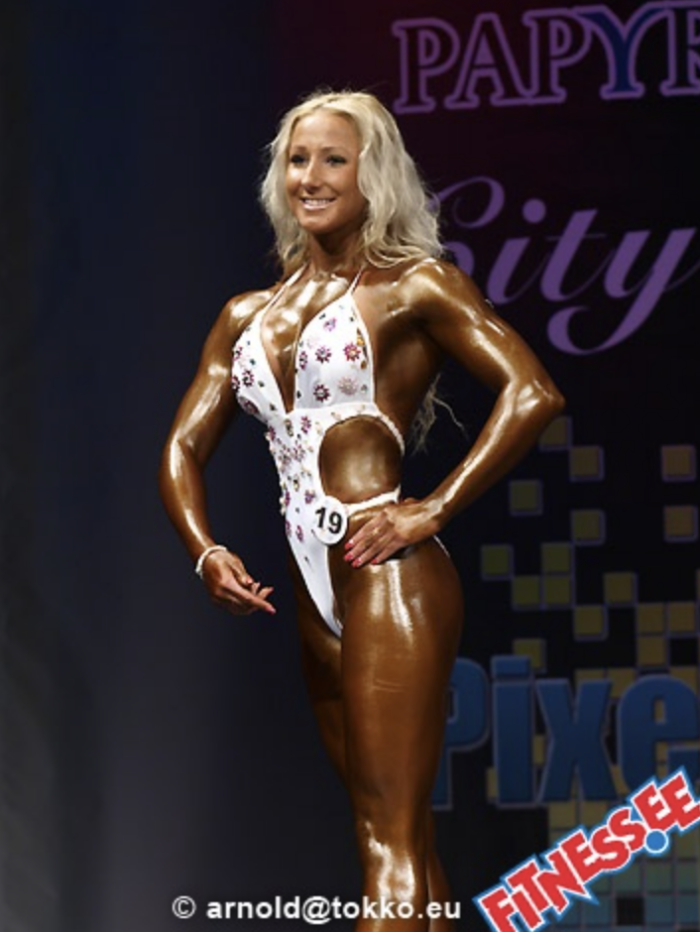
Kelli Gricevicius, last year’s overall Estonian bodyfitness champion, meets us at Coral Club on the afternoon of January 2. No lingering effects from the New Year celebrations—everyone, including Kelli’s coach Marek Morozov, is in good shape and raring to train;)
A warm-up on the rowing machine. Kelli always warms up. She asks how I warm up and for how long. I admit I don’t bother—I just get straight into it. This time, though, we do a proper warm-up first.
Back
Wide-grip lat pulldowns to the chest 4×10-12
We start with lighter weights and don’t go all out straight away. By the working sets, the weight is close to our limit, so the last reps take some serious effort. We keep a moderate pace and focus on the muscles working. Coach Marek helps out. The last set really makes us work. What a great workout, I think happily. Until the cable machine’s barbell attachment drops onto my neck as we change the weights. Nice… Still, I survive.
Close-grip lat pulldowns to the chest 4×10-12
The weights are close to our limit, and Marek helps us through the last reps again to maximize the training load. Once again, the pace is steady and moderate, with a focus on feeling the muscles work.
Standing cable rows to the waist 4×10-12
This exercise is completely new to me—during the first set, I feel as though I’m constantly losing my balance. Marek coaches me: bend lower and reach farther forward! Let your back STRETCH right out in front! Arch your back more! That’s it, now squeeze hard! I try. Done properly, it’s a very good, demanding exercise, despite the relatively light weight. Got it. I’ll definitely give it another go sometime.
Bent-over barbell rows to the waist 4×10-12
A substantial weight, and by now our backs are already tired. This takes effort. We grit our teeth and get it done.
Standing cable pullovers 4x 6-8+ 6-8+ 6-8
Marek shows no mercy and tells us to do more back work. He stresses that bodyfitness calls for a wide back, so we have to put it through its paces. Understood. He tells us to do a long drop set, reducing the weight as we go. By the last set, the weight is minimal and our backs are pumped.
Biceps
Standing barbell curls 4×10-12
A simple basic exercise, but it works. Enough for bodyfitness, where femininity counts for more than leanness and big muscles.
Seated cable curls 4×10-12
Another new and interesting exercise for me. At first, I can’t work out exactly where to position my elbows on my knees. Marek explains: put them where that hollow is. Found it? On top of your knee—look, right here. I can’t find it. I keep looking. I’ve found something. It does isolate the muscles better when the elbows are held as firmly in place as possible. The weight is enough to give the muscles a good pump by the end of the sets. This is my kind of workout!
Despite feeling pretty worn out by now, we run through a few poses afterward, and Marek also teaches us how to show our traps. Women should have this pose to show onstage, Marek muses…
Later, I also chat with Kerli about training.
Kelli: “I started with athletics, then took a break from training for a while. A few years ago, I took up inline skating. Around the same time, I took part in the lake running series and did a few ski marathons in winter. Until then, those sports had been my way of staying active in my free time.
I only got into bodyfitness and gym training in January 2007. A friend invited me along—she already knew her way around the gym.
In bodyfitness, as in bodybuilding, a naturally favorable skeletal structure—wide shoulders, a wide back and a narrow waist—gives you a good foundation for success. And, of course, you need a strong desire to pursue it.
Aktivist: “What are your off-season and competition weights? Height? Age?
Kelli: “I’m 165 cm tall and 22 years old. My off-season weight has been a maximum of 62 kg, and my body weight at competitions was 55 kg. It should be lower, of course. To succeed at championship level, you need to get your body fat % down to 8-10. Naturally, you also need muscle and good proportions.
Aktivist: “What does a typical day look like for you—waking up, meals, daytime activities (work, school, etc.), training…?
Kelli: “My daily routine depends on whether I’m preparing for a competition. If I’m not, I usually wake up at 7.00 and eat; most mornings I’m at school; I eat around 11.00; train at 13.00 and have a shake afterward; work from 15.00-23.00; eat at 17.30; and eat at 21.00. When dieting, I also fit in two workouts a day whenever possible—cardio and a gym workout.
Strength training
Aktivist: “How is your strength training structured? Do you divide your training into cycles—for size, definition, etc.?
Kelli: “I don’t use separate training cycles. I try to keep increasing or maintaining the weights I lift in every exercise. The main emphasis is on basic exercises with free weights—a barbell and dumbbells. Machines mainly supplement these and add variety. I also keep changing the order of the exercises. Since I train at the gym 6 times a week, my muscle group split is designed to allow as much recovery time as possible: legs always have their own days, and upper-body pushing and pulling movements are also on separate days.
Aktivist: “How many times a week do you train at the gym?
Kelli: “I train at the gym 6 times a week. My split looks like this, with the main emphasis on back, shoulders and legs:
Sunday: back (lighter), biceps, abs (rectus abdominis)
Monday: quads (lighter), hamstrings (heavy), calves, glutes
Tuesday: chest, shoulders (lighter), abs (rectus abdominis)
Wednesday: back (heavy), forearms, abs (transverse abdominis)
Thursday: quads (heavy), hamstrings (lighter), calves, glutes
Friday: shoulders (heavy), triceps, abs (rectus abdominis)
Saturday: rest
Aktivist: “What about cardio?
Kelli: “I usually do cardio 2x a week for around 45-60 minutes—running, incline walking, the stepper, cycling or the wave, a hot new machine in Estonia that mimics skating.
Aktivist: “How does the amount of cardio change before a competition?
The amount of cardio definitely increases before a competition. It all depends on whether I’m on schedule.
Aktivist: “How do you unwind after training?
Kelli: “I try to get massages, but unfortunately I rarely manage it, simply because I don’t have enough time. A sauna makes a nice change, too.
Aktivist: “How often do you practice posing?
Kelli: “A few times a week. Every day before competitions. Unfortunately, no matter how much you practice, you still forget exactly how to hold your body on stage. You learn with every competition.
Nutrition
Aktivist: “What nutrition principles do you follow?
Kelli: “I eat at least 4 times a day. When dieting, I eat when I get hungry, rather than at set times (except after a workout, of course). I always have a recovery drink after a workout. Every meal contains enough protein. I also take oil as a daily supplement. I drink water and a fat burner drink. I don’t drink coffee at all.
Aktivist: “Your favorite food and drink?
Kelli: “Fish.
Aktivist: “Do you have refeed days, and how do you approach them? What do you eat?
Kelli: “I don’t plan them, but there may be days during the week when I eat a little more than usual.
Aktivist: “How do you change your diet when preparing for competitions? How long is your preparation period?
Kelli: “My preparation period is about 3 months, during which I reduce the proportion of carbohydrates in my diet. I get to know my body better every year, so I’m sure I’ll have a better understanding of the right approach in the future.
Aktivist: “What supplements do you take?
Kelli: “I generally use Fast HTR, and other minerals and vitamins before competitions if needed. Of course, I try to eat as varied a diet as possible to get everything I need from food.
Appearance
Aktivist: “Appearance is certainly especially important for a female competitor. How do you look after yours?
Kelli: “I look after myself like any other woman. I might use a tanning bed a little more often before competitions. I’m also a nail technician as a hobby.
Aktivist: “What do you prefer to wear day to day?
Kelli: “I don’t follow fashion trends; I try to look for quality when buying clothes. I like wearing jeans day to day.
Aktivist: “Jewelry?
Kelli: “The usual things women wear: rings, earrings, necklaces, etc. J I don’t have any tattoos.
Aktivist: “How do you choose your stage jewelry, and what should you keep in mind?
Kelli: “I like anything with stones, which makes choosing stage jewelry very difficult. But generally, the more it sparkles, the better—it catches the eye more J
Aktivist: “How do you plan your stage hairstyle, makeup, bikini and costume so they all work together? Do you come up with everything yourself? Who does your makeup, hair and so on before you go on stage?
Please share some tips for our female readers on what to keep in mind about their stage appearance (makeup, hair, colors, etc.). What definitely doesn’t work? What looks good on stage?
Kelli: “I do my own stage hair and makeup. I can’t say yet what I’ll do for the next competition. Your makeup and stage outfits should complement each other. Your hairstyle shouldn’t look too everyday, but it shouldn’t be too formal either. The same goes for makeup: if it’s too heavy and striking, it no longer looks good. When choosing the color of your competition outfit, perhaps the thing to consider is whether the fabric’s color suits you. I had my most recent competition outfits made and chose the design from a magazine. I came up with the arrangement of the stones on the bikini and one-piece myself, and attached them to the fabric myself too. It was quite time-consuming.
That’s all for now. We look forward to more sporting success from Kerli!
Come train with us! ArtGym