Alfa rowing competition: Endrekson wins
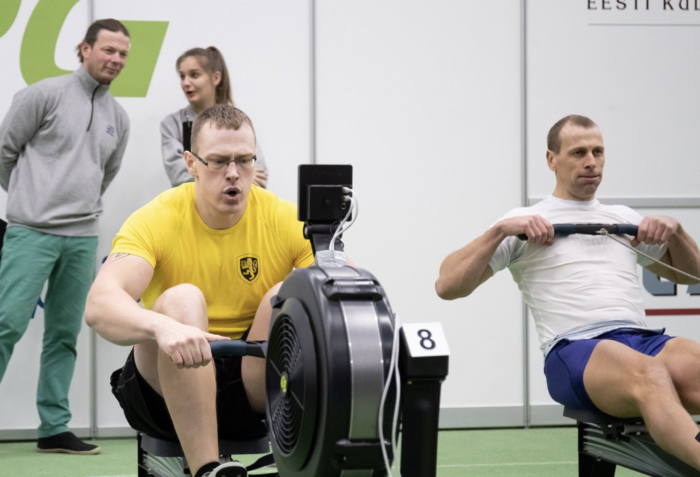
Indoor rowing delivered in the men’s final exactly what indoor rowing promises: a short distance, a painful pace and a result decided in the first few strokes. Tõnu Endrekson defended first place with a time of 2:45.1 and kept the chasing pack firmly behind.
Why does the Alfa rowing competition matter?
Indoor rowing is not your ordinary weekend sports day. In Estonia, this is one of the best-known indoor rowing showdowns, where the minutes spent on a single ergometer say quite a lot about an athlete’s strength, endurance and nerve.
1000 meters looks short on paper. In reality, it is a brutal distance. You have to dare to go out fast, you can’t fall apart in the middle, and at the end you still need to find a couple more strokes while your legs and arms are already burning. That is exactly why Alfa is always a good place to see who has really put in the work over the winter.
Tõnu Endrekson’s win also carried emotional weight. Jüri Jaanson took part in the veterans’ class, paying tribute to Endrekson on the occasion of the final year of a rowing career. For Estonian rowing, these names mean a great deal; they are not just lines in a results sheet.
How did Endrekson win the final?
After the race, Endrekson admitted honestly to taking a risk and going flat out from the very start. On an ergometer, that is not a small decision. If the pace is too wild early on, you pay for it at the end. This time, the plan held.
“To my surprise, the others didn’t catch up at the end,” said the Pärnu native. The finishing time of 2:45.1 proved too tough a mark for the competition.
Behind Endrekson, a very rare battle played out. Allar Raja, Belarusian rowing legend Pavel Šurmei and strong amateur indoor rower Rainar Piik all finished with exactly the same time: 2:46.5. That meant that, for the first time in the competition’s 27-year history, three second places were awarded.
A result like this says a lot about the level of the final. The gap between the winner and the next finishers was narrow, but in a 1000-meter race, 1.4 seconds is already a clear gap. There is no room for a long tactical game here. Every stroke counts.
Alfa rowing competition and the new records
The day did not rest on the men’s final alone. Two new Alfa records were also set, showing that the next generation and the various competition classes were in strong form.
Among young men up to 19 years old, Leo Muiste from Viljandi took the win. Muiste covered 1000 meters in 2:48.6, a full second better than the previous record set by Alvar Räägel in 2004. Here is a rather telling detail: with the same time, Muiste would have finished sixth in the men’s final.
In the men’s lightweight class, Viljandi’s Kermo Randmäe improved a previous Alfa record that was already Randmäe’s own. The new best was 2:58.6. In a lightweight race, a time like that is a sign of excellent rhythm and the ability to keep every stroke clean to the end.
Among women, Grete Alttoa was the fastest with a time of 3:18.2. Liisu Mitt and Kadri Vilbaste finished behind. The names may sit in a short row in the results sheet, but each of those races means the same thing: a few minutes of total effort in which you can’t let your focus slip even once.
What should you look at in indoor rowing results?
If you are looking at indoor rowing results for the first time, don’t fixate only on the winning time. Look at the age class, the body weight class and the distance as well. 1000 meters and 2000 meters are very different challenges. One is sharp and painful, while the other demands more patience and a better sense of pace.
The Alfa rowing competition is held over 1000 meters. That favors an athlete who can start strong but doesn’t panic when the oxygen debt arrives quickly. A simple truth: the ergometer gives you nothing for free.
For recreational athletes, too, a competition like this is a good yardstick. It doesn’t replace a training plan, but it shows whether your strength and endurance are moving in the right direction.
The next major test on the calendar was the Estonian indoor rowing championships in Narva, where the race was already over 2000 meters. That is a different game: the pacing has to be smarter, because an overly bold start can stretch the last 500 meters out very long.
FAQ: Alfa rowing competition
What distance is the Alfa rowing competition?
The Alfa rowing competition is held over 1000 meters. It is a short but very intense race, where both a strong start and the ability to hold on until the end matter.
Who won the men’s final?
Tõnu Endrekson won the men’s final with a time of 2:45.1. Second place was shared by Allar Raja, Pavel Šurmei and Rainar Piik, who all finished with a time of 2:46.5.
Why was this competition special?
The day was made special by Endrekson defending first place, three second places with exactly the same time and two new Alfa records. In addition, Jüri Jaanson took part in the veterans’ class.
Author:Turg.Fitness.ee
Come and train! ArtGym