
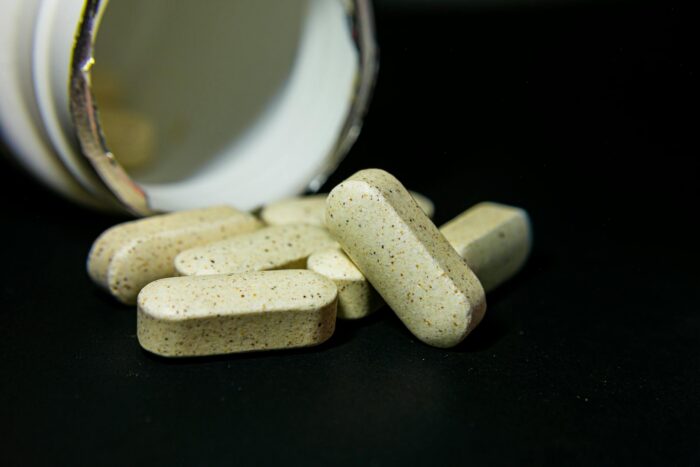
BCAA is short for branched-chain amino acids – valine, leucine and isoleucine. Nutrition books often mention them only in passing, even though they give muscle tissue the most direct protein synthesis signal. Below I’ve pulled together what research has shown about BCAAs and how to put it to use in training.
Why BCAAs carry so much weight in muscle tissue
These are essential amino acids, which the body can’t produce itself. You can always get them from complete protein: about 25% of whey protein is BCAAs. The point of a separate BCAA supplement isn’t to replace ordinary food, but to deliver a concentrated dose around training, when muscle tissue is at its most receptive.
Hard training speeds up amino acid oxidation, slows protein synthesis and sets off catabolism in muscle tissue. For synthesis to restart, leucine levels in the muscle have to rise (Norton, Layman 2006). Leucine does two jobs at once: it signals the start of protein synthesis and is also a building block (Rennie et al. 2006). Yoshizawa (2004) showed that valine, isoleucine and above all leucine influence synthesis even when the other amino acids aren’t present.
Leucine also preserves muscle mass at rest. Alvestrand et al. (1990) found that of the leucine taken up by muscle tissue, 40% went into the free amino acid pool, 20% was synthesized into proteins and 40% was used for energy. This metabolic flexibility explains why leucine works both as an anabolic signal and as a fuel.
BCAAs and the hormonal background
By the end of hard training, an athlete’s testosterone level tends to drop, even when protein intake is generous. Kraemer (1988) showed that a body supplied with BCAAs maintains a more favorable testosterone-to-cortisol ratio, and the training effect is amplified. Carli, Bonifazi, Lodi et al. (1992) confirmed that taking branched-chain amino acids before training prevents the testosterone drop.
BCAAs and body fat: wrestlers and the Andes trek
BCAAs have an interesting side effect – they favor fat loss specifically around the waist. In a study by Mourier et al. (1997), wrestlers on a diet to reduce body weight lost significantly more abdominal fat tissue than the control group.
The effect is even clearer in the oxygen deprivation of high altitude. On a 21-day trek through the Peruvian Andes, all 16 participants lost body weight. The control group lost 1.8 kg, of which 90% was fat tissue and 10% muscle mass. The BCAA group, who took 7.2 g of leucine, 3.6 g of valine and 3.6 g of isoleucine split across three servings a day, lost 1.07 kg, gained 0.71 kg of muscle mass over the same period and burned 1.78 kg of fat tissue (Shena, Guerrini, Tregnaghi et al. 1992). The authors’ summary was blunt: the control group catabolized muscle, while the BCAA group built it.
What more recent studies add on BCAAs
Shimomura, Yamamoto et al. (2006) found that taking BCAAs before barbell squats reduces post-workout exhaustion and later muscle soreness. Blomstrand et al. (2006) showed that BCAAs activate the enzymes responsible for protein synthesis and reduce protein breakdown in both endurance and strength training. The same author (Blomstrand 2006) describes the role of BCAAs in reducing central fatigue in endurance sports. Ohtani et al. (2006) add that, combined with glutamine and arginine, the mixture speeds up recovery and amplifies the training effect.
In people with diabetes, BCAA levels in the heart and skeletal muscle improve the supply of all amino acids for protein synthesis and reduce protein catabolism (May, Buse 1989). In older adults, muscle protein metabolism likewise prefers branched-chain amino acids; Fujita and Volpi (2006) consider long-term leucine supplementation justified to counter the loss of muscle mass.
How to use BCAAs in practice
My own takeaway from years of reading and observing: BCAAs are potent enough that, for certain periods – for example, during a fat-loss phase – you can limit yourself to them alone around training. A practical scheme is 10 g before and 10 g after a hard workout (or 5+5 g of pure L-leucine) with water. If needed, this replaces the entire intra-workout nutrition mix. Half an hour later comes a protein and carbohydrate recovery drink or ordinary solid food – whatever suits you.
Find the most important BCAA of all HERE.
FAQ: frequently asked questions about BCAAs
Do I need BCAAs if I already eat plenty of protein?
Alongside your daily protein, BCAAs aren’t essential – about 25% of whey protein is already BCAAs. Around training, though, a separate dose gives a faster leucine spike than whole protein, which is useful in the cutting phase and for early-morning fasted workouts.
When should I take BCAAs?
Right before and right after training. The studies described here used doses of 10 g before and 10 g after. At high altitude or during weight loss, the daily dose was split into three servings.
Do BCAAs help burn fat?
Not directly, but during a calorie deficit, BCAA helps preserve muscle mass and steers weight loss more toward body fat. The data from the wrestlers and the Andes trek point to exactly this pattern.
Sources
Norton LE, Layman DK. Leucine regulates translation initiation of protein synthesis in skeletal muscle after exercise. The Journal of Nutrition 2006; 136: 533S–537S.
Rennie MJ, Bohe J, Smith K, Wackerhage H, Greenhaff P. Branched-chain amino acids as fuels and anabolic signals in human muscle. The Journal of Nutrition 2006; 136: 264S–268S.
Yoshizawa F. Regulation of protein synthesis by branched-chain amino acids in vivo. Biochemical and Biophysical Research Communications 2004; 313(2): 417–22.
Alvestrand A, Hagenfeldt L, Merli M, Oureshi A, Eriksson LS. Influence of leucine infusion on intracellular amino acids in humans. European Journal of Clinical Investigation 1990; 20(3): 293–8.
Kraemer WJ. Endocrine response to resistance exercise. Medicine and Science in Sports and Exercise 1988; 20: S152–S157.
Carli G, Bonifazi M, Lodi L, et al. Changes in the exercise-induced hormone response to branched chain amino acid administration. European Journal of Applied Physiology 1992; 64: 272–277.
Mourier A, et al. Combined effects of calorie restriction and branched-chain amino acid supplementation on body composition and exercise performance in elite wrestlers. International Journal of Sports Medicine 1997; 18.1: 47–55.
Shena F, Guerrini F, Tregnaghi P, et al. Branched-chain amino acid supplementation during trekking at high altitude. European Journal of Applied Physiology 1992; 65: 394–398.
May ME, Buse MG. Effects of branched chain amino acids on protein turnover. Diabetes/Metabolism Reviews 1989; 5(3): 227–245.
Shimomura Y, Yamamoto Y, et al. Nutraceutical effects of branched-chain amino acids on skeletal muscle. The Journal of Nutrition 2006; 136: 529S–532S.
Blomstrand E, Eliasson J, Karlsson HK, Kohnke R. Branched-chain amino acids activate key enzymes in protein synthesis after physical exercise. The Journal of Nutrition 2006; 136: 269S–273S.
Blomstrand E. A role for branched-chain amino acids in reducing central fatigue. The Journal of Nutrition 2006; 136: 544S–547S.
Ohtani M, Sugita M, Maruyama K. Amino acid mixture improves training efficiency in athletes. The Journal of Nutrition 2006; 136: 538S–543S.
Fujita S, Volpi E. Amino acids and muscle loss with aging. The Journal of Nutrition 2006; 136: 277S–280S.
Source: BCAA
Come and work out! ArtGym




