Bikini fitness and the lessons of the 2014 Estonian Cup
Bikini fitness was one of the few divisions at the 30th Estonian Cup where the hall felt a truly competitive tension. Indrek Otsus’s commentary leaves a simple truth ringing: in some divisions the talent pool was thin, but the work seen on stage deserved honest attention.
Bikini fitness saved the competition’s tension
Indrek Otsus opened with a sharp observation: leave bikini fitness out, and the number of participants had shrunk to a critical level. The same concern had already come up after the 2012 Estonian Championships. A year and a half later, the picture was not much brighter.
The lack of competition showed in almost every division. If just three or four of the best athletes stayed away, a division immediately looked sparse. This is not a problem of one competition alone. It shows how narrow the base of Estonian bodybuilding and fitness is.
Only 4 athletes competed in athletic fitness: 1 youth, 1 junior and 2 men. According to Otsus, that was a pity, because the division is a serious one and the new rules made the competition faster and more spectacular. Otsus’s thanks went to Kristjan Singh, Kristjan Pals, Ants Varblane and Allan Nikopensius. They showed up and gave it everything.
As a side note: since it was easier to move 4 athletes than the equipment, the strength portion was held at Reval Sport, around the corner, so to speak. The athletes showed their physiques in the evening in front of a larger audience. It wasn’t ideal, but it worked.
What bikini fitness showed that evening
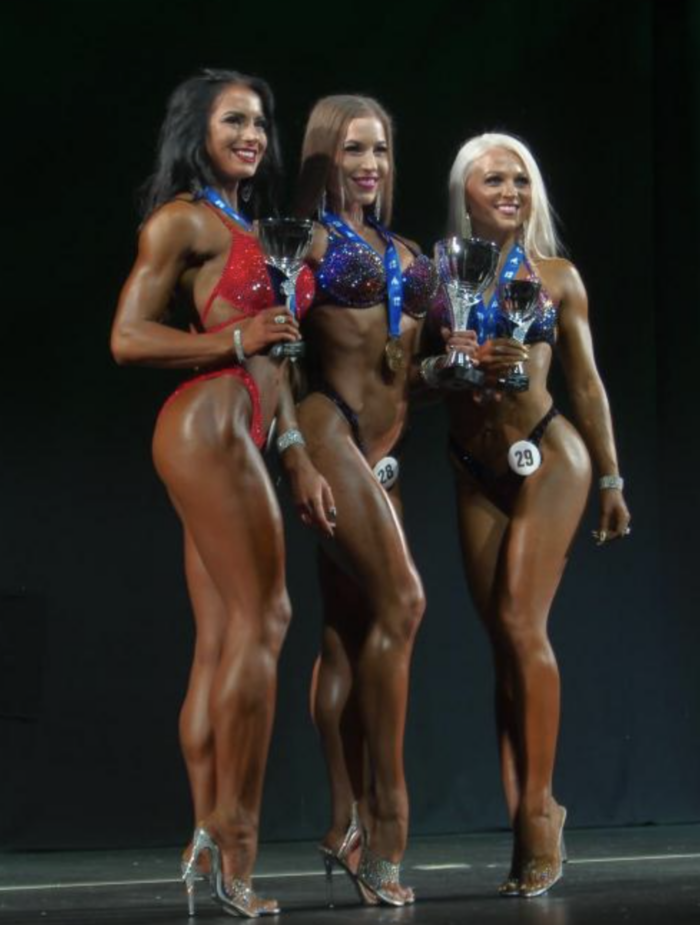
On bikini fitness, Otsus was surprisingly complimentary. The average level, Otsus said, had clearly risen. This time there were no competitors on stage of whom you could think they had yet to find the door to the gym.
23 competitors were split between 4 categories. That meant bikini fitness as a whole was one of the few places where you could sense real competition. The winners were Heddi Priivits among the juniors, Kristina Aleksejeva in the -163 cm category, Ellen Parik in the -169 cm category and Reet Reimets in the +169 cm category.
Otsus added that junior Anastasia Dvorkina, who lost narrowly, caught many people’s eye as a hope for the future. The overall win went to Reet Reimets. Her improved muscle development, proportions and sensible condition made the result easy to understand.
Honestly, there is an uncomfortable point here too. In Otsus’s assessment, bikini fitness is essentially a beauty contest, where innate predispositions play a big role: body proportions, metabolic type and facial looks count for a lot. That doesn’t diminish the work, but it explains why judging the division sparks arguments.
The other divisions and the athletes’ condition
Beach fitness, which made its Estonian debut a year earlier, had an unexpectedly low turnout this time: 3 juniors and 2 men. The division is still looking for its place, both in Estonia and worldwide. Otsus’s question was an apt one: how do you judge a classic bodybuilding world champion in board shorts? Time will tell.
In the case of junior winner Nikita Dvorkin, Otsus saw a bigger future in fitness. Men’s winner Holger Maiväli could, in Otsus’s view, bolster Estonia’s thin ranks of bodybuilders, since muscle mass and good lines give the chance to do so.
In fitness, Endla Vaher and Johanna Lond were still of junior age. Endla Vaher was the best, as expected, especially in the free routine, which was new and interesting. Johanna Lond carried on the division’s good traditions. There were role models, and room to grow as well.
Esta Pilt was the only competitor in women’s physique. Otsus felt that, next to athletic fitness, it suits Esta well. Otsus had not seen Esta in such good shape for a long time: the balance of muscle mass and dryness was just right. Otsus also raised the question of whether women’s physique could carry on under the name women’s bodybuilding in Estonian.
Bodyfitness had 1 junior and 4 women on stage. At the international level, bodyfitness competitors had become more muscular year after year. If this direction continues, Estonian athletes may find it hard going internationally. At the same time, Otsus said outright that Darola Kruusik’s frame is world-class.
In bodybuilding the field was small, but not empty. Janar Rückenberg won the overall and showed top-level condition. Muscle mass, dryness and vascularity reflected a successful preparation. Opinions on the free routine differed: some liked it, while others thought that for such a style you would need to weigh 20 kg more.
Raigo Kuusnõmm, overall 2nd place, stood out for good proportions and compactness, but there was room to improve in dryness. Rain Kuusnõmm faced strong competition in the overall category from junior winner Rainer Palm. Siim Kelner, junior 2nd place, was missing mostly the last bit of polish in condition. Kristjan-Johannes Konsap deserved praise: the longer break from competing had not been wasted time.
Bikini fitness and the wider lesson for the Estonian scene
So what actually happened? The 30th Estonian Cup, held in Tallinn on April 26, showed two things at once. On one hand, bikini fitness had brought a number of new names to the stage and clear competition. On the other, several traditional divisions were too sparse.
Janar Rückenberg and Reet Reimets were crowned the best. The results reference in the original story was given as EKV 2014, news item 5835. Today it is worth viewing mainly as a historical moment: an era in Estonian fitness when new disciplines rose quickly, while the established ones had to worry about having a broad enough base.
FAQ
Why was bikini fitness so important at this competition?
Because bikini fitness alone brought 23 competitors and 4 categories to the stage. That gave the competition a tension that several other disciplines lacked.
Did Indrek Otsus praise only the winners?
No. Otsus also singled out athletes who didn’t win but showed progress or promise for the future. For example, Anastasia Dvorkina, Rainer Palm and Kristjan-Johannes Konsap clearly received positive attention.
What was the main message of the whole commentary?
The main message was that Estonian fitness and bodybuilding needed a broader base. When a couple of the stronger athletes stayed away from a discipline, serious competition disappeared right along with them.
Author: Indrek Otsus
Source:Turg.Fitness.ee
Come and train! ArtGym