Body fat measurement: methods and errors
Measuring your body fat percentage is useful when you want to track changes beyond the number on the scale. None of the commonly used methods measures body composition directly, but used correctly, they provide useful information about how your physique is changing.
Why does measuring body fat percentage matter?
Your weight may drop, but that alone does not tell you whether you have lost fat, water or muscle mass. Body composition assessments usually divide the body into fat mass and fat-free mass. More detailed models also distinguish bone tissue mass, with further distinctions between protein and water mass.
The simple truth is that the more components you want to assess separately, the more complex the measurement becomes. A four-component model is more accurate in theory, but it requires more than one simple device. In practice, this means preference is given to methods that can be repeated and compared with the same person’s previous results.
It is also important to remember that different methods may not give exactly the same number. If one device shows 12% and another shows 14%, that does not automatically mean one of them is wrong. Often, the trend matters more: whether your body fat percentage is going down, going up or staying the same.
How is body fat percentage measured?
Underwater weighing and skinfold measurements
Underwater weighing compares your body weight in water with your body weight on land. These measurements are used to calculate body density and, from that, an estimated body fat percentage. The method assumes that fat mass and fat-free mass have fixed densities.
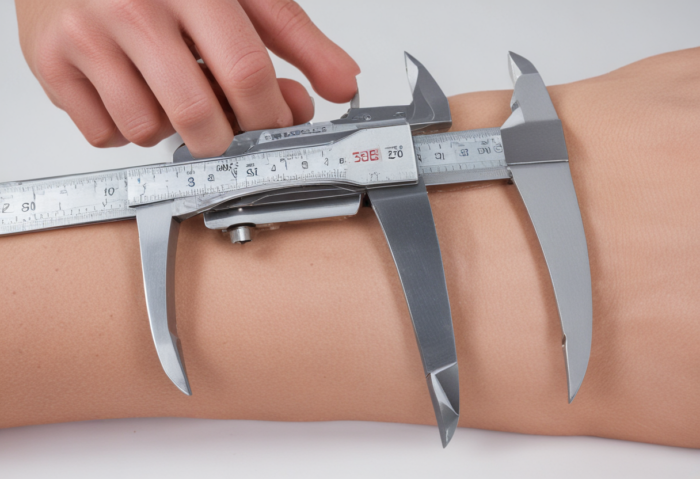
Skinfold thickness measurement developed historically from this approach. In the four-site method, for example, skinfold thicknesses are added together and equations are used to estimate body fat percentage. If the number of measurement sites changes, the equations must change too.
The strength of this method is its simplicity. Its drawback is the influence of the person taking the measurements. The same person should measure the same sites in the same way; otherwise, the result may fluctuate even when the body has not actually changed.
DXA and BIA
Dual-energy X-ray absorptiometry, or DXA, helps determine bone density, but it can also assess body composition. A DXA scanner passes X-rays at two different energy levels through the body and uses the results to calculate lean soft tissue mass, bone tissue mass and fat mass.
BIA, or bioelectrical impedance analysis, measures the body’s electrical resistance. Some devices measure current through the feet, others through the hands, while longer devices assess a greater proportion of the body. Electrical conductivity depends largely on the body’s water content. If the device assumes that lean soft tissue mass is 73.2% water, it can use this to calculate an estimate of body composition.
What did 21 weeks of measurements in a bodybuilder show?
The original study aimed to examine how changes in body composition affect bone mineral content and to test an ultrasound technique for assessing soft tissue. The study involved the Biophysics of Bone and Cartilage research group at the Institute of Physics at the University of Kuopio in Finland, the Bone and Cartilage research unit and Kuopio University Hospital (http://www.kuh.fi/).
The participant was a man aged 27 years, with a height of 172 cm and a starting weight of 92 kg. He followed a nutrition plan designed by Jerry Ossi for 21 weeks, with the aim of reducing fat mass and maintaining muscle mass. His weight was monitored every week in the morning using digital scales.
Body fat percentage was measured every three weeks using DXA (Lunar Prodigy, GE Medical, Wessling, Germany), BIA (InBody 3.0, Biospace, Seoul, Korea) and skinfold thickness measurements at four sites. The participant avoided eating and drinking for two hours before measurements, and the same person took the measurements throughout the study.
Over 21 weeks, body weight fell from 91.6 kg to 75.1 kg (r2 = 0.99, n = 22). All methods showed a linear decrease in body fat percentage, but BIA and skinfold measurements overestimated body fat percentage at the end of the study. According to DXA, body fat percentage decreased from 21.5 % to 4.7 %.
Fat mass decreased from 20.0 kg to 3.7 kg (r2 = 0.99, n = 9). Fat mass fell by 780 g per week, while fat-free mass increased by 90 g per week. Initially, the abdominal region had the highest fat percentage at 27.4 %, but by the end it had the lowest at 4.0 %. All methods gave similar results when body fat percentage was around 17.
Practical tips: measuring body fat without the panic
If you use BIA scales or a handheld device, always take measurements under conditions that are as similar as possible. Morning measurements, consistent fluid intake and the same routine provide a better basis for comparison than a random measurement after a workout or a large meal.
Repeatability matters most when measuring skinfolds. Use the same person, the same sites and a steady, unhurried technique. A small difference between DXA and skinfold results is normal because fat distribution varies from person to person.
Machines are useful tools, but poor coaches. At a bodybuilding competition, judges award points based on the physique they can see, rather than a measurement report. Alongside the numbers, it is therefore worth considering your reflection, photos and your coach’s assessment.
FAQ: measuring body fat percentage
Which method is the most accurate?
DXA is one of the most accurate options for the general user, but it is not the most convenient for day-to-day monitoring. BIA and skinfold measurements work well for tracking changes when measurement conditions stay the same.
Why do BIA results fluctuate?
BIA depends on the body’s water content. Fluids, food, training and even the time of day can affect the result. That is why it is important to take measurements at a similar time and with similar preparation.
Is body fat percentage more important than your reflection?
No. Body fat percentage helps you track progress, but proportions, muscle mass, posture and overall appearance also matter when assessing your physique.
Translated from Body magazine, Author: Ossi Riekkinen
Author: Ossi Riekkinen; Greta (translation)- BODY lehti
Come and work out! ArtGym