
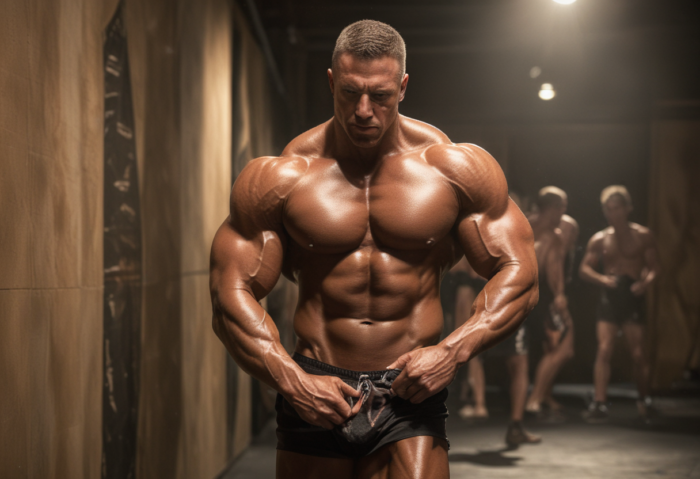
Bodybuilding competition backstage: the tension before the stage
The prelude in bodybuilding begins long before the judges call you onto the stage. From the audience’s seat everything looks polished and glossy, but backstage a different contest is under way: the stares, the comparing, the doubts and the pressure spinning in your own head.
I’m not going to rewrite the organizational side of Imre’s competitions, the European Championships and Maastricht 2010 all over again. What interests me is the other side of the coin. What happens before the final result, before the stage makeup, before the posing and before the moment the audience sees big, dry, muscular bodies.
Why the prelude matters in bodybuilding
A competition doesn’t actually start on stage. It starts when the different national teams and competitors see each other for the first time. In the corridor, at the weigh-in, in the hotel, backstage. Everyone looks at everyone. Not maliciously, at least not always, but competitively. Who is bigger? Who is drier? Who looks more powerful in clothes? Who already seems ready?
Honestly, the atmosphere is pretty heavy. You can feel yourself being judged even when nobody says anything. Some people peek out of the corner of their eye. Some stare openly. And if you’re in the same sport yourself, you inevitably do it back. How else would you even notice that everyone is staring?
From the outside it can even look comical. The teams arrive in big baggy clothes, shoulders wide, walking with confidence. A trained body looks even bigger. And then for a moment a thought creeps in: what did I come here for? It’s a very human thought, even if it’s not usually said out loud.
That’s why the psychological side is worth talking about. Bodybuilding is often looked at only through physique, but a person lives inside that physique. They have nerves, doubts, an ego, fatigue and a wish not to let anyone down. Competing isn’t just diet, training and posing. It’s also the ability to withstand a gaze that seems to be measuring you all the time.
How the prelude plays out backstage
The men’s weigh-in is one of the most vivid moments of this prelude. You have to take your clothes off, and suddenly everything is much more honest. A baggy hoodie no longer helps. The dryness, the veins and the fullness of the muscle are all visible, and so is whatever is still missing. I can’t speak for others, but I think even very good competitors have the same thought run through their heads: damn, everyone is so big and so sharp.
I don’t consider myself a veteran of big international contests. That’s exactly why I hope the fearful thoughts get quieter with experience. Ott could probably put it better: does it get easier with every competition, or do the others still seem bigger and better every time? Probably nobody is completely free of tension. That just wouldn’t be logical.
Looking back, once the first emotion has passed, one thing seems clear. The more you can rise above this play-acting, the more energy you save. Everything is decided on stage in the end. Not in the hotel corridor. Not at the weigh-in. Not in that moment when someone looks twice as powerful in clothes.
In Holland it seemed to me that we, the Estonian men, were visually among the smaller ones backstage. Certainly more modest in clothes. Maybe I was already too tense in the situation myself to judge it properly, but that was the feeling. The result spoke a different language, though: three men in the final and me in seventh. Some men who looked especially big, dry and powerful at the weigh-in ended up behind our men in the end.
Here is a simple truth: the stage changes the picture. The lighting, the posing, the proportions, the confidence and how the physique actually comes in count for more than the first impression by the washroom door. A man who is invisible at the weigh-in can be the one you can no longer ignore on stage the next day.
Practical thoughts for the competitor
What happens backstage doesn’t stay at the venue. The same gaze follows a bodybuilder into everyday life. Friends, acquaintances and training partners notice everything. How big are their arms? Is there fat on the stomach? Are they still as dry as in the photos? At first this kind of attention can even feel nice. There’s no point pretending it didn’t draw many of us to the sport.
But at some point a voluntary hobby turns into something like an obligation. Appearance becomes a business card. Once you have been in peak shape on stage, under good lighting, made up and with your muscles pumped full, that is the picture some people hold on to. When they later see you in ordinary life, they may be disappointed. You’re not that big every day. The muscle doesn’t show as much under a jacket. The stomach isn’t contest-dry all the time.
So what actually happens? A person compares you with your best moment. And you compare yourself too. It’s exhausting. You may say other people’s opinions don’t interest you, but in real life that’s not always so easy. Especially when you meet someone who hasn’t seen you for a long time and sizes you up from head to toe.
The pre-contest period at home can be just as tense. The closer the competition gets, the more the mirror starts to run your life. In the morning you check your shape. At lunchtime you check again. Before training, during training and after training too. Are the veins showing? Is the dryness improving? Is there one more line visible on the leg or the triceps? Is the diet already eating muscle? Is there still more to lose from the stomach?
The last four to six weeks before a competition can become nerve-racking and frustrating. It is nonstop worrying, 24 h a day, about your form and how you look. From the outside it may seem strange, but for the competitor it is very real. At some point you don’t even want to step in front of the mirror, because every glance raises a new question.
What has helped me is the thought that you don’t have to win everything backstage. You don’t have to make yourself look bigger at every glance. You don’t have to prove in every room that you are thick, dry or intimidating enough. Your form shows on stage if it is there. If it isn’t, even the widest hoodie won’t save you.
That doesn’t mean the tension disappears. Bodybuilding is a sport where the body is both the tool and the thing being judged. You have to accept that. But the sooner a competitor realizes that other people’s glances are not the judges’ final verdict, the more energy you have left to actually compete.
The prelude and the mental side of bodybuilding
The point of this story is not to scare anyone. Rather, I want to show what goes on in the heads of the athletes the audience watches from the hall. On stage is the final result. Backstage are fatigue, waiting, comparing, quiet insecurity and sometimes genuine fear. All of it comes with the sport, but it is talked about less than training or diet.
When a person chooses this kind of lifestyle, they have to accept the side effects as well. Being under the spotlight is sometimes inspiring, sometimes exhausting. Some days attention gives you strength. On other days you would just like to be an ordinary person whose stomach, arms and legs nobody is making notes about in their head.
And yet we do it again. We train, prepare for competitions once more and compete. Probably precisely because, alongside all the tension, there is something in this sport that pulls you back. The moment on stage, when everything that came before comes together, sometimes outweighs the whole difficult prelude.
FAQ
Does the prelude here mean the same as contest preparation?
Not quite. Preparation is training, diet, rest and timing your form. Here, the prelude refers more to the psychological side: looking, comparing, inner tension and the feeling that arises before you step on stage.
Is comparing yourself backstage normal?
Yes, it’s very common. The question is rather how much you let it eat up your energy. Seeing the others is unavoidable, but the competition is decided on stage, not in the corridor.
How can a competitor reduce mental tension?
Routine helps: a set plan, a calm warm-up, trust in your preparation and a conscious step away from constant comparing. You can’t control everything, but you can direct your attention.
Author: Janar Rückenberg
Source:Turg.Fitness.ee
Come and train! ArtGym




