
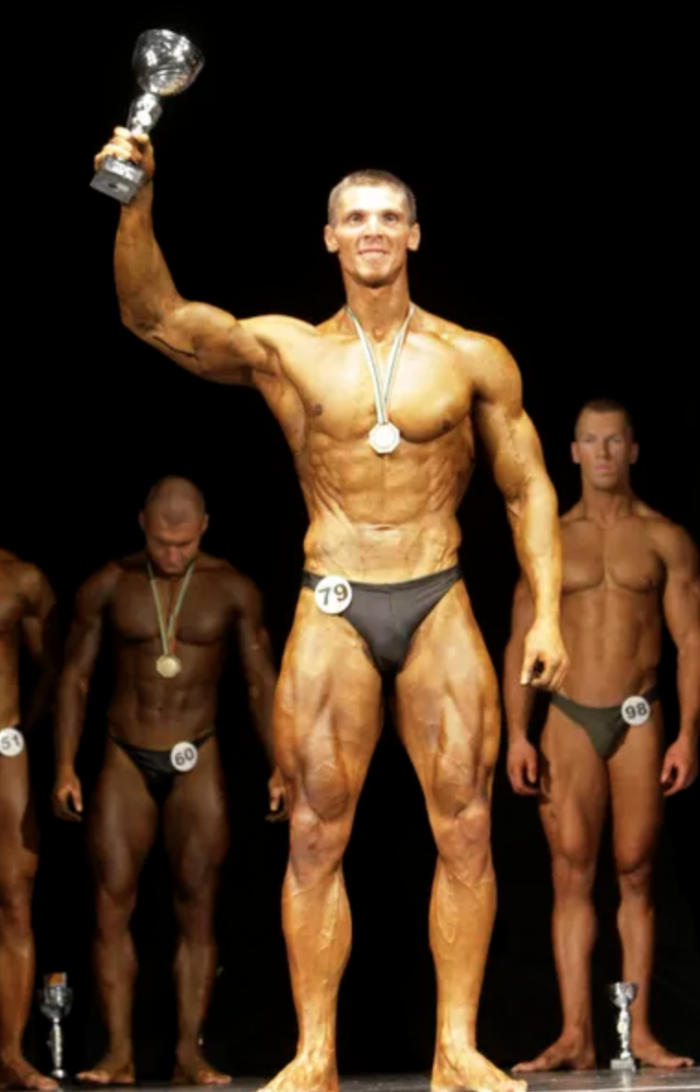
Sometimes life has to be hard for you to appreciate the moments when it is easy…
What have diets given me, and why do I put myself through bodybuilding at all?
I have been asked this many times. It may sound strange, but hardship, pain and suffering have given me a great deal. As the lines of a poem put it: “Hard times are our best teachers!” My pre-contest “fasts” have profoundly changed the way I see the world. Suffering and periodically going without life’s pleasures have helped me grow enormously as a person. I would put it this way: in hard times, I see and perceive the life around me far more realistically than I do when times are good or I am in my comfort zone. I begin to appreciate and understand values that I might otherwise not fully grasp.
I have developed the ability to distinguish real problems from things that are not actually worries or problems at all. You have surely heard it said that the joy of giving is far greater than the joy of receiving. It is true, and I often experience this precisely when my meals are meager and I cannot eat very much. It is not simply a case of “he can’t eat it himself, so he brings it to everyone else.” No, I simply feel a desire to do something kind for others, to give to them, to buy them gifts. And it is when I am suffering myself that I take particular joy in seeing how happy my gift, or a treat I have brought the children, makes them.
I also feel, see and experience just how much nonsense people waste money on. On the one hand, this is nothing new, but I also connect it very much with the realization of how little you actually need to live a normal life, function normally or be happy. That applies both mentally and physically. It is incredible how much joy and pleasure you can get from 20 grams of sour cream on top of 200 grams of plain low-fat quark.
Can you feel joy and satisfaction without pain and suffering?
Probably, but I firmly believe that this is possible only in the short term, certainly not in the long run. The writer John Green has said on the subject: “The existence of broccoli does not, in any way, affect the taste of chocolate!” It certainly sounds impressive, and perhaps even logical at first, but to my mind it is a slogan with a hint of demagoguery that does not hold up. Pure wordplay. Admittedly, the taste of lettuce or the existence of broccoli is hardly likely to determine what chocolate tastes like. Yet there is no doubt whatsoever that bland beans, that same broccoli or kohlrabi served as your main dish for months on end affect how chocolate tastes to you. “What it tastes like” versus “how it tastes to you”: it depends on how you interpret it, how you translate it. There is no question that, as a matter of fact, chocolate remains a dessert and a treat. But how that treat tastes after months of dieting and eating bland food, and just how good it tastes, is something that calls less for scientific proof than for firsthand experience.
In fact, the objective taste of a particular food is not really relevant here. What we are talking about is the idea that, to know what is good, you also need to spend some time experiencing something different: something bad, uncomfortable or unpleasant. Ultimately, it all comes down to relativity. How you perceive something depends on the environment you come from, your frame of reference, what you compare it with and how much you have already had of something or someone. This applies to absolutely everything. What would being happy mean if we had never experienced being unhappy, or if we did not know what it meant to “feel normal” or “just be”? There is no black without white, no good without bad, no warmth without cold, and so on. These extremes exist, but they are also different for each of us and relative.
Yet it is also clear that, to perceive and define one extreme, you need to experience its opposite. If you feel good and comfortable all the time, before long that pleasant, comfortable state becomes boring and no longer feels good or comfortable. So do not fear suffering and hardship: time and again, they help renew the sense of everyday well-being, a moment of leisure or a comfort zone whose value tends to fade so quickly. This applies to absolutely every area of life. Indeed, life itself, progress and growth all work through experiencing contrasting states, experiencing them anew and learning from them.
So do not be afraid to suffer: a double cheeseburger from Statoil after months of dieting tastes vastly different and many times better than it does if you eat it day after day. This teaches us to appreciate what is already good and reminds us that we do not always need to rush toward something new. Suffering teaches us to find joy in simple things. If you had to run everywhere, imagine how good it would feel to be able to walk for even a few minutes now and then. After all, you cannot keep moving forward forever. At some point you reach a limit, and you have to start rediscovering the joy in familiar things, activities, states of being—whatever it may be—that have been there all along!
See also Janar’s forum thread!
Author: Janar Rückenberg
Come train with us! ArtGym




