
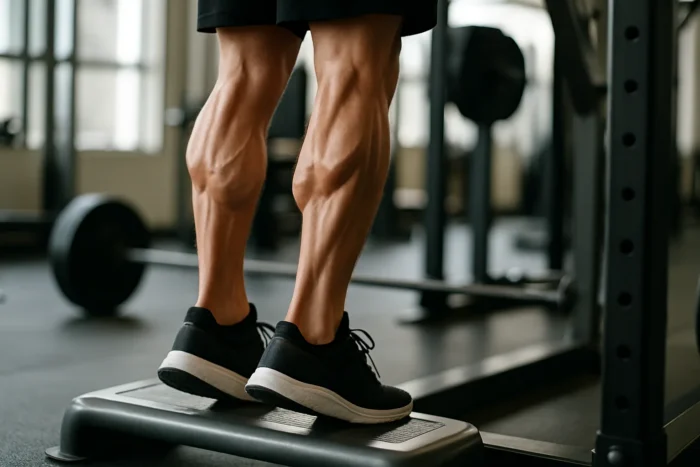
In short:
- The best way to develop your calf muscles is the calf raise through a full range of motion – from a low position to a high one.
- The standing raise emphasizes the gastrocnemius muscle, the seated variation the soleus muscle.
- A block under the balls of your feet and changing the heel position provide a greater training load and better progress.
Calf exercises often take a back seat in a training program, even though strong calves support walking, jumping and running and give the leg a finished shape. Ervin Liebert’s “Atleetvõimlemine” (Athletic Gymnastics) devotes an entire series of exercises to the calves and shows that proper technique has hardly changed in almost a century – only the equipment has. Below we look at which calf exercises to do and how to vary them.
Which calf exercises are the most effective?
Calf exercises are based mainly on one movement: the calf raise, where the heel lifts off the floor and body weight shifts onto the balls of the feet. “Athletic Gymnastics” describes several variations:
- Calf raise with a barbell across the upper back – place a block (about 10 cm) under the balls of your feet so the movement gets its maximum range. On every repetition, rise as high as possible and lower as far as possible.
- One-leg calf raise, one hand holding on – a comfortable variation where your free hand keeps your balance and you focus completely on the main movement; the ball of the working foot is on the block.
- Seated calf raise, barbell across the knees – a raise done seated, where the weight rests on the knees.
- Calf press (plantar flexion) on the leg press – lie under the leg press with your legs straight on the pressing platform so that your heels extend over the bottom edge, and press the platform with the balls of your feet.
A full range of motion is decisive: the calf develops the most when you lower the heel down low (stretch) and then rise as high as possible (contraction). Exercise selection can be refined even further based on EMG studies – this is covered in The best exercises based on EMG studies.
How do the standing and seated variations differ?
The calf is made up of two main muscles: the superficial gastrocnemius muscle (m. gastrocnemius) and the soleus muscle (m. soleus) beneath it. The gastrocnemius attaches above the knee, so a standing, straight-leg calf raise emphasizes precisely this muscle. When the knee is bent – as in a seated raise – the gastrocnemius partly switches off and the soleus does the main work.
That is why it is worth including both in your program: the standing raise (barbell across the upper back or on one leg) and the seated raise (barbell across the knees). This way you develop the entire calf thoroughly. “Athletic Gymnastics” recommends a 2–3-second pause at the top of the raise, which strengthens the contraction.
How do you increase the training load and progress?
Calf muscles are used to carrying your body weight all day, so they need a clear extra training load and progression to grow. A few techniques from “Athletic Gymnastics” and from general strength training principles:
- Use a block under the balls of your feet – it lets you lower the heel further and gives a greater range of motion.
- Vary the heel position – in different sets, turn the heels straight, inward and outward; this slightly changes how the training load is distributed across the calf muscle.
- Add weight gradually – a barbell across the upper back, a dumbbell in your hand or the load on the leg press; ACSM and NSCA stress the importance of progressive overload for smaller muscle groups too.
- Do enough repetitions – calf muscles tolerate volume well, so 3–4 sets of higher repetitions usually work well.
Explosive calf strength also contributes to jumping ability – how to train the jump in a targeted way is covered in How to jump higher… exercises basketball players could do. To fit calf training well into your overall program, also see Building a training program: a complete guide.
As with any strength exercise, keep the movement controlled and avoid jerking. If pain appears in the ankle or the Achilles tendon, reduce the training load and consult a doctor if necessary.
How often should you train your calf muscles and how do you keep your technique right?
Because the calf muscles are resilient and loaded every day, they tolerate training more often than many other muscle groups – 2–3 times a week works well, but leave time for recovery between heavier sets. The World Health Organization recommends that adults do strength exercises for the larger muscle groups on at least two days a week (WHO, 2020); on those days you can conveniently add calves at the end of a leg or full-body workout.
There are three main principles of technique. First, do the movement slowly, especially in the lowering phase, because it is precisely in a controlled stretch that the muscle gets a heavy load. Second, avoid bouncing at the knees and swinging the body – the calves must do the work, not momentum. Third, pause briefly at the top and consciously squeeze the calf. These simple rules make even a light-weight exercise considerably more effective and help prevent ankle overload.
References
- Ervin Liebert. “Atleetvõimlemine” (Athletic Gymnastics). atleetvoimlemine.fitness.ee
- ACSM (American College of Sports Medicine). Resistance training guidelines for healthy adults.
- NSCA (National Strength and Conditioning Association). Progressive overload and exercise selection.
- WHO (2020). Physical activity – fact sheet.
Frequently asked questions
Why do calf exercises in both standing and seated positions?
A standing, straight-leg raise emphasizes the superficial gastrocnemius muscle, which attaches above the knee. A seated, bent-knee raise activates more of the soleus muscle underneath. Together, both variations develop the entire calf.
Why place a block under the balls of your feet?
A block (about 10 cm) lets you lower the heel further and gives the movement a greater range. A full range of motion – from a deep stretch to a high raise – is important for calf development.
How many times a week should you train your calf muscles?
Calves tolerate volume well, so it works to train them 2–3 times a week, doing 3–4 sets of higher repetitions. Still, leave the muscle time for recovery.
What does changing the heel position mean?
Turning the heels straight, inward or outward in different sets slightly changes how the training load is distributed across the calf muscle. It is a simple way to add variety to your training, but a full range of motion remains the most important thing.
Come and train your calves! ArtGym




