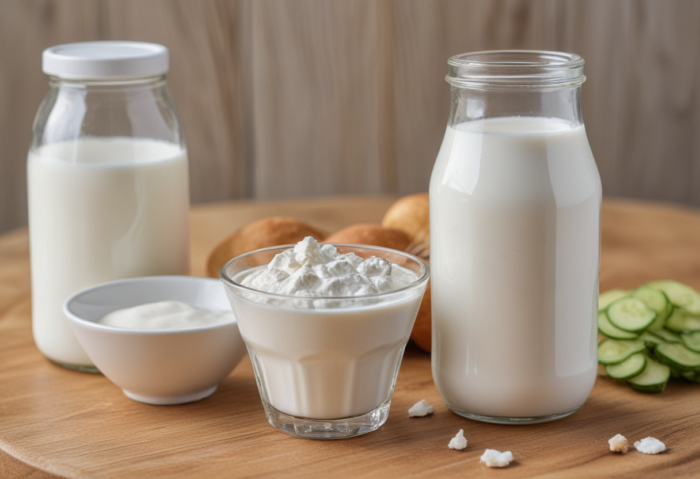
Best dairy for building muscle: yogurt, cottage cheese, milk and more
Milk for muscle sounds funny, but dairy has a firm place in a bodybuilder’s fridge. Here’s a simple cheat sheet on when to choose yogurt, cottage cheese, milk, cheese or ice cream if your goal is to eat smart and keep your menu under control.
Why is dairy on a bodybuilder’s menu at all?
If bodybuilding had a patron animal, it would surely be the cow. Honestly, there’s some truth in that old joke. A cow gives us steak, milk, cheese and the raw material that whey protein and casein are made from. Those two words get thrown around the gym almost as often as squat and press.
The strength of dairy is simple: it delivers protein without much cooking or calculating. That said, not all dairy products are an equally sensible choice. Some suit breakfast, some suit the evening, some work after a workout and some are better as a rare treat. The difference comes mainly down to the ratio of calories, carbohydrates, fat and protein.
A simple truth: if you choose dairy by taste alone, your menu quickly goes off track. If you choose only by the numbers, eating can get boring. The best solution is to know what each option actually delivers.
Dairy in practice: yogurt and cottage cheese
Yogurt
About 1 cup, low-fat, plain with no additives. The figures below are based on the average nutritional values of various brands: 154 kcal, 13 g of protein, 17 g of carbohydrates and 4 g of fat.
Plain, and that matters. Flavored yogurt can look innocent, but it often contains more sugar than you need. If your diet allows, add a few berries or some fruit yourself. That way you at least see what you’re putting in the bowl. Regular low-fat yogurt works well as a snack, especially when you want something light but don’t want to be left with an empty stomach.
Cottage cheese
1 cup, low-fat: 163 kcal, 28 g of protein, 6 g of carbohydrates and 2 g of fat. Those numbers say quite plainly why cottage cheese is an old favorite of gym-goers.
Cottage cheese makes a good snack, but it’s an even better calm evening meal. The reason is casein, a slower-digesting protein that works especially well before bed. You stay full and get a solid dose of protein. If you want extra flavor, add cucumber, fresh herbs or a little pepper rather than a sweet sauce.
Dairy after a workout: milk and cheese
Milk
1 cup, fat-free: 83 kcal, 8 g of protein, 12 g of carbohydrates and 0 g of fat. Fat-free milk is an easy way to add liquid, flavor and a bit of protein to a shake without the fat coming along with it.
Heavyweight bodybuilding competitors can sometimes allow themselves fattier milk, but for most people who train it’s smarter to keep things lighter. You can mix your post-workout shake with skim milk. Recent scientific studies at Baylor University in Texas showed that a combination of whey and casein after training produces the best results for building muscle.
Cheese
1 slice, low-fat: 49 kcal, 7 g of protein, 1 g of carbohydrates and 2 g of fat. If you feel a sandwich definitely needs cheese, choose a low-fat variety. With an average of 49 kcal and 2 grams of fat, it won’t wreck your diet as long as the amount stays reasonable. Plus, you get 7 g of extra protein.
With cheese, the trap is the quantity. One slice is one thing; three or four slices are another. That doesn’t mean cheese is bad. It means cheese needs an honest measure. Set out a slice and eat it calmly, rather than straight from the package.
What to look out for when choosing dairy?
The first thing is the label. Check how much protein, sugar and fat the product contains. The second thing is timing. Before bed, cottage cheese suits better than sweet yogurt. After a workout, milk in a shake can do its job. In the morning or as a snack, plain yogurt works as long as you keep the add-ins under control.
Ice cream is a topic of its own. 1 cup gives you 267 kcal, 5 g of protein, 33 g of carbohydrates and 14 g of fat. If you’ve so far been trying to eat sherbet instead of ice cream, it may not be the better choice. Sherbet has double the calories, most of which come from sugar. At the same time, it has almost no fat or protein. This can cause a sharp rise in insulin levels.
Does that mean ice cream is health food? No. But the fat and protein in ice cream slow down the absorption of carbohydrates. If you have ice cream, have it as a dessert, not as a protein source. The portion matters more than a fancy justification.
Dairy FAQ
Is dairy suitable for building muscle?
Yes, as long as it fits into your daily menu. Dairy provides protein, and some products, such as cottage cheese, are a very practical choice in the evening too.
Is flavored yogurt a bad choice?
Not always, but it often contains a lot of added sugar. If your goal is to improve body composition, plain low-fat yogurt is the safer choice.
When should you eat cottage cheese?
Cottage cheese works well before bed because it contains casein. That makes it a calm, nourishing evening source of protein.
Sources
Source: Muscle and Fitness, Jordana Brown
Translated by: Aktivist
Come and work out! ArtGym