
The deadlift: bringing a forgotten exercise back into your program
The deadlift often gets overlooked in the gym, even though it is one of strength training’s most honest tests. With proper technique, it builds strength in your back, legs, hips, grip and core all at once.
Why does the deadlift matter?
You rarely see people doing deadlifts. You might spot weightlifters performing them, or someone doing a variation. Yet the deadlift is one of the foundations of strength training.
That does not mean everyone has to do it at any cost. If your lower back hurts, your mobility is limited or the technique is completely unfamiliar, you need to start cautiously. But when it comes to building strength, the deadlift’s value is hard to overstate.
Although the deadlift is one of the three lifts in powerlifting competitions, it is less popular among everyday gym-goers than the squat and bench press. People do not boast nearly as often about how much they can lift off the floor. Frankly, that is a shame.
Of these three lifts, the deadlift can be considered the best measure of overall body strength because it recruits the most muscles. It works the latissimus dorsi, trapezius, erector spinae, glutes, biceps femoris, quadriceps and iliopsoas. Your forearm muscles also do their part: something has to hold on to the barbell.
At the same time, your core stabilizers, including the rectus abdominis and transversus abdominis, have to keep your body stable. In other words, ¾ of your body’s total muscle mass is involved in performing this exercise. Your joints get to work too: your ankles, knees, hips, spine, shoulders and fingers.
How do you make the deadlift work for you?
There are two main deadlift styles: sumo and conventional. The main differences are stance and grip width. In the sumo style, your feet are wide apart and you grip the barbell inside your legs. In the conventional deadlift, your stance is narrower and you grip the barbell outside your legs.
The sumo style has gained popularity because it places less stress on the lumbar vertebrae than the conventional deadlift. It is often favored by people with slimmer builds and longer-than-average torsos. The load does not disappear, though. Sumo places greater demands on the knee and ankle joints because the angles at these joints are more acute.
The quadriceps work harder in the sumo deadlift than in the conventional version. The conventional deadlift places more stress on the lower back rather than the knees and ankles. The smaller hip angle makes the hamstrings and glutes work harder.
The barbell usually travels farther in the conventional version, but the difference in distance may be fairly small, especially for a shorter person. The force produced by the hamstrings and glutes working together can help you lift heavier weights than a style that relies solely on the quadriceps. Still, deadlift world records have been set using both styles.
Starting position
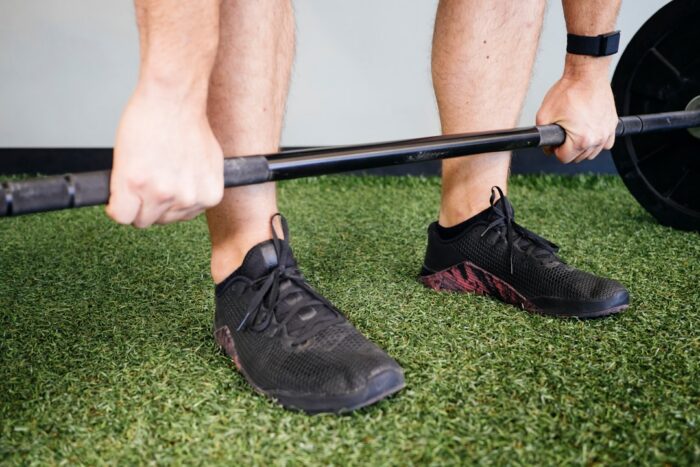
- Keep your feet flat on the ground, roughly shoulder-width apart for the conventional style and slightly wider than shoulder width for sumo.
- Grip the barbell firmly with one palm facing you and the other facing away.
- Your knees should be bent as they would be at the bottom of a full squat.
- The barbell should be as close to your shins as possible.
- Your back must be straight.
- Your head should be tilted back or in a neutral position.
The pull
- Start the pull by extending your knees and hips so that your hips and shoulders rise together. Keep your back straight and make sure your shoulders are directly over the barbell or slightly in front of it.
- As the barbell passes your knees, push your hips forward and your shoulders back.
- At the top, your hips and knees should be fully extended and your shoulders back.
What does good deadlift technique require?
The simple truth is that the deadlift does not forgive a sloppy setup. Before the barbell leaves the floor, your body must be braced, your grip firm and your back straight. If you jerk the barbell off the floor, the movement can easily get out of control.
Remember!
- Your back must remain straight throughout the lift.
- At no point during the lift should your back be rounded and your shoulders rolled forward.
- Keep the barbell as close as possible to your shins, and to your thighs once it passes your knees.
- Your feet must always stay flat on the ground, with your center of gravity over your heels.
- Do not yank the barbell off the floor. The pull must be smooth, and you need to give it your full concentration from the start.
- Pay close attention to your form. Rounding your back, letting your knees cave inward and pulling with your back and shoulders instead of your legs and hips are common mistakes that cause injuries.
- Because the exercise recruits many muscles at once, take a longer rest between two sets.
It’s a good idea to start with a lighter weight and film your lift from the side. This lets you see straight away whether your hips rise before your shoulders, the barbell drifts away from your body or your back rounds at the start of the pull. These small mistakes quickly catch up with you when the barbell gets heavier.
If your technique starts to break down, you don’t have to drop the deadlift from your training program. You can deadlift from blocks, use a trap bar, practice the hip hinge or reduce the weight for a while. The goal isn’t to attempt a personal record every workout. It’s to learn to lift with strength and good technique.
FAQ: the deadlift and your training program
Is the deadlift suitable for beginners?
Yes, as long as you take it slowly at first and master the technique before adding weight. For beginners, the priorities are keeping your back straight, holding the barbell close to your body and pulling smoothly.
Should you choose sumo or conventional?
The choice depends on your body, mobility and goal. Sumo may feel more comfortable on your lower back, while the conventional deadlift makes your hips, glutes and hamstrings work harder.
Why do you need longer rests between sets?
Because the deadlift engages many muscles at once and places a heavy demand on your nervous system. If your rest is too short, your technique will start to break down before your strength gives out.
Come and deadlift! ArtGym
Author: Disa Hatfield PowerMag Magazine translated by Ilo Rihvk




