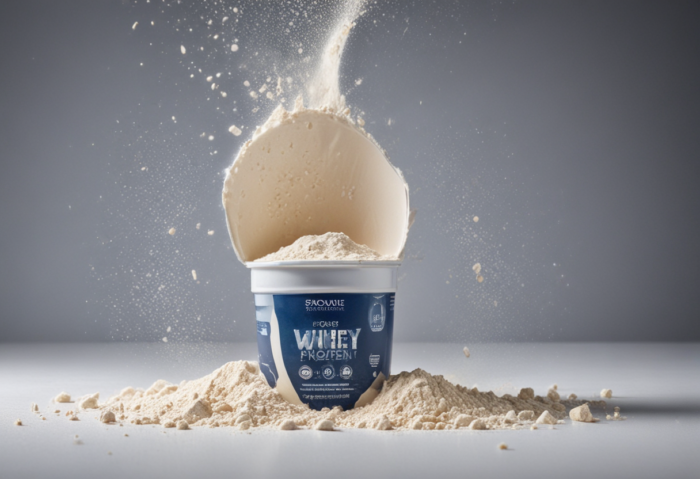
This has long been a topic of debate. Surely every beginner has wondered about it more than once. So what is the answer—do you need it or not? I’ll take the liberty of introducing another frequently asked question on the subject: at what age could, should or may you start adding protein powders to your diet as supplements?
Let me start with the first and main question. Broadly speaking, you could answer it either way. I wouldn’t rush to either extreme. My view is that if you are 100% certain you are meeting your daily protein needs through regular food, then there really is no absolute need for protein powder. But it is nowhere near as simple as it first seems. For a start, how sure are you that your food really does provide all the protein you need each day? Let’s be honest: plenty of people don’t even know which foods contain protein, and even if they manage to work that out, I’m far from convinced they can put together a day’s worth of food that supplies the required amount. Yet this is extremely important, especially if you do strength training—or any training at all. Getting enough protein each day matters whether you are a cyclist, a footballer or an athletics competitor. Given how limited most athletes’ knowledge of nutrition is, I would again question whether everyone gets the protein they need from regular food. In many cases, it simply comes down to a lack of knowledge. The traditional Estonian staple has always been potatoes and gravy. Let’s be honest…that mostly provides carbohydrates. Potatoes contain only carbohydrates, and flour-based gravy with a few small scraps of meat or pieces of frankfurter doesn’t provide much protein either. If you do eat porridge in the morning, it’s good to have 1 2 glasses of milk with it. Sadly, in many cases, those 1 – 2 glasses of milk may turn out to be your only source of protein all day.
My point is that before you consider skipping your post-workout protein shake (combined with carbohydrates, of course), you should know exactly what you will have in its place.
From watching, listening to and seeing how young people who train and play sports eat, whatever their sport, there is often reason to conclude that the protein shake they would have after a workout—if they had one—would probably be their only serving of protein all day. Let me quickly add that I am certainly not suggesting that this one serving of protein after a workout would make up for an unhealthy diet or irregular eating during the rest of the day. As I said, a protein shake would at least ensure that this young, growing body gets some protein to support its training. Of course, it is essential to explain to this young, developing athlete RIGHT AWAY why they need a consistent, regular supply of protein, why regular eating matters and that protein doesn’t only come in powders and pills.
Secondly, even if you time your meals and know how to get your daily protein through food, a shake containing fast-absorbing whey protein still has a significant effect on recovery. Whey protein has a composition that few foods can match. On top of that, a shake is liquid, which further speeds up absorption. Whey protein contains branched-chain amino acids, which are important stimulators of protein synthesis. If these stimulators reach your muscles quickly after a hard workout and stimulate protein synthesis—in other words, get the machinery that replaces broken-down proteins running sooner—what could be wrong with that…fast recovery can only be a good thing.
Essentially, if you believe that rapid amino acid absorption after a workout and the ability of branched-chain amino acids to stimulate protein synthesis matter for your progress, you’ll have that post-workout whey protein shake. If you don’t believe in it, you simply won’t. For some reason, I do!!!
Thirdly…the bigger you are, the greater your body mass (including muscle mass), the more protein you need each day. Yet getting that larger daily amount of protein is very difficult. Protein powder is a very good way to reach that amount. You can easily mix protein powder into your regular meals to increase their protein content. Here’s a simple example: suppose you are an experienced bodybuilder weighing 100 kg. According to many studies, a bodybuilder who trains hard should consume at least 2 g/kg of body weight in protein. This means that this 100 kg bodybuilder should get at least 200 g of protein a day. That is quite a lot—so much that it is fairly difficult to get it all from food. If quark were the only food you ate all day, you would need to eat at least 5 packs (250-gram packs) of quark. And quark is a relatively protein-rich food. Potatoes, gravies, soups, pasta, burgers and the other foods that typically feature in the daily diet of an average Estonian family don’t provide much protein. I wonder how many people who train make sure every meal contains protein as well as carbohydrates? How many try to ensure that each meal includes a small piece of meat, a slice of fish fillet, a few egg whites or 100 – 150 grams of cottage cheese? If you do, congratulations…your diet is in pretty good shape, and you have done a great deal to help turn your efforts in the gym into results. Of course…if you cannot follow that dietary principle, a protein shake won’t make you grow either. If you train with weights week after week, your body grows 24 hours a day, and that requires a regular supply of protein every 3 – 4 hours. However, if you can bring at least some structure to your diet but perhaps genuinely struggle to get enough protein-rich foods every day, a protein shake can be a significant help to your body as it recovers from training. A post-workout shake, together with extra energy, would be like putting out the first major fire.
What else… for me, a protein shake is the best option after a workout. For one thing, it is convenient and easy to drink. For another, quite often after a hard workout, I simply cannot stomach solid food, even if I try to force it down. A shake is liquid, though, so it always goes down easily. It also quenches my thirst, and I enjoy drinking it. My appetite only returns and I have my next meal 45 – 90 minutes later. Still, you should not just sit around in a deficit after training: you need to supply your body with the building blocks (and extra energy) it needs, because recovery starts as soon as the work is done. And if you have no appetite, a protein shake with carbohydrates fits the bill.
What is more… people often finish a workout and do not get to eat for perhaps another 1 – 2 hours. Some have a long journey home, and so on. Having a protein drink with some extra energy immediately to hand would once again help put out the “fire”. One or two hours after a workout without a proper meal is too long… that is a scientifically established fact.
Let us also talk about a couple of myths I have heard. First, there are “theorists” who suspect that using protein powders could lead to dependence. “What if your muscles stop growing without protein powder?” Nonsense… that simply cannot happen… I will not waste any more time commenting on such rubbish.
Second, a word to those who use protein powders and mass gainers, especially young beginners. You need to understand that these protein powders are no miracle products. You cannot say things like “I have been taking Mass 2 for 3 weeks now, and damn it, I cannot really feel any particular effect” or “I have been using Whey Gold Standard for the past month, and it really kicked in and worked brilliantly”. You see, that is not possible. If you are simply using different ordinary protein powders, I maintain that nobody feels, or can feel, any difference in their effects. Whether you take Gold Standard or Hera 80… you simply will not experience different effects. It is ordinary protein (a nutrient), just concentrated into powder form… you cannot actually feel any effects or a “kick” from taking protein powder. It is about as ridiculous as a “guy” eating a tub of “Farmi” quark after every workout for a month, then a tub of “Tere” quark after every workout the next month, and saying, “Damn, this ‘Tere’ quark really gives me so much more, or somehow packs a bigger punch.” Protein powder simply contains ordinary nutrients, predominantly protein in concentrated form. People often ask me, too: “Hey, have you taken ‘this’ or tried ‘that’? How does it work? What is it like?” Honestly, all I can comment on in those cases is how well the protein powder I tried dissolves or how it tastes. Whether American protein gave me anything more than Hera 80 is something I simply cannot say.
Young people and protein powders. I have debated with several people involved in sport whether protein powders are appropriate for young people and at what age they could start using them. Opinions fall into two camps: some set a very high age limit (18 years) or even higher, while others are much more accepting. Here is my personal view… I think that if a young person’s training load and the amount and type of their daily physical activity warrant it, then 14 – 15 is quite old enough to start using protein shakes. Especially since what I said earlier applies here, too. At school, I see young boys putting in several hours of strenuous physical activity a day. For many young people, the protein drink they have after training would very likely be their only serving of protein that day.
Let me give you a real-life example from my own experience. There was one 15-year-old boy at our school. We had a lesson on Thursdays. During term time, his Thursday looked like this (as I understood it): morning… breakfast, which for most is very likely not particularly substantial. Many simply eat very little in the morning. Perhaps a cup of coffee and a couple of sandwiches. The next meal at school is at 11:40… and that is if they actually go and eat. First, the gap has already been too long (7:30 – 11:40); second, school meals are not particularly high in protein; and third, young people quite often pick which days to go and eat and which to skip (depending on the food). Then the sequence begins. He has two consecutive lessons with me from 13:00 – 14:30. After the second lesson, at about 14:45, he goes to the gym, where, as a basketball player following a full-body program, he spends 1.5 hours. Strength training finishes at about 16:15, followed by basketball practice starting at around 16:30, which sometimes stretches to 2 – 2.5 hours. So that means he is working hard for practically 6 – 7 hours straight without eating. I should also mention that he is not local and lives 7 – 8 km outside town, so he cannot go home in between. If you want to train, that means putting in a long day like this. Once in a while, I see him with a pastry and a soft drink.
Come on, someone tell me that a protein shake with some extra energy somewhere in between would be too much for him because he is only 15 years old. Utter nonsense, if anyone even dares to suggest it!!! Of course, I am not claiming that a protein shake is “the one and only”. That snack could also be a carton of yogurt, a tub of quark or some milk, with honey or raisins added, a bar of chocolate, and so on. But nobody can tell me that he must not or should not have a protein shake with pastries or honey somewhere in between because he is too young. I say this and emphasize it because I have met quite a few people who think that way.
By now, I have also talked a great deal about the importance of proper nutrition and eating regularly throughout the day… between workouts, you need to give your body everything it needs… both protein and carbohydrates. Fortunately, we have now improved this young man’s diet, too. The thing is, I did not really notice at first; I am not beside him all the time, after all. Only after a while do you start to realize that, damn, these guys may be young, may recover well and not let hunger bother them, but when I stopped to think about it, they were going a bloody 6 – 7 hours with practically nothing to eat… and their bodies were still growing, too. These young men simply do not realize how important proper nutrition is, yet many of these hard-training youngsters still want to build muscle mass and achieve good strength levels with that attitude.
So, if a young person is active and can afford a protein drink, my view is that they can readily start using one from the age of 14. Of course, I must immediately add that a protein shake is no substitute for a sound, balanced diet overall.
But what is the final “takeaway” on the main question of this article??? As you can see, the article is full of arguments that mainly highlight the benefits of using a shake. There are certainly counterarguments to these positive points. I would put it this way: ultimately… it is indeed a fact that the more carefully planned and structured your everyday diet of regular foods is, the less you need a protein shake. Whether you have a protein drink after a workout is a deeply personal decision. Personally, though, I believe it can be beneficial even when your diet is in order, because there are situations where eating a proper meal of regular foods simply is not possible. Moreover, given the state of your body and muscles and your body’s internal environment after training, the composition and use of protein powder (alongside additional energy) offer some advantages over regular foods. If you have the means, there are quite a few situations—including those discussed in this article—where using protein shakes is advisable and beneficial. It certainly will not do you any harm!!!
Author: Janar Rückenberg
Come and train! ArtGym