No appetite? How to eat more calories
Your appetite can vanish just when your goal is to gain weight and get stronger in the gym. When your plate is full but your stomach says stop halfway through, what you need is smarter food choices, not just a bigger portion.
That doesn’t mean you should eat mayonnaise and candy every day. You can add calories in a way that still supports training, recovery and muscle building.
Why does appetite matter when building muscle?
When someone says they can’t manage to eat, it sounds funny to some people. In reality, it’s a very common problem in the gym. It’s especially common among people who are naturally leaner, who move a lot, or whose days are so packed that one proper meal keeps getting skipped.
I remember well the time I started training more seriously and my goal was to gain about a kilo every month. Five eggs and a big bowl of oat flakes in the morning felt less like a healthy plan and more like a small punishment. The scale still wouldn’t budge on its own. In the end, the daily amount of food had to be quite large.
A simple truth: muscle mass needs energy. If your body constantly gets fewer calories than it burns, it’s very hard to build anything new. Training gives your body a reason to grow, but food provides the material.
Appetite and energy density: choose smarter foods
If your stomach fills up quickly, energy-dense foods can help. That means a small amount delivers a lot of energy. For example, an apple fills your stomach more, but a small piece of fattier cheese delivers calories far more easily.
That doesn’t make the apple a bad food. The goal is just different. If you want to lose weight, high-volume, lower-calorie foods help. If you want to gain weight but your appetite is small, you need the opposite approach.
Fats help boost your calories
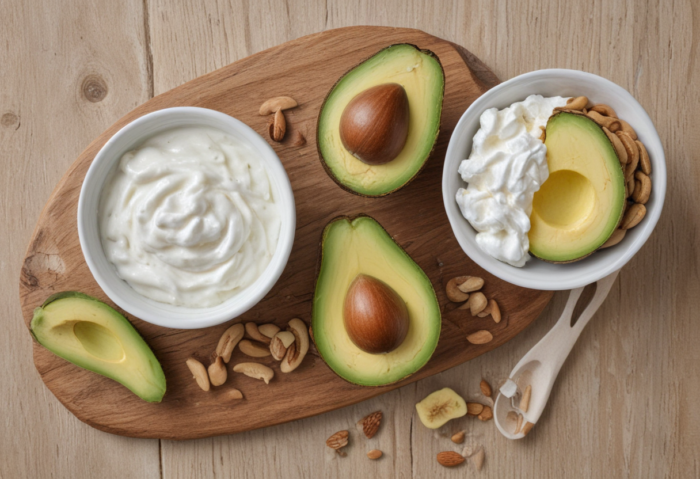
Avocado is a good example. It works on bread, in a salad, in a smoothie and even next to scrambled eggs. 100 grams of avocado gives about 160 kcal and plenty of fat, yet the portion doesn’t feel huge in your stomach.
Nuts and nut butters are similar helpers. A handful of nuts disappears quickly, but delivers more energy than you’d think at first glance. Natural nut butter can be stirred into porridge, quark or a smoothie.
Be sensible with oils, but there’s no need to fear them. A tablespoon of olive oil in a salad or over a meal adds calories without making you eat another plateful. Honestly, it’s one of the easiest tricks.
Choose protein-rich foods, but not ones that are too lean
Fatty fish such as salmon, herring or eel provides protein and fat at the same time. Compared with lean white fish, this option is higher in calories and suits someone who wants to gain weight.
Whole eggs are also practical. One egg has about 70–80 kcal, 6–7 grams of protein and 5–6 grams of fat. The yolk is not the enemy, especially when your goal is to get stronger and get more energy from your food.
Higher-fat dairy products can help too. Greek yogurt, quark, milk, kefir and cheese provide protein and work well as snacks. If you get full quickly, 2.5% or 3.5% milk may make more sense than the leanest option.
How to get more calories when you can’t manage to eat?
The simplest change is to drink some of your calories. Liquid food often goes down more easily than a big main course. That doesn’t mean your whole menu should be smoothies, but one substantial drink a day can make a big difference.
Oat flakes work well for this. 100 grams of oats provides about 390 kcal and contains carbohydrates, protein, dietary fiber and minerals. As porridge it can be very filling, but in a smoothie the same amount is easier to get down. Add a banana, milk or kefir, nut butter and, if needed, protein powder.
A mass gainer can be convenient when regular food is truly hard to eat. It’s not a miracle powder. The idea is simple: you get your carbohydrates and protein in liquid form. If you use one, treat it as a supplement rather than a full replacement for real food.
Keep sweet foods in check, but there’s no need to cut them out completely. Dark chocolate, dried fruit, dates, raisins and honey can be good additions as long as your main meals are in order. For example, a banana in a smoothie gives great flavor and carbohydrates, but you can also stir a spoonful of honey into the same drink.
Practical tricks to improve your appetite
Don’t start with giant portions right away. If you’re used to eating three small meals, then five big meals a day usually ends with you abandoning the plan. It’s better to add one snack or one high-calorie drink to each day.
Prepare your meals in advance. A ready-made sandwich, yogurt with nuts or a bottle of smoothie in your bag makes the decision easy.
Use sauces and add-ons wisely. Olive oil, pesto, avocado, cheese, seeds and sour cream can make ordinary food more energy-rich. The same rice, potatoes or pasta gives you more when you add a source of fat and protein too.
Keep dietary fiber under control. Vegetables are essential, but if every meal is a big bowl of salad, you’ll feel full before you’ve taken in the energy you need. Do keep adding vegetables, but don’t build the whole bowl out of them alone.
Track your weight calmly. If your weight hasn’t moved at all in two to three weeks, add a small portion to your day: a handful of nuts, a glass of milk, a spoonful of oil on your food or one banana in a smoothie. A small step is better than suddenly forcing yourself to eat.
FAQ: appetite and weight gain
Do I have to eat junk food if I want to gain weight?
No, you don’t. You can also raise your calories with avocado, nuts, fattier fish, eggs, dairy products, oats and good-quality oils. Sweets can fit into the menu now and then, but they shouldn’t be the foundation of your plan.
Do smoothies help if my appetite is small?
Yes, they often do. For many people, liquid food is easier than a big portion of solid food. A good smoothie can contain milk or kefir, oat flakes, a banana, nut butter and a protein supplement.
How fast should my weight go up?
A very rapid increase is usually not the best sign. Steady, consistent gain gives your body time to adapt and makes it easier to judge whether you’re adding muscle mass or just excess body fat.
Author: Peep Reinart
Come and train! ArtGym