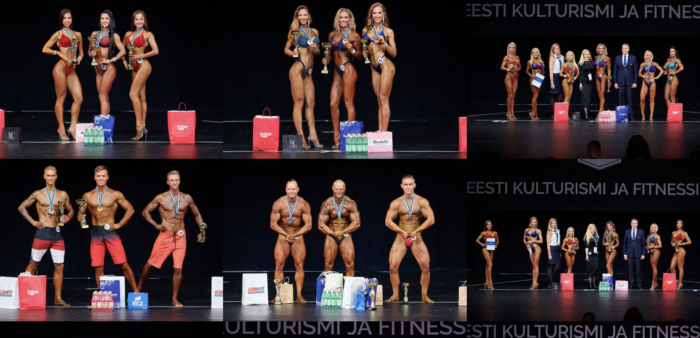
The Estonian fitness team was in action in Finland, North Macedonia and Lithuania all at once on October 15–17. The weekend brought several medals, a number of finals placings and a good look at how broad the next generation of Estonian bodybuilding and fitness really is.
Why the Estonian fitness team stood out over the weekend
The Nordic Championships in bodybuilding and fitness, held in Lahti, were the biggest yardstick for Estonian athletes this weekend. The competition ran October 15–17, and Estonia was there with 25 competitors.
That is not a small number. When a single event brings together experienced athletes, juniors and competitors from different categories, it gives a fairly honest picture of where the whole sport stands. Not just the top, but also who could be fighting for medals in a couple of seasons.
Saturday, October 16, started strongly for Estonia. Egert Oiov won silver in men’s physique -179. Olivia Hermlin took a silver of her own in bikini fitness 172+. Bronze medals went to Risto Saul in men’s physique -179 and to Elisabeth Atamanski, who medaled in both bikini fitness -160 and junior bikini fitness -163.
Besides the medalists, several more Estonian athletes reached the final. Sander-Henri Saul placed sixth in men’s physique -179. Olivia Hermlin finished fifth in junior bikini fitness 169+. Relika Merilai was sixth in bikini fitness -160, Kerli Djomina fourth in bikini fitness -169, and Liis Marian Toomse also fourth in bikini fitness -172.
Kirke Kirt was fourth in bikini fitness 172+ and Deisy Liivja sixth in junior bikini fitness 169+. These placings may not sound as shiny as a medal, but a finals spot at Nordic level means strong condition and solid stage experience.
How the Estonian fitness team collected its medals
Sunday, October 17, added one more medal to Estonia’s results table in Lahti. Ivan Šarapov took bronze in men’s classic physique -180. This category demands a different overall stage presentation than regular men’s physique: there is more emphasis on classic proportions, balance and posture.
Karmen Kiier and Olga Tarassovskaja also reached finals on Sunday. Kiier was fourth in bodyfitness -169. Tarassovskaja placed fourth in acrobatic fitness. Both results show that Estonia was not represented in just one or two popular categories; the picture was broader.
Honestly, that is the most interesting part of competition weekends like this. Medals make the headlines, but finals placings show depth. When several categories reach fourth, fifth or sixth place, the team has more than one strong name.
Other competitions the same weekend
The weekend was not limited to Finland. On Saturday, October 16, Estonians also competed at the IFBB Diamond Cup Skopje in North Macedonia. Evelyn Raig turned in a strong performance there and won two silver medals: in bikini fitness -166 and in masters bikini fitness.
Kristle Tamm won silver in the fit model category in Skopje. She was also fourth in bikini fitness -166. It is a good example of an athlete who can compete in several classes at one event and stay high up in both.
On Sunday, October 17, Estonians were also on stage in Lithuania, at the Lithuanian Open Cup held in Kedainiai. Elly Künnap took third place in masters bikini fitness. Märt Ermil did not manage to reach the final in men’s physique this time.
So what actually happens when Estonian athletes are on stage in three countries in a single weekend? First, the team gets plenty of comparison material. Second, athletes gain experience in front of different judges and competitors of different levels. Third, the community sees whose condition holds up, who has room to develop and who could already move higher at the next start.
What the Estonian fitness team takes away from the results
A weekend like this is packed for an athlete. Peak condition has to be timed to the day. Travel, weigh-ins, makeup, waiting backstage and several possible rounds on stage all take their toll. From the outside it sometimes looks simple: you walk on stage, pose and wait for your placing. In reality, months of work lie behind it.
In fitness and bodybuilding, small details decide. Physique, stage confidence, posing, proportions and meeting the category requirements all have to work together. If one of them is weak, a medal can turn into fourth place. And at this level, fourth place is often a very small margin.
From the Estonian perspective, the big plus of the weekend was the broad participation. Medals came from men’s physique, classic physique, bikini fitness, masters and fit model. In addition, juniors and bodyfitness athletes reached finals. That gives coaches and the federation a clearer picture of where the work is heading.
A simple truth: international stage experience is a very valuable asset in fitness. You can’t get it from training alone. Every competition teaches you how your body reacts to travel, how to handle the tension on stage and what to do differently during your next prep.
FAQ: the Estonian fitness team and competitions
How many medals did Estonian athletes win in Lahti?
At the Nordic Championships in Lahti, Estonian athletes won six medals in total: two silver on Saturday, three bronze on Saturday and one bronze on Sunday.
Who won a medal at IFBB Diamond Cup Skopje?
Evelyn Raig won two silver medals in Skopje, and Kristle Tamm won silver in the fit model category. Tamm was also fourth in bikini fitness -166.
Why does a finals spot matter in fitness?
A finals spot shows that an athlete stays close to the top in international competition. It brings experience, visibility and a clear direction for the work of the next competition season.
Author:EKFL
Come and train! ArtGym