Russian Bear at the European Bodybuilding Championships
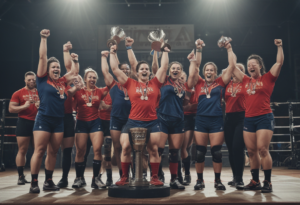
The Russian Bear was the clearest sign of this European Bodybuilding Championships: the Russian athletes didn’t just come to take part, they took over the stage by force. The competition in St. Petersburg showed how quickly bodybuilders from the former Soviet Union had risen to the top at IFBB level.
Why the Russian Bear made such a strong impression
The European bodybuilding champions were decided for the 34th time, and for the second time it took place in St. Petersburg. For Estonians, the city already held earlier significance: there are fond memories from 1990, when Ain Paavo came home with a gold medal.
In the meantime, though, the balance of power had changed considerably. Considering the level of strength sports, and especially weightlifting, in the former Soviet Union, it was no surprise. It was more a matter of time before athletes from the new countries reached the top after joining the IFBB.
Even so, the host country’s dominance was startlingly large. Of the seven championship titles, Russia took as many as 5, plus four silvers and one bronze. It was no narrow win. It was a forceful statement.
What the Russian Bear showed in the results
Poland got two golds, Belarus a silver and two bronzes, and Slovakia two bronzes. Bulgaria, the Czech Republic, Ukraine and, as the only Western country, Spain had to settle for one medal each.
There’s not much to reproach the judges for. The Russian men were genuinely good. The only debatable call was placing the Bulgarian second in the up to 70 kg body weight class. The home-crowd effect may well have been felt there.
The smaller number of entrants also stood out. The lightest weight category had only 7 athletes, the others 12–15, and only the new category (-87.5 kg) had 22 competitors. There are now 7 body weight classes at the European Championships. For comparison: in 1976, when weight categories were first used instead of height, there were only three (-75kg, -90kg, over 90kg). Times move on.
Ott Kiivikas and the Estonian view
Estonia’s only competitor was Ott Kiivikas. An athlete who has already placed 7th–8th once naturally hopes to at least repeat that. This time the placing came in lower, but judging by the condition, there was no reason to hang one’s head.
Personally, I think Ott did well. The homework was done and the condition was at least as good as last year. But bodybuilding is a sport where you only find out your level once you’re put next to the others. No two years are the same.
Alongside the competition, doping control came up too. An old friend and fellow competitor asked: how many positives will there be? And answered their own question: none, because the testing is done by the Moscow lab. Let’s remember that at last year’s World Championships, 13 of the 18 medal holders tested positive. I do wish they were wrong.
Results by body weight class
Up to 65kg
- Majek Kamil – Poland
- Vasily Kamishnikov – Russia
- Andrey Aksamit – Belarus
- Peter Kovacik – Slovakia
- Darius Petrokas – Lithuania
- Yalchin Mammedov – Azerbaijan
- Maurizio Montalto – Italy
Up to 70kg
- Oleg Melgunov – Russia
- Hristomir Hristov – Bulgaria
- Marcel Jasen – Slovakia
- Sergey Biller – Russia
- Ricardas Siska – Lithuania
- Pavel Rohal – Czech Republic
- Michael Gulch – Germany
- Sinisa Privulovic – Serbia
- Thomas Nuhn – Germany
- Robert Archman – Czech Republic
- Orhan Yilmas – Turkey
Up to 75kg
- Rystam Dgabrailov – Russia
- Miguel Martinez – Spain
- Peter Kokoska – Slovakia
- Dimitry Tribila – Belarus
- Jan Kvbik – Czech Republic
- Vadim Vlasov – Belarus
- Vugar Verdiyev – Azerbaijan
- Galin Kolarov – Bulgaria
- Robert Horvat – Croatia
- Patrick Mounier – France
- Antonio Lypo – Italy
Up to 80kg
- Sergey Shevaldin – Russia
- Alexander Vishniak – Belarus
- Ilya Goroshko – Russia
- Grezegorz Ozga – Poland
- Muritala Moha Idowo – Belgium
- Sergey Maleshko – Belarus
- Gerhard Nenning – Austria
- Miroslav Pastyrik – Czech Republic
- Evgeniy Zuhravlev – Ukraine
- Thomas Kreienbuhl – Switzerland
- Elmar Abdullayev – Azerbaijan
- Erdal Utar – Turkey
Up to 87.5
- Bogdan Szczotka – Poland
- Artem Ivanov – Russia
- Alexander Hlebnikov – Ukraine
- Francisko Mula – Spain
- Viktor Lauter – Hungary
- Roland Ullram – Austria
- Parfait Aim Konstedt – Switzerland
- Adam Adamski – Poland
- Igor Milanovic – Serbia
- Mario Feuser – Germany
- Vladimir Gnoevoy – Ukraine
- Marian Cambal – Slovakia
- Frederic Lathuille – France
- Alen Kanavalov – Belarus
- Ott Kiivikas – Estonia
Up to 95kg
- Viacheslav Burenkov – Russia
- Pavel Ershov – Russia
- Petr Soukup – Czech Republic
- Tomas Bures – Czech Republic
- Giedrius Gailounas – Lithuania
- Maxim Koldasnikov – Russia
- Matviy Bidniy – Ukraine
- Andrej Maszewski – Poland
- Maxim Ermakov – Russia
- Ian Dowe – England
- Francis Juliana – Netherlands
- Ermino Marconi – Italy
Over 95kg
- Alexander Feodorov – Russia
- Oleg Emelianov – Russia
- Aleksey Shabunia – Belarus
- Rodoslav Slodnewicz – Poland
- Darius Karpinski – Poland
- Mario Ondris – Slovakia
- Dimitry Salik – Ukraine
- Bogdan Kravchenko – Ukraine
- Dmitry Golubochkin – Russia
- Alex Gregor Sturm – Austria
- Eric Roger Mallet – France
- Radek Cejka – Czech Republic
- Andreas Stefanides – Cyprus
- Alanasov Dimitrov – Bulgaria
- Kukeli Rando – Albania
FAQ
Why was Russia so dominant?
The foundation was already there in strength sports and weightlifting. Once those athletes and coaches moved into international bodybuilding, the level caught up quickly.
How did Ott Kiivikas do?
Ott Kiivikas placed 15th in the up to 87.5 class. His condition was solid, but the competition was tough this year.
What stood out most about this European Championships?
What stood out most was Russia’s overwhelming dominance: 5 golds, four silvers and one bronze. You don’t see a picture like that every year.
Author: Indrek Otsus, EKFL vice president
Source: WHO – physical activity.
Come and train! ArtGym