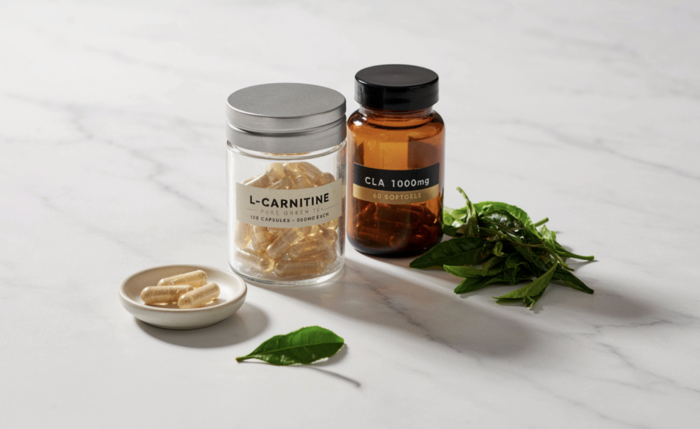
At a glance:
- A fat burner does not replace an energy deficit, protein, dietary fiber, strength training or sleep.
- Studies of L-carnitine, CLA and green tea generally show small effects on body weight, with results depending on participants’ usual diets and characteristics.
- If you choose a supplement, treat it as a potentially small addition, rather than the main driver of weight loss.
- With green tea extracts, read the ingredients and safety information, because a concentrated extract is not the same as a regular drink.
A fat burner sounds like a shortcut: a capsule or powder that makes your body use more fat and lose weight. The evidence paints a more sober picture: L-carnitine, CLA and green tea may show a small effect in some studies, but none of them will do the fundamental work of managing your body weight for you. Below, we look at what randomized trials and meta-analyses actually allow us to conclude.
How does a fat burner actually work?
Fat burner is a marketing term, not a single, specific biological mechanism. Some ingredients aim to influence fatty acid transport and oxidation, others thermogenesis or appetite, while others simply provide stimulation through caffeine. In practice, however, energy balance determines whether fat mass decreases: if your energy intake consistently exceeds your expenditure, there is little scope for a supplement to work.
It therefore makes sense to assess fat burners as rigorously as other weight loss interventions: was the study randomized, was there a placebo comparison, were body weight and fat mass measured, and is the result noticeable in real life? The earlier Fitness.ee article Fat burners part I provides useful background on why it is easier to believe in a mechanism than to prove a clinical effect.
Does L-carnitine help burn fat?
L-carnitine helps transport fatty acids into mitochondria, making it seem like a logical candidate for supporting fat burning. However, this does not automatically mean that a healthy person will lose a lot of fat by taking it as a supplement. In a meta-analysis of 9 studies involving 911 adults, carnitine was associated with an average reduction in body weight 1.33 kg greater than with the control intervention; however, the effect diminished with longer use (Pooyandjoo, 2016). This is a signal, but not a firm promise.
In practical terms, L-carnitine may offer a little help for some people, particularly when an energy deficit or particular metabolic characteristics are present, but it does not drive fat loss on its own. The topic has previously been explored in Estonian in the article L-carnitine — just a fat burner?, but a current reading calls for more caution: a biochemical role does not equate to a large clinical effect.
Does CLA reduce fat mass?
CLA, or conjugated linoleic acid, is a group of fatty acids that has long been studied in relation to body composition. An older meta-analysis of 18 eligible studies found that CLA may produce a modest reduction in fat mass; a small, gradual change was reported at a typical daily dose of 3.2 g (Whigham, 2007). A newer review is even more sobering: an analysis of 70 randomized trials involving 4159 participants found average reductions of 0.35 kg in body weight and 0.44 kg in fat mass, but the authors emphasized that the effects were small and might not be clinically significant (Asbaghi, 2024).
This is an important distinction: a statistically detectable change does not always mean you will notice a clear difference in the mirror, around your waist or in your training performance. For CLA, a reasonable conclusion is that it is not the best first step. Before adding a supplement, it is worth getting your protein intake, calorie intake, vegetables, training load and recovery in order. You can also read Fat burners part II for a historical comparison, but today’s evidence calls for modest expectations.
Do green tea and caffeine speed up weight loss?
Green tea contains catechins and caffeine, which is why it has been studied in relation to thermogenesis and body weight. A Cochrane review found that, in randomized trials lasting at least 12 weeks, green tea preparations had a small, statistically nonsignificant effect on weight loss in adults with overweight or obesity (Jurgens, 2012). This does not mean green tea is a poor choice of drink; it means green tea extract should not be considered a reliable weight loss aid.
Safety is a separate consideration with green tea supplements. EFSA has assessed the safety of green tea catechins and highlighted that a regular infusion and a concentrated supplement do not have the same risk profile: EFSA review of the safety of green tea catechins. Caution is especially warranted if you have liver problems, take medication or use several stimulant supplements at once.
When does a fat burner make sense at all?
A fat burner can only make sense when your core strategy is already in place. This means you can track how much you eat, protein and dietary fiber help keep you full, strength training protects your muscle mass, and your physical activity and sleep are at realistic levels. Without these foundations, a supplement often just creates a sense that you are doing something, without addressing the underlying cause.
A sound decision starts with a question: am I looking for a small addition to a plan that already works, or am I trying to use a supplement to compensate for a disorganized daily routine? In the first case, a product may be worth trying; in the second, the benefit is likely to be small. The same critical approach is worth applying to broader ingredient blends, which Fitness.ee has covered in Fat burners part III.
References
- Pooyandjoo M, Nouhi M, Shab-Bidar S, Djafarian K, Olyaeemanesh A (2016). The effect of (L-)carnitine on weight loss in adults: a systematic review and meta-analysis of randomized controlled trials. Obesity Reviews. PMID: 27335245. DOI: 10.1111/obr.12436
- Whigham LD, Watras AC, Schoeller DA (2007). Efficacy of conjugated linoleic acid for reducing fat mass: a meta-analysis in humans. American Journal of Clinical Nutrition. PMID: 17490954. DOI: 10.1093/ajcn/85.5.1203
- Asbaghi O, Shimi G, Hosseini Oskouie F, Naseri K, Bagheri R, Ashtary-Larky D, Nordvall M, Rastgoo S, Zamani M, Wong A (2024). The effects of conjugated linoleic acid supplementation on anthropometrics and body composition indices in adults: a systematic review and dose-response meta-analysis. British Journal of Nutrition. PMID: 37671495. DOI: 10.1017/S0007114523001861
- Jurgens TM, Whelan AM, Killian L, Doucette S, Kirk S, Foy E (2012). Green tea for weight loss and weight maintenance in overweight or obese adults. Cochrane Database of Systematic Reviews. PMID: 23235664. DOI: 10.1002/14651858.CD008650.pub2
Frequently asked questions
Does a fat burner work without dieting?
Probably not to any noticeable extent. Without an energy deficit, any potential effect of the supplement is usually too small.
Is L-carnitine the best fat burner?
The evidence does not support that claim. Studies have shown a small signal of weight loss, but that does not make L-carnitine a standalone or reliable tool for fat loss.
Does CLA help reduce belly fat?
Changes in fat mass in CLA studies are generally small. You should not expect a specific reduction in belly fat without addressing your diet and training.
Is green tea better as a drink or a capsule?
Regular green tea can be suitable as an everyday drink, but concentrated extracts require more caution, and you should read the ingredients.
What should you do before buying a fat burner?
First, review your food diary, protein intake, step count, strength training and sleep. These have more influence on your results than any single supplement.
Come and work out! ArtGym