Flirt smart: gym etiquette and growth
Flirt in the gym only when the situation is natural and the other person clearly signals that a conversation is welcome. The point of this article isn’t to teach pushiness, but to take the idea of an old fitness.ee piece and put it in today’s language: a good mood, confidence and respectful interaction can make your workouts better, but boundaries come first.
Why does the flirting topic come up in the gym at all?
The gym isn’t just barbells, dumbbells, benches and machines. There are people there too. Some come to unload the tension of their workday, some are preparing for a competition, some are simply trying to build a habit. If you’re a serious lifter, you quickly notice that the energy of the room affects you more than you’d like to admit.
The old article’s core idea was simple: the proximity of attractive people and a brief chat can raise a man’s alertness, confidence and even testosterone levels. The original cited an experiment by University of Chicago researchers in which male students chatted with people in a lab. Half of the students spoke with men and half with women. Testosterone levels were measured before and after the conversation, and in the men who had talked with women they rose by 30% on average.
That 30% sounds impressive. But honestly, it doesn’t mean every gym conversation will instantly grow your biceps or add kilos to the barbell. Hormones fluctuate over the course of the day anyway. Sleep, stress, food, how hard the session is and even whether you had a good or bad morning all play a part. So don’t turn one number into a miracle cure.
There is a practical point here, though. If you feel alive, confident and in a good mood before training, it’s easier to do a proper warm-up, stay focused and push through the final sets. Sometimes a small social spark gives you more drive than yet another coffee.
How to think instead of flirting: just communicate normally
The most important rule in the gym is simple: the person came to train. If they’re wearing headphones, looking at the floor, in the middle of a set or have their eyes on their phone, that’s not an invitation to talk. Let them train.
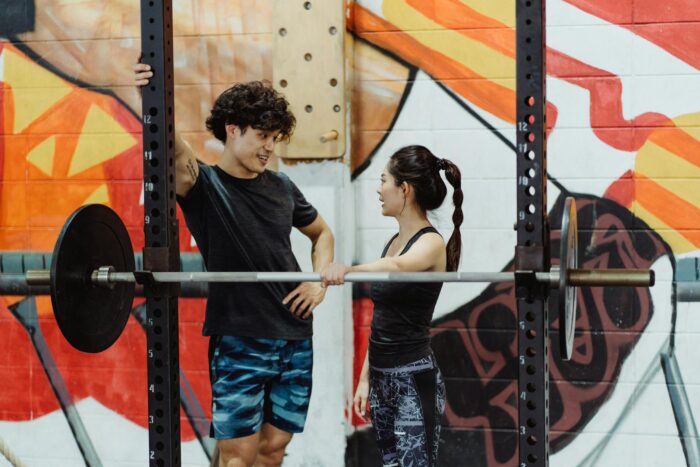
If the situation is natural, a short chat can be perfectly normal. For example, someone asks how many sets you have left. You answer, offer to let them work in if needed, and that’s it. If the conversation carries on by itself, great. If not, you don’t push.
The original suggested offering help, for example with taking the weight off a leg press. That idea only works if help is genuinely needed. Don’t rush over to someone’s machine to play the hero. Ask calmly: “Do you need help with the plates?” If the answer is no, the answer is no.
So what actually happens when the interaction goes well? You relax. Your posture improves. The workout no longer feels so mechanical. Some people get a small mental boost from it. But that boost has to come from respect, not from someone feeling uncomfortable in the gym.
Keep the conversation short
The best gym talk is often short. One comment, one question, one smile. Then back to training. If you’re both interested in talking for longer, a moment for that will come later, not in the middle of someone’s heavy working set.
Don’t make the body a topic of conversation
A compliment can seem innocent, but in the gym it’s slippery ground. “You have a great body” may not sound as good as it did in your head. It’s safer to talk about training, equipment or an exercise: for example, “Is this bench free?” or “Are you doing more sets here?”
Practical tips: how to flirt without crossing boundaries
A simple truth: good communication starts with attention. See whether the other person wants contact at all. If the replies are short, their gaze drifts away and their body turns away from you, end the conversation politely. That’s not failure. It’s a normal social skill.
- Don’t start a conversation in the middle of a heavy set.
- Don’t stand too close.
- Don’t comment on a stranger’s body, clothes or sweating.
- Ask permission before offering help.
- If you get a no, calmly move on.
- Keep training as the main focus, not a pretext.
If you want to use that old “testing tip” in a modern way, think of it like this: before a heavy workout, do something that lifts your mood and focus. For some people that’s a short friendly chat. For others it’s good music. For others it’s a warm-up set that feels especially light. Flirting isn’t part of a training program, just a possible small mood boost.
And yes, a 30% testosterone rise sounds better than some supplement ad. But there’s already plenty of noise around supplements, hormones and muscle growth. Lasting progress still comes from the same things: consistent training, enough food, sleep and recovery. If social confidence helps you walk into the gym more cheerfully, that’s a benefit. If it turns into getting in other people’s way, the effect is the opposite.
Flirting and training: what should you really keep in mind?
Good gym culture makes everyone’s workout better. That means weights get put back, the bench gets wiped clean and nobody pressures others. The same goes for conversation. A little humor and a friendly tone are fine, as long as they work for both sides.
If you feel you need extra motivation before training, don’t fixate on the idea of flirting alone. Write down today’s goal. Warm up properly. Pick your first exercise so that you find your rhythm. If a nice conversation strikes up in the gym, take it as a bonus, not as a muscle-building strategy.
In the end, what counts is the kind of person you come across as to others in the gym. Big and strong doesn’t have to mean awkward or pushy. It’s better to be someone who is easy to share a room with while training.
FAQ
Does flirting in the gym help you build muscle?
Not directly. Friendly interaction can lift your mood and confidence, but muscle growth depends primarily on training, food, sleep and recovery.
Does a 30% testosterone increase mean a better workout?
Not automatically. The 30% mentioned in the original came from a change measured after a short conversation, but a single reading is no substitute for a proper training plan.
How can you tell whether a conversation is welcome?
If the other person responds openly, keeps up the contact and isn’t in a hurry to get back to their workout, a short chat may be fine. If the replies are curt, end it politely.
Author: joker, Muscle&Fitness
Source: WHO – physical activity.
Come and train! ArtGym