Health and success: massage as your ally
Health is a prerequisite for success. We are enterprising and goal-driven, but at some point a question arises: will I have enough health to see all of this through? We have no power over time, but we can shape our health ourselves — and massage is one of the oldest methods for supporting it.
Health and Estonia — where we stand in the statistics
According to a World Health Organization study, Estonia ranks 69th in the world for quality of life. In sports terms, we are in the company of the also-rans. Considering Estonians’ high self-esteem, this is undeniably a mediocre result.
Our top athletes and singers compete for high results on the world stage, but for the average person the equivalent goal could simply be a long life. Estonia’s current national records speak plainly:
Men: healthy life expectancy 58.1 years, average life expectancy 63 years.
Women: healthy life expectancy 68.1 years, average life expectancy 75 years.
The gap between healthy life expectancy and average life expectancy is considerable. It means that a significant part of life is spent with health problems. Frankly, there is no need to accept that.
The health formula: lifestyle is 50% your own doing
Of the factors that influence our health, lifestyle accounts for 50%. Heredity makes up 20%, environment 20% and medicine 10%. So half of the health formula is ours to shape.
Within the influence of lifestyle, physical activity accounts for 25%. That is a big number — it means that improving your movement habits alone has a significant effect on your overall health. The human body, with its musculoskeletal system — bones, joints and muscles — is built to move.
But here a law of nature applies: moderation. The ancients knew this well — Moderatio est custos vitae, moderation is the guardian of life. Back then there was an official whose job was to make sure physical activity did not go too far. That was the masseur.
Massage and health — centuries of experience
Massage has gone hand in hand with the medical sciences and is one of humankind’s oldest methods of manual therapy. The earliest known written records of massage’s healing effects come from ancient texts:
- NEI-CHING, or Knowledge of Man (2598 BC) — ancient Chinese philosophy
- AJUR-VEDA, or Knowledge of Life (1800 BC) — ancient Indian philosophy of life
- Avicenna (Ali Abu Ibn Sina, 980–1037) — Egyptian and Persian medical wisdom
These traditions relied on observation, philosophical teachings and experience passed down from generation to generation. Even today, traditional Eastern medicine rests in part on the same foundations: Confucianism and Taoist teaching, Buddhism and yoga, chakras and yin-yang theory, acupuncture points and meridians.
The scientific study of massage began in antiquity. Hippocrates (460–370 BC) wrote about it in his Corpus Hippocraticum. The chief physician of the gladiator school in Pergamon, the Greek-born Galenos Galenus (129–199), is the patron of sports massage of that era — his system consisted of bathing, physical exercises and massage technique.
The Middle Ages held back the development of massage in Europe. In the modern era, the Swedish fencing instructor Per Henrik Ling (1776–1839) took the reins and developed the method known today as Swedish massage. Johann G. Mezger of Amsterdam won Europe-wide fame in 1850 when he cured the Danish crown prince — his clinic later became one of Europe’s leading massage centers.
In 1995, representatives of four leading European massage nations — the Netherlands, Belgium, Austria and Switzerland — gathered in Papendal (the Netherlands) and founded the European Association of Sports Masseurs (E.A.S). Finland, England, Italy and Estonia have joined since. The E.A.S’s task is to harmonize the level of massage and training across member countries and to develop common professional standards and European massage work passports.
In Estonia, massage lived on alongside the sauna for centuries. People were massaged in manor-house rooms and in farmyards, in smoke saunas and in town saunas — the skills were passed down from generation to generation, from master to apprentice. The tradition of sauna massage has survived from those times to this day. When sanatoriums and natural-therapy spas emerged, massage took on a new role, above all in rehabilitation.
The physiological effects of massage: what the research says
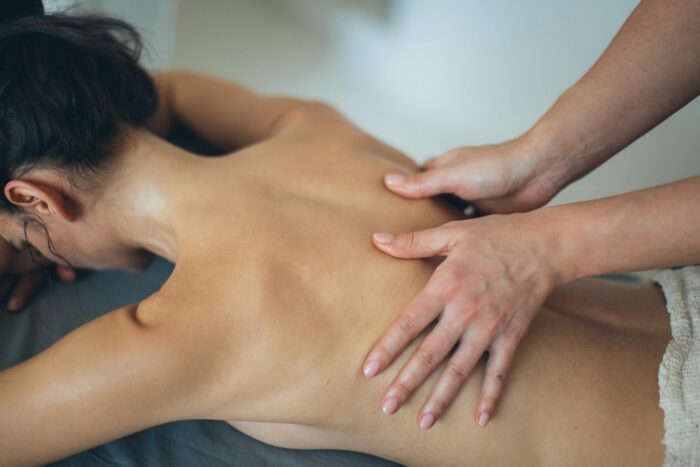
The physiological effects of massage have been studied extensively. In practice, the main goals are relieving pain, reducing muscle cramps, removing swelling and improving metabolism.
Pain. Most patients experience a reduction in pain, even though the procedure itself may feel painful at first. The reduction in pain is explained by three theories. First, the gate control theory — studied by Melzak and Wall in 1965; the same theory also explains the pain-reducing effect of acupuncture and electrostimulation therapy. Second, the pain-relieving effect of morphine-like substances found in the tissues — endorphins, enkephalins and substance P — which we can influence physically through massage, sauna visits or sport. Third, local reflex processes in the spinal cord. Massage is suitable for anything from menstrual pain to chronic overuse pain. Acute injuries and inflammations are generally not treated with massage.
Skin and circulation. Mechanical stimulation opens the sweat and sebaceous glands in the skin and releases histamine and serotonin, which dilate the capillaries. The result is better blood and lymph circulation and greater skin elasticity. Scar tissue adhesions soften and the extensibility of connective tissue improves. The cosmetic benefit is undeniable: tissue permeability increases, which improves the absorption of cosmetic and pharmacological active ingredients. Lymphatic massage is especially important for reducing swelling in oncology patients and after cosmetic procedures.
Muscles. Massage does not strengthen muscles. That takes muscle fiber contraction, in other words physical exercises. On the contrary, what we achieve is muscle relaxation. Even light massage helps clear lactate, or lactic acid salts, into the peripheral blood, which speeds up muscle recovery after training. Combined with stretching exercises, this is a professional approach to recovery.
Note: never massage a hypertonic muscle. Intense athletic exertion causes an inflammatory reaction and swelling in muscle tissue, so it is wiser to wait and use moderate cold therapy as a preliminary treatment.
Clinical studies have also shown some clearing of the lungs with percussive and vibrating techniques, a more even pulse, and slower, deeper breathing. Red blood cell and hemoglobin levels in the blood are above normal even an hour after the procedure. Abdominal massage changes intestinal peristalsis. The psychological effect, improved sleep quality, has also been widely observed. The placebo effect plays a not insignificant part here, as it does with many treatment methods.
So what actually happens when you choose massage? Your keywords for making that decision should be knowledge of massage’s effects and of the process itself. Massage textbooks accepted in Europe describe the massage process as four interrelated segments. Every trained massage therapist also knows the contraindications, the rules that must be followed without exception.
No treatment brings recovery if the person does not want it themselves. And the laws of nature keep to their course: Naturam expelles furca, tamen usque recurret, Horace told his students, among whom was a future Roman emperor.
FAQ
How much of health is heredity, and how much can I influence myself?
Heredity accounts for 20% of health, environment 20% and medicine 10%. Lifestyle, including physical activity, nutrition and stress, makes up 50%. This means half of the health formula is genuinely ours to shape.
When is massage not recommended?
In cases of acute inflammation, injuries, fever and certain skin conditions. Hypertonic muscles and fresh sports injuries are not massaged; in that case the first choice is moderate cold therapy. A trained massage therapist always checks for contraindications before the procedure.
Does massage help with weight loss?
Deep, firm massage reduces fluid in the underlying soft tissue, not fat tissue. Cellulite may get temporary relief, but massage alone does not produce any significant change in body composition.
Come for a massage! ONDI
Source: WHO – physical activity.
Come and train! ArtGym