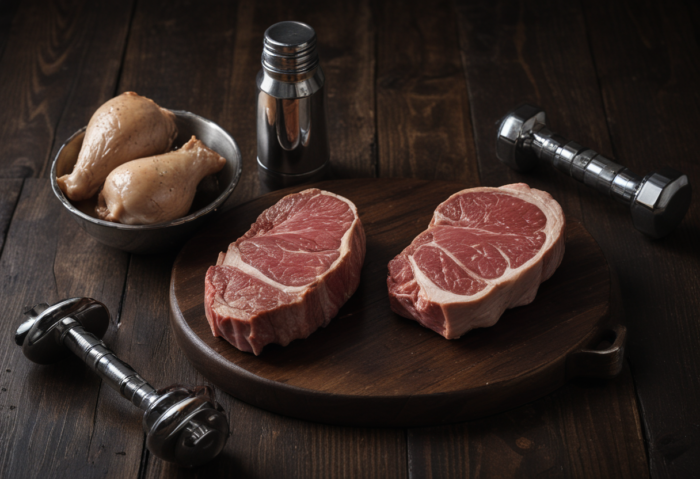
You are what you eat. There’s a lot of truth in that saying. If you eat nothing but asparagus, after a while you’ll start to resemble the plant yourself. And if you eat meat, well… You surely get the idea. No, you won’t turn into a cow right away.
You are surely aware that protein, an energy-rich nutrient, plays an important role in building mass. You may also know that there are different kinds of protein: slow and fast, animal and plant… The list is long. In short, though, red meat (beef, lamb, pork, game) is low in fat, high in protein and contains all the essential amino acids, but it contains no carbohydrates. Red meat is also the meat that most closely resembles the composition of our own muscle tissue, which means it should be the best and most natural building material for our muscles.
A well-known protein source
Red meat has long been at the center of discussion, including among bodybuilders. The 80s and 90s were periods of fat phobia, and during that time quite a few people avoided meat as a protein source because of its low fat content.
Bodybuilders were nevertheless among the first to realize that building muscle requires both protein and fat.
At first, protein came from fish and poultry, but gradually red meat was added to the menu, and as time has gone on it has come to make up a larger and larger share of total protein intake.
Today it is openly acknowledged that humans are made to eat meat and that we need it to get vital amino acids, a suitable mix of fats, vitamins and minerals. We need a balanced diet in which red meat has an important place.
The right amount of meat
How much red meat you should eat to ensure an adequate supply of vitamins, minerals, fats and essential amino acids naturally depends on the rest of your diet. But a good baseline is eating red meat 3-4 times a week.
In addition to meat, it is recommended to eat enough root vegetables, legumes, grain products, seeds and nuts, which make your diet better balanced in terms of different fats and antioxidants. Plant antioxidants, meanwhile, neutralize the free radicals in the body that form when a lot of red meat is eaten.
Vegetarians can also get all the nutrients the body needs from food. However, it takes a lot of knowledge about planning a menu so that it contains all the essential amino acids needed to optimize muscle growth and meet all of the body’s needs.
Did you know that…
…allergies caused by fish, egg, milk and nut protein are far more common than those caused by meat protein, which are extremely rare.
…the rawer the meat you eat, the longer it takes your body to digest it.
…red meat contains all the essential (vital) amino acids.
…the body can make use of only three calories out of the four that one gram of protein provides.
Fat content varies
Red meat contains about 75% water, 20% protein and 1 5% fat, and the quality of the fat differs from animal to animal. Fat quality depends both on what the animal has eaten and on whether it is a ruminant (for example cattle) or a monogastric animal (for example a pig). The meat of the latter generally contains more unsaturated fat than that of ruminants.
All red meat is rich in omega-6 fatty acids, which are essential fatty acids, meaning you have to get them from food. Omega-6 is involved in tissue growth and vital bodily functions, as well as in producing the proteins needed for immune defense.
Overdoing omega-6 can have unpleasant side effects. It increases the risk of inflammation and makes the body more susceptible to free-radical attack, and over time it may lead to heart and cardiovascular disease, as well as cancer. For this reason, from a fat perspective it is better to choose meat from animals raised on a plant-based diet, because such meat contains a lot of omega-3, which means its fatty acid profile is better balanced and healthier for us.
Meat rich in minerals and vitamins
Red meat is rich in important vitamins and minerals. One mineral worth highlighting is iron. Iron’s most important job is transporting oxygen and electrons. Thanks to this, you feel good and alert, and it also boosts immunity, physical performance and the ability to learn. If you don’t get enough iron, the energy from food isn’t used as efficiently, and we feel tired and irritable.
Other important minerals from red meat include zinc, which has a positive effect on the immune system, selenium, which protects cells from free radicals, and calcium, which strengthens the skeleton and enables muscles to contract. Red meat is also rich in B vitamins, especially vitamin B12. Among other things, B12 helps with the formation of red blood cells and the functioning of the nervous system. If a B12 deficiency persists for a long time (years), it can cause anemia, which in turn leads to permanent nervous system damage.
Beef
(lean, for example beef tenderloin)
NUTRITIONAL VALUE / 100 g
120 kcal
21 g protein
0 g carbohydrates
4 g fat
– A kilo of beef contains about 5 g of creatine.
– Good beef tenderloin should be bright red when you buy it.
– Chanterelle mushrooms go well with this meat, for example in a sauce or fried separately.
Lamb <highest in energy
NUTRITIONAL VALUE / 100 g
133 kcal
19.8 g protein
0 g carbohydrates
5.9 g fat
– Compared with other meats, lamb contains relatively high amounts of saturated fat.
– Preferably serve it with potatoes, as this brings out the rich flavor of lamb better.
– Rosemary, garlic, lemon and olive oil are good for seasoning lamb.
– If you roast lamb in the oven, the internal temperature of the roast when done should be about 70-75°C.
Pork
(lean, for example pork tenderloin)
NUTRITIONAL VALUE / 100 g
106 kcal
20.6 g protein
0 g carbohydrates
2.6 g fat
– Contains a lot of unsaturated fat.
Game <highest in protein
(for example moose)
NUTRITIONAL VALUE / 100 g
99 kcal
22 g protein
0 g carbohydrates
1.2 g fat
– Very low in fat, with a good fat composition.
– Thyme, basil, oregano, marjoram, bay leaf and juniper berries are good for seasoning game.
– Since game is very lean, when roasting it in the oven you can brush it with oil now and then to keep the meat as juicy as possible.
Translated from the magazine Body; Author: Hannah Runsten
Translated by: Greta
Come and eat meat! Armudu
Come and train! ArtGym