
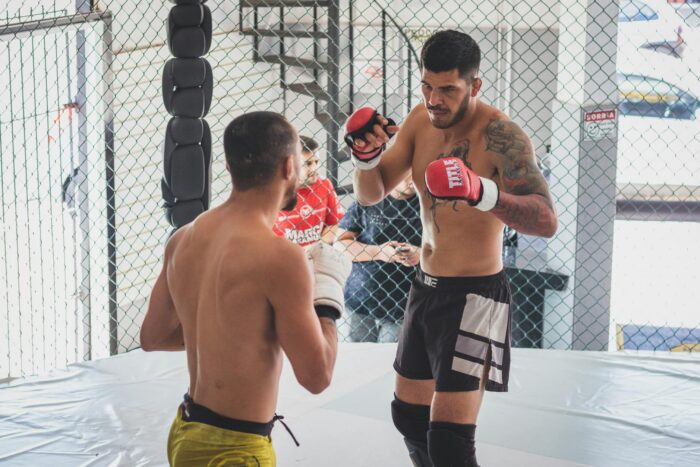
MMA in Estonia: an overview of mixed martial arts
MMA in Estonia first drew a wider audience in 2006 and has since overtaken Muay Thai, kickboxing and even boxing in popularity. A short overview for fitness.ee readers: what kind of sport this is, where it came from, and who the people are whose names keep coming up in Estonian combat sports.
The abbreviation MMA comes from the English term Mixed Martial Arts. In Estonian, people speak of “segatud võitluskunstid” (mixed martial arts), but I have always liked the word “põimunud” (interwoven) better. It conveys more accurately that this is not just a matter of throwing several styles together side by side, but of building one whole in which striking, ground fighting and grappling blend into each other.
MMA in Estonia: how it got here
Modern MMA came into the public eye in 1993 in the US, when the Ultimate Fighting Championship was founded — the league we know today by the abbreviation UFC. The original idea was simple and, in a way, bold: put representatives of different martial arts in one cage and see which style really works. There were essentially no rules, because the whole point was not to prescribe any.
Honestly, that state of affairs didn’t last long. In the late nineties, rules were added that protected fighters and brought more humanity to the sport. UFC’s current president Dana White still uses the slogan “as real as it gets”, but today’s MMA is far more disciplined than what it all started from.
We owe much of today’s MMA technical toolkit to the Gracie family and the Brazilian Jiu-Jitsu they practiced. Royce Gracie dominated the first UFC events against opponents many times his size and strength — precisely thanks to his ground-fighting skills. That shattered the myth that the bigger man always wins. Internationally, the sport was carried forward by two leagues: the UFC in the US and Pride Fighting Championship in Japan.
Techniques and rules used in MMA
Techniques fall roughly into two groups. The first is striking: kicks, punches and knee strikes. The second is grappling — ground and standing holds, joint locks, takedowns, throws and chokes. In a real MMA bout, one and the same fighter can switch between the two within a second, which is exactly what makes the sport so exciting to watch.
As in any humane sport, MMA has a number of clear prohibitions. Biting, eye-gouging, putting fingers in the opponent’s mouth and manipulating small joints — twisting toes or fingers — are banned. Strikes to the groin are also not allowed. These rules apply at big international galas as well as at Estonian competitions.
Coaches and fighters on the Estonian MMA scene
Two names always come up when talking about Estonian MMA. Priit Mihkelson teaches mainly Brazilian Jiu-Jitsu and works at the Tallinn club 3D Treening. Jorgen Matsi is Estonian MMA’s most dedicated coach — essentially every man competing in Team Scared & Paranoid colors has come up under him at Elustreening in Tartu.
Together, the two — 3D Treening and Elustreening — make up Team Scared & Paranoid, the team that actively competes in Estonia. The reason their names are the ones that stick is simple: Jorgen’s and Priit’s students don’t lose fights. Estonian MMA’s history so far confirms this.
Among the fighters who have found their way into the Estonian MMA cage are Priit Mihkelson, Jorgen Matsi, Ott Tõnissaar, Erik Õunapuu and Lauri Ülenurm. The list grows every year, but these are the people the current generation is measured against.
FAQ about MMA in Estonia
When did MMA arrive in Estonia?
MMA reached the public in Estonia in 2006. Since then the sport has grown rapidly, surpassing Muay Thai, kickboxing and boxing in popularity.
How does MMA differ from other martial arts?
MMA combines techniques from several styles — strikes as well as grappling and ground fighting. A practitioner of a single style usually struggles in a mixed-rules bout wherever their own school runs out.
Where do I start if I’m interested in MMA?
The most sensible thing is to go to either 3D Treening in Tallinn or Elustreening in Tartu and join a beginners’ training session. Both clubs teach the basic techniques calmly and step by step, without anyone throwing you into the cage right away.
If you have questions or opinions, you’ll find the Fightclub subforum on the fitness.ee portal, where MEE, jrx and sweals answer. Also check out photos of the latest event in the fitness.ee gallery and the video on Fitness TV. More about the fighters and the development of MMA in upcoming articles.
Author: Mee
Source: WHO – physical activity.
Come and train! ArtGym




