
In short:
- You can train your neck safely using hand resistance or a neck harness, with a light training load and a slow tempo.
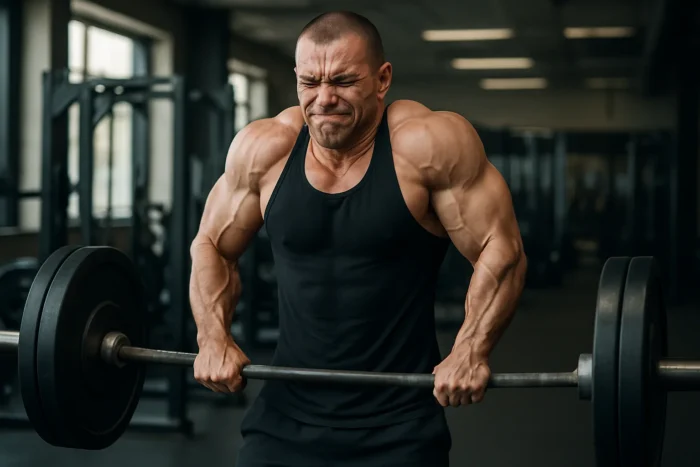
- The best exercises for building the trapezius muscles are shrugs with dumbbells and the barbell upright row.
- The neck is a sensitive area — avoid jerky movements and consult a doctor if you have a previous neck problem.
A strong neck and trapezius muscles give the upper body a compact look, but their role in supporting posture and the neck is even more important. Properly performed neck exercises strengthen an area that daily sedentary work tends to weaken. This guide is based on the exercises in Ervin Liebert’s “Athletic Gymnastics” and on modern strength training safety principles.
Which neck exercises are safe for beginners?
The simplest and safest neck exercises use hand resistance. Liebert describes an exercise in which you place your hands alternately on your forehead and on the back of your head and try, with strong efforts, to overcome the resistance of your hands, then slowly give way. It is precisely this slow, controlled yielding that makes the exercise safe — you regulate the training load yourself with your hands and need no extra weight. The neck works in every direction: forward, backward and to the sides.
More advanced trainees can add neck harness raises, where, sitting bent forward, the head is lowered to the chest and raised toward the back of the head, or the rear variation, where the weight hangs behind the head. Neck harness exercises require good preparation and a light training load. Wrestler’s bridge-type exercises, meanwhile, are already an advanced level and are not suitable for beginners. A broader view of movement training is given in the article What is functional training.
How do you train the trapezius muscles?
The trapezius muscle (musculus trapezius) extends from the base of the skull across the shoulder to the shoulder blade, and its upper part gives the neck and shoulder girdle their characteristic shape. The most direct trapezius exercise is the shrug with dumbbells: keep your arms as straight as possible and raise your shoulders high; if you like, add a slight rolling motion at the end of the movement. You can do the same with a barbell.
Another effective exercise is the barbell upright row: with a narrow overhand grip, the barbell is pulled up from the starting position to under the chin, without changing the position of the body. This puts good load on both the deltoids and the trapezius muscles. Because the trapezius works closely with the shoulder muscles, it is worth combining neck and trapezius training with a broader shoulder routine — the article Shoulder training covers this in more detail. When doing shrugs, the goal is not a heavy barbell but to feel the muscle contract at the top position.
A practical recommendation is to add one trapezius exercise at the end of a back or shoulder training session, doing 2–3 sets of 10–12 repetitions. When doing shrugs, keep the movement clean — raise your shoulders straight up toward your ears and lower them slowly, avoiding pushing your head forward or swaying your body. The barbell upright row suits those with mobile wrists and shoulders better; if the movement causes a pinching feeling in the shoulder, stick with shrugs, which load the trapezius just as effectively but with a gentler joint angle.
How often and how heavy should you train your neck?
The neck is a small, sensitive muscle group, so the rule here is “less is more”. It is enough to train your neck on one to two days a week, doing 1–2 exercises and 2–3 sets of 10–15 light repetitions. You can train the trapezius on shoulder day within the same range. The World Health Organization (WHO) recommends that adults do muscle-strengthening exercises on at least two days a week, and neck strengthening fits well within that framework.
When choosing the weight, control is what decides, not the training load: the neck must work from the muscle throughout the entire range of motion, without the head dropping under momentum. NSCA strength training guidelines emphasize gradual progression especially for sensitive areas — start with hand resistance and add extra weight only once the movement is completely pain-free and controlled. If you have never trained your neck before, also take a look at the guide Advice for strength training beginners.
What mistakes should you avoid in neck training?
The most dangerous mistake is moving with momentum — the neck does not tolerate sudden, jerky movements, and they can injure a muscle or a joint. The second mistake is too much weight in neck harness exercises; here it is worth starting with the minimum and increasing very slowly. The third is forcing the range of motion: do not push your head into positions that cause pain from straining. Warm up your neck before training with light rotations, and stop the exercise immediately if you feel sharp pain, tingling or numbness in your hands. Consult a doctor if you have a previous neck injury, frequently recurring headaches or high blood pressure, because some neck exercises temporarily raise your blood pressure.
References
- Liebert, E. “Athletic Gymnastics”. Exercises 95–100 (neck exercises with hand resistance and a neck harness) and 56–57 (shrugs, barbell upright row), atleetvoimlemine.fitness.ee.
- NSCA (National Strength and Conditioning Association). Essentials of Strength Training and Conditioning — progression and safety.
- ACSM (American College of Sports Medicine). Resistance training guidelines for healthy adults.
- WHO (2020). Physical activity — muscle-strengthening training 2 days a week.
Frequently asked questions
Do you actually need to train your neck separately?
For most people, light neck exercises are enough to support posture and strengthen the neck. Heavier, dedicated neck training is mainly necessary for wrestlers, boxers and other contact-sport athletes.
How do you train the trapezius without weights?
Shrugs can be done with your own body weight or with a band: raise your shoulders toward your ears and hold the contraction for a moment. Hand-resistance exercises cover the neck portion and likewise require no equipment.
Why does my neck hurt after training?
Mild muscle soreness the day after training is normal, but sharp pain, tingling or numbness is a warning sign. In that case, reduce the weight and range of motion and see a doctor if needed.
How often can you train your neck?
One to two times per week is enough for most people. The neck is a small muscle group that needs recovery, so training too often or too heavy is more likely to increase the risk of injury.
Come train your neck! ArtGym




