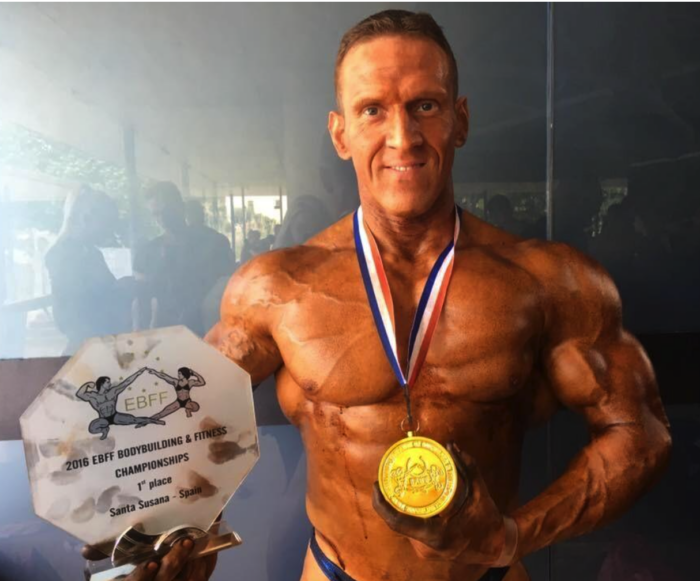
Ott Kiivikas returned home from Spain in May 2016 as European champion — winning Estonia’s first senior men’s European bodybuilding gold. Joining him on the podium were Andra Vagur (silver) and Endla Vaher (bronze). Three medals at a single European Championships marked a historic achievement for Estonian bodybuilding and fitness.
Kiivikas’s journey to the top
Kiivikas had competed at the European Championships several times before 2016. His previous appearances had earned him one bronze and three silvers — all creditable results, but gold had always slipped just out of reach.
That year brought a breakthrough. In Santa Susanna, he stepped on stage in condition that left the judges in no doubt: the gold medal was going to Estonia. It was the high point of his career to date and Estonia’s first official European gold in senior men’s bodybuilding.
Raigo Kuusnõmm competed in the same category. He reached the semifinals and finished seventh — a strong result for a competitor who consistently ranks among Europe’s very best.
The Estonian team in Santa Susanna: alongside Kiivikas
From 4–8 May, one of Estonia’s largest bodybuilding and fitness delegations gathered in Spain. The athletes competed across several disciplines, securing at least one place in the finals in each.
Andra Vagur won silver on her championship debut in the bikini fitness height category up to 169 cm. Such a result on a first appearance at the European Championships is rare at this level and reflects a long period of preparation. Jane Tammearu also reached the final in the same category, finishing fifth.
In junior bikini fitness, Karina Polovnikova (-160 cm) reached the semifinals, finishing 9th. Reet Reimets placed 12th in the height category up to 169 cm, while Jekaterina Remets also finished 9th in the -160 cm class.
Endla Vaher delivered a strong performance in fitness. Her clean execution of a complex routine in the final earned her bronze — Estonia’s third medal at the same European Championships.
Classic bodybuilding brought Estonia four places in the finals. Rain Kuusnõmm finished fifth in the height category up to 168 cm, and Imre Vähi matched that result in the up to 175 cm class. Peep Reinart (-171 cm) and Siim Savisaar (-180 cm) finished seventh.
In bodyfitness, Tatiyana Pudovkina reached the semifinals and finished 15th. Esta Pilt secured a creditable 8th place in masters bodyfitness.
What Kiivikas’s victory means for Estonian sport
Bodybuilding has long been a quiet success story in Estonian sport. Plenty of people train in gyms, but elite competitors have always been exceptional — getting to the stage can take ten years of discipline, diet and recovery.
Kiivikas’s European gold brought that work into the spotlight. After Santa Susanna, Estonian media began covering bodybuilding more regularly, and younger athletes gained reassurance that someone from a small nation could reach the very top in Europe.
Andra Vagur’s and Endla Vaher’s medals extended that impact to women’s sport. Bikini fitness and fitness were already growing disciplines in Estonia, and the results at the 2016 European Championships gave them a boost that reached everyday gym workouts — after that spring, more and more women began considering training for competition.
FAQ
Where were the 2016 European Bodybuilding Championships held?
In Santa Susanna, Spain, from 4–8 May 2016. This small town on Catalonia’s Mediterranean coast is a popular host for international bodybuilding and fitness competitions.
Was this Ott Kiivikas’s first European gold?
It was his first European title. He had previously won one bronze and three silvers at the European Championships, but in 2016 he brought his best-ever condition to the stage.
How many medals did Estonia win in total?
Three: Kiivikas’s gold in bodybuilding, Andra Vagur’s silver in bikini fitness (-169 cm) and Endla Vaher’s bronze in fitness.
Author: EKFL
Source:Turg.Fitness.ee
Come and work out! ArtGym