
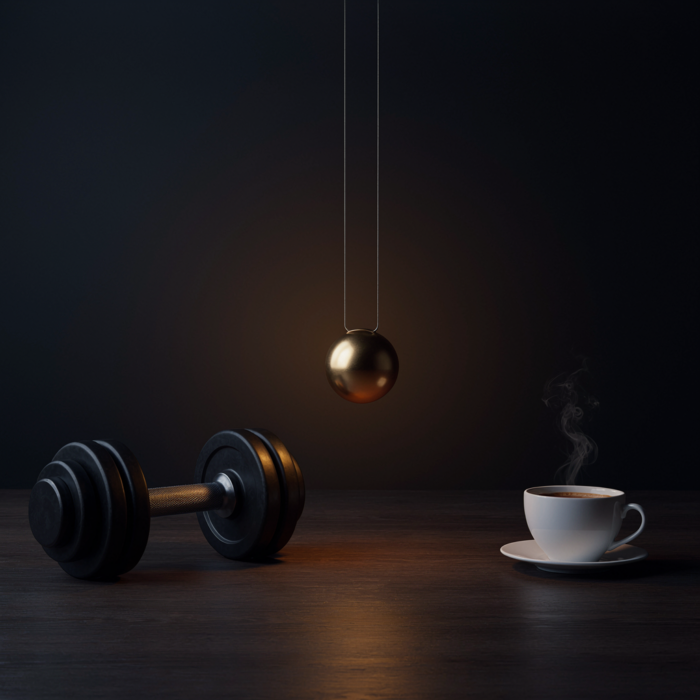
The pendulum: moderation in training and in life
The pendulum is a simple picture of how the body and life often work: the further you swing to one extreme, the stronger the backlash can be. We see the same thing in training, dieting, work and even partying. The question isn’t whether going all-out is bad, but whether you know how to account for its price afterwards.
Why the pendulum matters in training and in life
We all know what a pendulum is. Pull it all the way to one extreme and let go, and it swings through the midpoint at speed and out to the other extreme. Pull it back less, and the return swing is calmer too.
Honestly, life very often seems to work the same way. The bigger the departure from your usual rhythm, the clearer the consequences later. There’s nothing mystical about it. The body and the mind want their balance back.
A hard workout is a good example. The more draining and challenging the training session, the more recovery it demands. If you squeeze yourself dry down to the last drop of capacity, you’re out of action for a while. If you keep the training load more reasonable, you get moving again sooner.
The same pattern shows up in everyday life. After 6 – 7 shots, the next morning may not be glorious, but that can’t be compared with a situation where 25 – 26 shots were taken the evening before. The further you push, the harder it comes back.
How the pendulum works with diet and training
Whoever our creator may be, they seem to love moderation and stability. This is especially clear when it comes to dieting. If you suddenly shut off the food taps and push the calorie deficit very deep, a strong counter-reaction can follow once the diet is over. The hunger pendulum swings back.
So what actually happens? A person holds out for a long time, suffers, and denies themselves almost everything. Then the diet ends and the appetite comes back with great force. Many people eat back everything they lost, and sometimes even more.
A simple truth: healthy eating shouldn’t be a punishment or a short project. It’s better to make it your ordinary midpoint. When a normal everyday routine is in order, you don’t have to keep swinging from one extreme to the other.
In training, extremes aren’t always bad. Sometimes they’re used deliberately. Take the Smolov system, where you bench press or squat four times a week. That’s an extreme, because no normal person bench presses or squats four times a week, and a classic strength program doesn’t usually mean four sessions a week for a single lift.
Even so, such a defined load can contribute to progress for some people. The idea is that the body gets a strong stimulus, then recovers and may respond with supercompensation. The outcome can be a new personal record or muscle mass gain. But the key word here is “limited”. An extreme can’t be your everyday life forever.
How to keep the pendulum under control
One option is to turn some things that once seemed extreme into the norm. Pull-ups every day, for example. In ordinary life most people don’t do pull-ups every day, but if you find a volume your body can handle, it can become a habit.
The point here isn’t that everyone should immediately start pulling like crazy. The point is adaptation. If someone does pull-ups every day over a longer period, the body starts to account for that load. For example, 6 months in a row of 50 – 100 pull-ups is already a clearly extreme idea, but with a well-chosen volume it can give your back solid development.
The same principle applies to work and rest. Some people are rushing around all the time. Up early in the morning, closing the laptop late at night, random meals, no time left for the family. For a while it seems like everything is working. Then comes the breakdown.
I’ve seen this pattern among people close to me. A person pushes and pushes until at some point they snap. Then comes the drinking, a complete crash, or a long slump that wipes out much of the earlier effort. Too much zeal is folly, as they say.
Practical signs the pendulum is swinging too far
The first sign is that you no longer have any reserve. Every workout demands self-overcoming, every workday ends with you squeezed empty, and every diet feels like a battle. If a small deviation throws your whole rhythm off, your training load is probably too high.
The second sign is black-and-white thinking. Either perfectly clean nutrition or total surrender. Either a workout every day or none at all. Either work from morning to night or complete burnout. These are the pendulum’s big arcs, not calm progress.
The third sign is the repeated promise “I’m starting again now”. Sometimes a fresh start really is what you need. But if your whole life consists of fresh starts, it’s worth looking toward the midpoint. What would be a rhythm you can keep even when the week isn’t perfect?
There are examples of the opposite, too. Some people make a one-hundred-eighty-degree turn: a big partier becomes very proper overnight, even pious. That’s the pendulum as well. The further someone was in one direction, the stronger the swing toward the other can be.
My point isn’t that you should always fear extremes. Sometimes a big push does deliver results. But if you want to keep your health, strength and good shape for the long run, the middle ground matters most. You reap what you sow, and the smarter you invest, the more you get back.
FAQ
Does the pendulum mean hard workouts are bad?
No. A hard workout can be necessary if it has a purpose and is followed by recovery. The problem starts when maximum effort becomes the everyday norm.
How can you tell a diet is too extreme?
If you think about food all the time, have no energy and only look forward to the day you can eat everything again, the restriction is probably too harsh. Good nutrition has to be sustainable.
Can training every day work?
It can, if the volume is manageable. Every day doesn’t have to mean a hard workout. Sometimes a small amount of repeated work that your body can adapt to is enough.
Author: Janar Rückenberg
Source:Turg.Fitness.ee
Come and train! ArtGym




