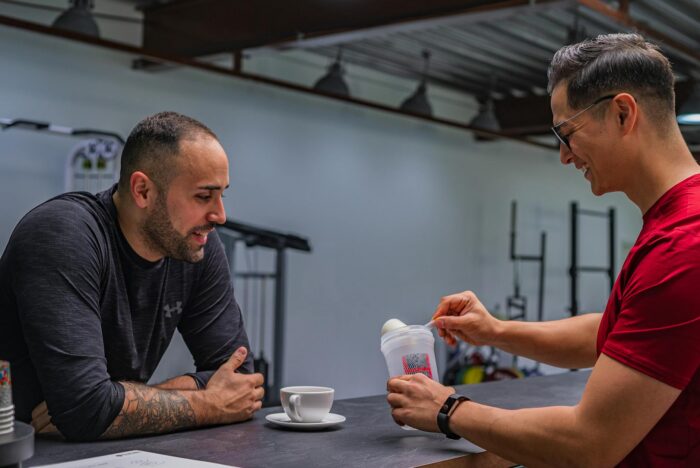
Post-workout nutrition and recovery
Post-workout nutrition often determines whether a hard workout simply leaves you tired or leads to proper recovery. After a gym session, your muscles quickly need water, carbohydrates, protein and specific amino acids, rather than an arbitrary large serving.
This article focuses on protein synthesis: how to kick-start it after a workout, why too much protein may not help, and how glucagon and gluconeogenesis can shift things in the opposite direction.
Why does post-workout nutrition matter?
Hard strength training does not build muscle during the workout itself. The workout sends your body a signal. The real work begins afterward, as your muscles try to replenish their energy stores, reduce breakdown and increase the rate of protein synthesis.
It used to be common advice to consume a very large amount of protein after a workout. I once supported that idea myself. Frankly, this is an area where our understanding has changed over time. It is not just a question of whether your shake contains 30 g or 60 g of protein. What matters far more is the type of protein, how quickly it is absorbed and whether the right amino acids reach your bloodstream along with it.
Studies have compared several different conditions. At rest, the rate of protein synthesis was 50% higher with elevated insulin levels than with normal insulin concentrations. At rest with elevated amino acid concentrations, the rate of protein synthesis was 150% higher than with normal amino acid concentrations. After strength training, protein synthesis increased by almost 100% compared with pre-workout values.
When more amino acids were available in the blood after strength training, protein synthesis increased by 200% compared with normal post-workout amino acid concentrations. When high amino acid concentrations were combined with elevated insulin levels, the rate of protein synthesis increased by 400% compared with conditions in which amino acid and insulin levels remained normal after the workout.
Interestingly, the post-workout shake in that last case contained only 6 g of protein and 36 g of carbohydrates. It was not a massive protein hit. The effect came from insulin levels being sufficiently high while the key essential amino acids were available at the same time.
Post-workout protein synthesis and amino acids
So what actually happens? After training, your muscles need nutrients quickly. Essential amino acids make the biggest difference, rather than an arbitrary large amount of protein. Nonessential amino acids do not increase protein synthesis in the same way. What matters is how quickly the amino acids you need reach your bloodstream.
That is why it makes sense to choose a rapidly absorbed protein after a workout. The original article highlights whey hydrolysate as a fast option. The translator’s note still applies here: without splitting hairs, all types of whey are quite welcome after training, provided the rest of your plan is sensible.
Too much protein, however, can work against what we want to achieve after a workout. A high-protein meal triggers glucagon release. Glucagon is a hormone that counteracts insulin and may reduce insulin secretion. When you consume carbohydrates together with a moderate amount of protein, insulin can do its job. When you consume too much protein at once, things may change.
This is where gluconeogenesis comes in. Glucagon can direct amino acids toward conversion into glucose. The simple truth: if you consume too large a dose of protein at once, some of the essential amino acids may end up being used for energy instead of muscle recovery.
BCAA, or branched-chain amino acids, play an important role here. L-leucine is particularly important. One unpublished study from 2000 examined the importance of BCAA in recovery. In endurance athletes, the rate of protein synthesis fell by 30% after training, and this lasted for about 6 hours after the workout. When they were given carbohydrates alone, their glycogen stores were replenished, but there was no noticeable effect on protein synthesis.
A drink containing only the BCAA L-leucine restored the rate of protein synthesis to its pre-workout level and set recovery processes in motion. When carbohydrates were added, the rate of protein synthesis rose above its pre-workout value. The conclusion was that L-leucine and insulin acting together significantly increased the rate of protein synthesis.
How should you put together a post-workout shake?
A practical plan does not have to be complicated. The aim is to give your muscles readily available carbohydrates, rapidly absorbed protein, an appropriate amount of amino acids and enough water. Ideally, this supports glycogen replenishment, protein synthesis and a reduction in protein breakdown.
- Add an adequate amount of branched-chain amino acids to your post-workout shake.
- Make sure you get the key essential amino acids immediately after training.
- Create the conditions for increased insulin secretion.
The original article recommended a shake containing 0.4 g of whey per kg of body weight, plus 0.8 g of carbohydrates per kg of body weight to rapidly increase protein synthesis. The carbohydrates in question were glucose and a glucose polymer, such as maltodextrin. The ratio and amount of BCAA are also important, as these amino acids enter the bloodstream quickly and help increase protein synthesis.
Immediately before and during your workout, you can sip a shake containing the following ingredients.
- Carbohydrates: 0.4 – 0.8 g/kg. The carbohydrates should have a high glycemic index and be absorbed quickly. The original recommendation was a 50/50 blend of glucose and maltodextrin.
- Protein: 0.4 g/kg. Choose a rapidly absorbed protein, such as hydrolyzed whey.
- Amino acids: branched-chain amino acids 3 – 5 g. If catabolic processes begin to dominate during training, BCAA are the first amino acids the body seeks to draw from your muscles for energy. Glutamine and L-leucine are particularly important.
- Creatine: 3 – 5 g. Creatine may increase your capacity for work during training, improve recovery through ATP-PC processes, and support muscle mass growth both directly and indirectly.
- Water: 2 l. The amount of fluid in the shake matters. Too little fluid makes the shake too concentrated, impairing nutrient absorption.
Ideally, a pre-workout shake should have a concentration of 4 – 8 percent. This helps improve nutrient absorption and keeps your body hydrated. The calculation is simple: 10 g of powder in 1L of water makes a 1% solution, while 100 g of powder in 1 L of water makes a 10 percent solution. You can use this to work out your own quantities.
A post-workout example for a 100 kg athlete
After your workout, you can—or should—have another shake with the same composition as the one you drank during training. The original article added 500 mg of vitamin C and 400 IU (international units) of vitamin E to this.
Once again, here is an example of what a 100 kg bodybuilder needs.
Shake before/during your workout:
- 40g – 80g of carbohydrates (50% glucose – 50% maltodextrin)
- 20g – 40g of hydrolyzed whey
- 3 – 5g of each supplement – creatine, glutamine, BCAA
- 2L of water
The calculation remains the same: 80g of carbohydrates + 40g of protein + 5g of creatine +5g of glutamine +5g of BCAA = 135g of nutrients. Mixing all of this into 1 L of water would make the shake a 13.5% solution, which would be too concentrated. Mixed with 2 L of water, the shake would have a concentration of 6.75%, which is good.
Immediately after your workout:
- 40g – 80g of carbohydrates (50% glucose – 50% maltodextrin)
- 20g – 40g of hydrolyzed whey
- 3 – 5g of each supplement – creatine, glutamine, BCAA
- 1 – 2 l of water
- 500 mg of vitamin C and 400 IU (international units) of vitamin E
This does not mean that every recreational athlete needs to follow the same plan down to the gram. Your body weight, workout duration, goal and digestion all matter. The point is that you should not rely solely on a large amount of protein after your workout. A combination works better: fluid, carbohydrates, rapidly absorbed protein and amino acids.
FAQ: post-workout nutrition
Do you need to consume a lot of protein after your workout?
No. The original article’s main message is that a large amount of protein alone is not the deciding factor in protein synthesis. Rapidly absorbed protein, essential amino acids and an appropriate insulin response are what matter.
Why is L-leucine important after your workout?
L-leucine helps activate a mechanism that supports protein synthesis. If enough insulin is available but L-leucine is absent, synthesis may not proceed at its maximum rate.
How does gluconeogenesis relate to this?
In this context, gluconeogenesis means that glucagon can direct amino acids toward conversion into glucose. If you consume too much protein at once, not all of the amino acids may end up where you want them to go after your workout.
Translated from the article: ”Solving the Post Workout Puzzle I, II”, John Berardi.
Author: Janar Rückenberg
Source: WHO – physical activity.
Come train with us! ArtGym