
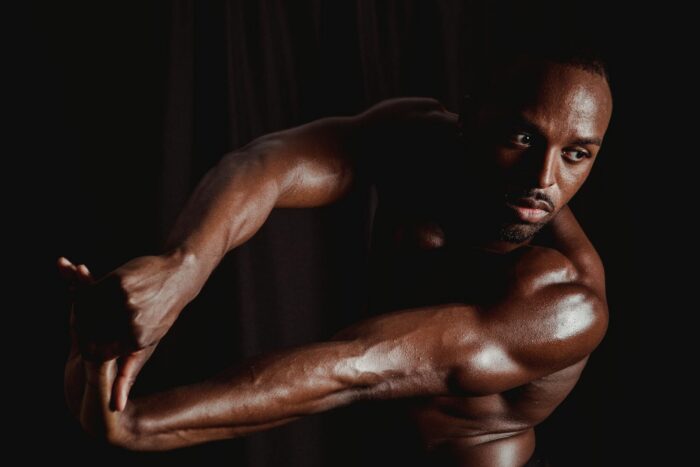
Ronnie Coleman: bodybuilding isn’t powerlifting
Eight-time Mr. Olympia Ronnie Coleman once answered a question from a young powerlifter in Flex magazine: does the biggest man on stage win? The answer was unambiguous — no. Below is the substance of that exchange, along with an overview of Coleman’s own training and contest-prep cycle.
The reader’s question Ronnie Coleman answered
Joe Sauter, a 26-year-old powerlifter, wrote to the Flex editors. Joe had helped a 21-year-old friend prepare for that friend’s first bodybuilding competition. The friend didn’t win. Joe figured the fix was simple — the friend should train harder, use basic exercises and eat big right up to show day. The strategy sounds logical. But does it work in bodybuilding?
Why Ronnie Coleman thought that strategy was a mistake
“Bodybuilding isn’t about being the biggest man on stage,” Coleman said. Coleman cited a friend who thinks exactly the same way: that the biggest wins. In reality it doesn’t work like that — a big man with no structure simply melts into the gray mass. A judge doesn’t see mass, but proportion.
Coleman clarified: that approach does suit a powerlifter — there, the number on the bar is what counts. In bodybuilding, a different combination counts: symmetry, proportion, size, polish and a whole range of subjective and objective criteria at once. Mass alone is not the goal.
According to Coleman, a two-part approach is required — first, building muscle mass evenly across the whole body rather than chasing a single muscle in isolation, and second, following a diet so that excess fat disappears and the muscle groups stand apart from one another.
Reps, weights and sets
Coleman doesn’t recommend light training — heavy basic training stays. The difference is in the repetitions: Coleman stayed in the 10–15 range. According to Coleman, a typical pyramid looked like this: first set 15 reps, next 12 reps and the last 10 reps.
In the bench press, for example, the working weights were 60 kg for 20 reps, 101 kg for 15, 142 kg for 15 and finally 182 kg for 12. The numbers are familiar to a powerlifter — unusually heavy for a bodybuilder. But the rep count stays in the bodybuilding range rather than at a single maximal effort.
“I stick with the same program all the time, and under constant pressure the body simply grows,” Coleman wrote. That is the principle: training doesn’t change over the course of the season. Only the diet and the weights in the final week change.
How Ronnie Coleman prepared for competition
12 weeks before the show, Coleman began gradually cutting fats, sugar and excess carbohydrates. Calories came down in steps so the body could adapt without shock — according to Coleman, an abrupt cut means a loss of muscle mass.
A practical example: all season long, Coleman ate pancakes for breakfast. When preparing for the contest, these were swapped for oatmeal — the meal changes, but muscle size doesn’t disappear.
Coleman reduced the weights on the bar only a week before the contest, when carbohydrates had already dwindled and energy levels were no longer high. Even that week, Coleman still trained on Monday and Tuesday, then rested for three days until stepping on stage.
The biggest man doesn’t win — a lesson from 1998
Coleman’s own conclusion was simple: forget the urge to be the biggest. The biggest doesn’t always look big on stage. You can be a little smaller than the next competitor, but if you show your muscles separately and sharply, you look bigger.
Coleman gave the 1998 Mr. Olympia as an example: Coleman weighed 112.5 kg and won, Flex Wheeler was 103 kg and placed second, and Nasser El Sonbaty, at 121.5 kg, was third. The biggest man on stage didn’t win. The winner was the one who showed off the muscles best.
FAQ
Does a powerlifter’s training program suit a bodybuilder?
Not as-is, according to Coleman’s answer. Basic exercises and heavy weights stay, but the reps rise to the 10–15 range and growth comes through constant pressure rather than one-off max lifts.
When did Ronnie Coleman change the diet?
12 weeks before the contest. Fats, sugar and excess carbohydrates are cut gradually — the body has time to adapt and muscle mass is preserved.
Does the biggest man win a bodybuilding contest?
No. At the 1998 Mr. Olympia, the winner was Coleman at 112.5 kg, not Nasser El Sonbaty at 121.5 kg. For judges, proportion and polish count, not just the weight on the bar.
Author: joker : Flex magazine
Source: WHO – physical activity.
Come and train! ArtGym




