
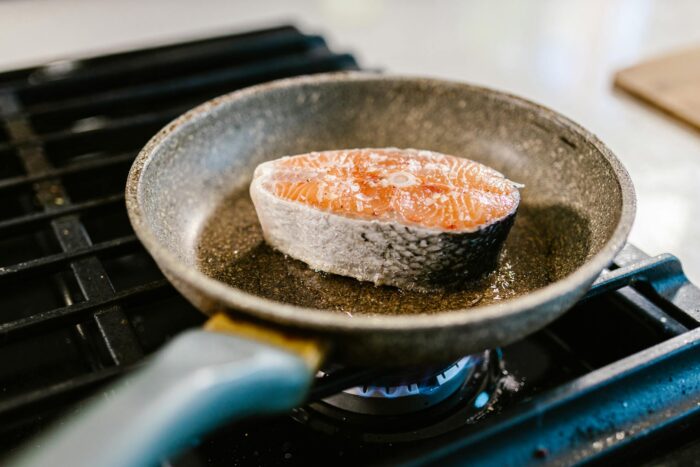
When the bulking phase is on and your meal plan starts to feel monotonous, put salmon in your basket on your next shopping trip. It’s not just a tasty fish — it’s one of the few protein sources that delivers both high-quality protein and the healthy fats your body needs when you train.
Why salmon suits a bulk
A nutrition plan with fewer carbohydrates and more fat can deliver very good results during a bulk. The point isn’t fat in itself, but which fat ends up in your diet. Salmon does contain a considerable amount of fat, but surprisingly little of it is saturated. Most of it is omega-3 fatty acids — exactly the ones that Western diets commonly lack.
Honestly, many lifters focus only on how much protein they eat and forget that fat quality affects muscle gain as much as grams of protein do. This is exactly where salmon beats chicken or tuna, for example. You get two things at once.
Salmon’s nutritional value and the effect of omega-3
One of the less talked-about but, for people who train, more important effects of omega-3 fatty acids is that they make muscle tissue more sensitive to insulin. The simple truth: when receptors respond to insulin better, the carbohydrate hit after your workout is stored in the muscles as glycogen rather than in fat tissue. So you get more out of the same meal.
Salmon has about as much protein as many lean fish, but the fatty acid profile makes the difference. In addition to omega-3, you get vitamin D, vitamin B12 and selenium — all of which matter for hormonal balance and recovery. So what actually happens when these nutrients arrive on your plate together? Your body recovers better, baseline inflammation stays lower, and hard training weeks don’t wear you down as quickly.
Salmon fresh, frozen or canned
In Estonian shops, salmon comes in three forms, and they aren’t all equal. Fresh salmon fillet is of course the best — the flavor is rich and the texture stays juicy after cooking. Frozen salmon is practically just as good if it has been properly frozen and is thawed slowly in the fridge, not under the tap.
Canned salmon will do in a pinch, but let’s be honest — it’s high in salt, the flavor is dull, and some of the omega-3 fatty acids are damaged during processing. If your goal is serious bulking, choose fresh or frozen fillet.
How salmon adds variety to your everyday menu
Chicken and tuna are simpler, cheaper protein sources, but if you eat them every day, the food quickly starts to feel like a chore. The rich flavor of salmon fillet makes it possible to turn meals during longer training cycles into something you actually look forward to. Same place to eat, same kitchen — but a different fish changes the whole eating experience.
Practical ways to prepare salmon:
- Baked in the oven on parchment with lemon and dill — the simplest way, and it always works.
- Pan-fried skin side down until the skin turns crispy.
- Cold-smoked salmon for breakfast with eggs.
- Steamed salmon fillet on a bed of vegetables if you want slightly less fat.
Salmon’s price is reasonable, especially compared with some more exotic fish. In the larger shops you can often find frozen fillet at a discount, and if you buy a whole pack at once, you can put together a week’s meals more cheaply.
FAQ about eating salmon
How often should you eat salmon?
Two to three times a week is a sensible range for most people. Beyond that, heavy-metal accumulation also starts to play a role, which is why eating it every single day isn’t recommended.
Is frozen salmon worse than fresh?
Nutritionally, hardly at all. Flavor and texture suffer only if thawing is rushed or if the fish has been thawed and refrozen repeatedly.
Is salmon suitable for a cutting phase too?
Yes, just watch your portion size. Because of salmon’s fat content, you need to keep a more precise count of calories, but the effect of omega-3 on muscle retention makes it a good choice while cutting.
Find omega oils here: https://turg.fitness.ee/et
Author: Mikk-Alvar Olle (transl. Flex)
Source: WHO – healthy eating.
Come and train! ArtGym




