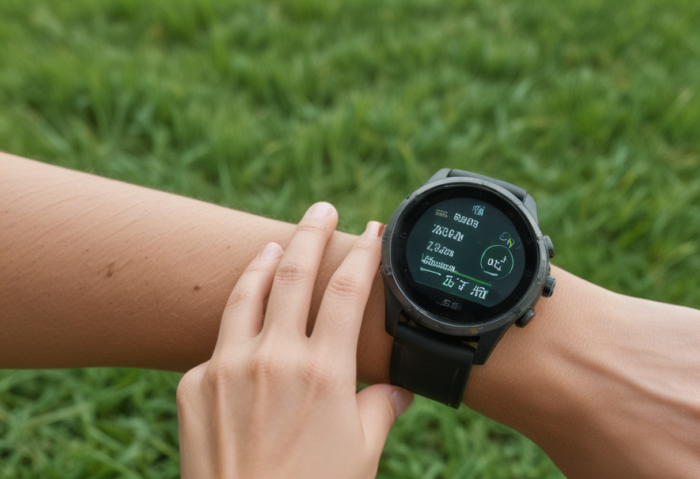
A stress monitor gives you an honest picture of what happens in your body during the working day, workouts and sleep. When how you feel tells one story but your recovery is falling behind, monitoring helps reveal where strain is really building up.
You cannot judge everything by how you feel.
Why does a stress monitor matter?
Stress is not always bad. A brief period of exertion helps you focus, increases alertness and can even benefit your training. The problem starts when your body cannot settle down afterward.
Many people only notice stress when their sleep becomes disrupted, their heart rate feels high in the evening, their training progress stalls or they wake up tired. It is a familiar pattern: the working day runs late, you squeeze in a hard workout in the evening, and the weekend is spent recovering rather than truly resting.
Objective monitoring helps distinguish between two things: whether the demands on your body are simply high or your recovery is inadequate. These are not the same problem. Better planning may help with the first. With the second, you need to look at sleep, rest breaks, activity patterns and mental demands.
How does a stress monitor work?
The solution described in the original article is based on Firstbeat technology. It measures heart rate variability: how much the time between two heartbeats varies.
The simple truth is that when your body is relaxed and recovering well, your heart does not beat like a metronome. The intervals between heartbeats vary naturally. When your body is under strain, the rhythm often becomes more regular because your nervous system is more primed to respond.
This is why heart rate variability is used to assess stress and recovery. It cannot tell whether you had a bad meeting or a tough squat day. What it does show is how your body responded to those situations.
Firstbeat monitoring usually runs for three days and nights. The device is attached to your chest with electrodes while you go about your normal life. During monitoring, you also keep a diary of your sleep, working hours, workouts and other significant activities.
What can monitoring reveal?
The results give you an overview of periods of stress, recovery, sleep quality and physical activity. This is especially useful when you cannot make sense of how you feel: you are tired, but there is no obvious reason.
So what is actually happening? Some people discover that training is not their main source of strain after all. Instead, an evening work email, eating too late or disrupted sleep is keeping their body under stress. For others, the problem may be too many hard workouts in a row.
What should you do with the results?
The point of monitoring is not to get a nice report to tuck away in a drawer. It is to make a small change you can track. For example, you might move a hard workout earlier, take a proper break in the middle of the working day or make one training day each week easier.
If your recovery is poor at night, start by looking at your sleep schedule. Does your bedtime vary by several hours? Are you using your phone too late? Does your evening workout finish so late that your body has no time to settle down?
If your stress levels are high during the working day, the solution may be simpler than a new training program. A short walk, a lunch break away from screens or a fixed time to finish work may do more for you than another coffee.
For athletes and recreational exercisers, the greatest value lies in being able to relate recovery to training. If your body is not recovering, there is no point in continually increasing your training load. Sometimes, greater progress comes from having the confidence to take an easier week.
Practical points before monitoring
During the monitoring period, keep your life as normal as possible. If you make your whole life perfect for three days, you will get an impressive result, but not a useful picture. Stick to your usual working days, workouts and evening routines.
Be honest when filling in your diary. Record your sleep, work, physical activity, workouts and particularly stressful moments. The more accurate the context, the easier it will be to understand later why certain periods showed up as stress in your body.
Do not treat one assessment as a final verdict. It is a snapshot of one period. If you make lifestyle changes, it makes sense to repeat the monitoring later and see whether your recovery has actually improved.
In all honesty, the greatest value of this kind of test is often motivation. When you see in black and white that your body is not recovering even when you think you are resting, it becomes easier to decide to go to bed earlier or briefly reduce your training load.
FAQ: stress monitors
Are stress monitors only suitable for athletes?
No. Athletes can benefit from using them to manage training and recovery, but they can be just as useful for office workers, managers or anyone whose sleep and ability to work have recently deteriorated.
Does a smartwatch measure the same thing?
A smartwatch can give you a general indication, but a device attached to your chest is more accurate at assessing heart rate variability. This is especially true when looking at small changes measured in milliseconds.
Can one assessment resolve stress?
No. Monitoring gives you information. Change comes from what you do with that information: improving your sleep, adjusting your training load, taking recovery more seriously and tracking whether you feel better.
Author: Medihub
Come and train! ArtGym