
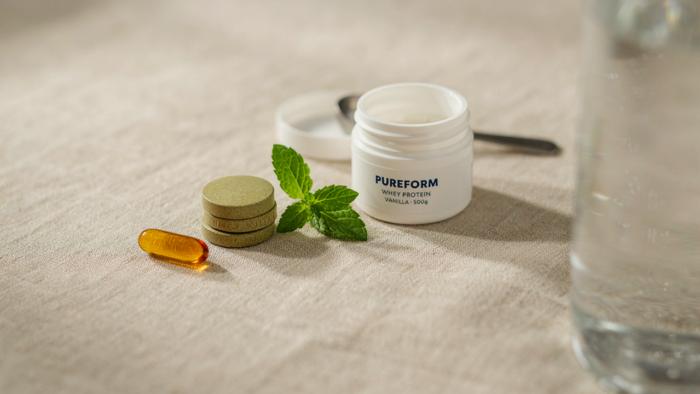
In short:
- Science backs two supplements for beginners: creatine monohydrate and adequate protein intake.
- Without proper nutrition and consistent training, no supplement will deliver meaningful results.
- Most popular products — BCAAs, fat burners, pre-workout — aren’t essential for beginners.
- Start with your diet: first assess your protein and calorie intake, then consider supplements.
Which beginner supplements are scientifically proven?
Supplements for beginners is a topic with a lot of marketing noise and little real substance. Before you spend money on various products, it’s worth knowing which supplements have an actual scientific basis. If you want to understand what supplements actually contain, that’s a good starting point.
The scientific literature clearly supports two categories:
Creatine monohydrate
Creatine is one of the most studied sports supplements in the world. The International Society of Sports Nutrition (ISSN) has confirmed that creatine monohydrate is safe and effective for building strength and muscle mass (Kreider et al., 2017). In beginners, the effect of creatine is often even more noticeable than in experienced athletes, because muscle creatine phosphate stores are lower before first use.
Recommended dose: 3–5 g a day, every day. A loading phase (20 g a day for 5–7 days) speeds up saturation, but isn’t essential.
Whey protein or another quality protein supplement
Protein intake is essential for muscle growth. A large meta-analysis showed that protein supplements significantly increase gains in muscle mass and strength from strength training — especially in people whose daily protein intake falls below 1.6 g per kilogram of body weight (Morton et al., 2018). Still, if your diet fully covers your protein needs, a supplement isn’t essential.
Is creatine suitable for beginners, and how do you use it correctly?
Yes — creatine is one of the few supplements whose use science clearly supports even for beginners. Supplements: what you should know gives a broader overview of supplement categories in general.
The main benefits of creatine for beginners:
- Increases muscle strength and power during short-duration training loads (Kreider et al., 2017)
- Supports recovery between workouts
- Is safe for long-term use in healthy adults (Antonio et al., 2021)
- Offers one of the best price-to-quality ratios on the supplement market
How should you take it? 3–5 g a day, at any time — before a workout, after, or at another convenient moment. Consistency matters, not the exact time. Mix it into water or juice, or add it to a protein shake.
Who should be careful? People with kidney disease should consult a doctor before using creatine. The NIH Office of Dietary Supplements confirms that creatine is safe for healthy adults.
When should a beginner start using supplements at all?
Every newcomer to training asks themselves the question 💊 are supplements necessary.
Short answer: supplements complement — not replace — good nutrition and consistent training. The biggest progress in your first 3–6 months in the gym comes simply from your body adapting to the new training load through neurological adaptation, not from supplements.
A practical step-by-step recommendation:
- Assess your daily protein intake — are you eating 1.6–2.2 g of protein per kilogram of body weight?
- Make sure your sleep (7–9 hours) and overall nutrition are in order
- Only then consider adding creatine
- Use whey protein only if your daily protein needs aren’t met from food
Which supplements should beginners avoid?
Many popular products are unnecessary or overrated for beginners:
- BCAAs and free amino acid blends — unnecessary when total protein intake is sufficient (Morton et al., 2018); protein powder gives the same effect more cheaply
- Fat burners — weak scientific basis; a calorie deficit and physical activity are many times more effective
- Pre-workout stimulants — the effect of caffeine is real, but a high dose disrupts sleep and quickly builds tolerance
- Testosterone boosters — for most healthy young men there is no justification; the evidence base is weak
Even with natural supplements, it pays to be critical and look into the actual evidence base — for example, spirulina has well-established nutritional value, but it isn’t among a beginner’s top-priority choices.
References
- Kreider RB et al. (2017). International Society of Sports Nutrition position stand: safety and efficacy of creatine supplementation in exercise, sport, and medicine. Journal of the International Society of Sports Nutrition. PMID: 28615996
- Morton RW et al. (2018). A systematic review, meta-analysis and meta-regression of the effect of protein supplementation on resistance training-induced gains in muscle mass and strength in healthy adults. British Journal of Sports Medicine. PMID: 28698222
- Antonio J et al. (2021). Common questions and misconceptions about creatine supplementation: what does the scientific evidence really show? Journal of the International Society of Sports Nutrition. PMID: 33397265
Frequently asked questions
Does a beginner need to take supplements at all?
No, supplements aren’t mandatory for beginners. Good nutrition, enough protein from food and consistent training deliver the best results in the first 6–12 months, even without supplements.
What is the best supplement for a beginner?
Creatine monohydrate is the best-proven option scientifically, at a dose of 3–5 g a day. It is safe, affordable and effective for building strength and muscle mass.
When should you take creatine — before or after training?
The timing of creatine isn’t critical. What matters is taking it regularly every day, not the time of day. You can mix it into water or juice, or add it to a protein shake.
Does a beginner need protein powder?
Only if you can’t meet your daily protein needs (1.6–2.2 g per kilogram of body weight) from food. Protein powder is a convenient addition, not a requirement.
Are supplements safe?
High-quality, tested supplements such as creatine and whey protein are safe for healthy adults. When starting a new supplement, it’s worth checking the ingredients and, if needed, consulting a doctor or a nutritionist.
Let’s get training! ArtGym




