
The anti-fat propaganda of the 80s and 90s left a deep mark. Slowly, though, a different truth is spreading: not all fats are harmful, and some are downright essential. Fats consist of several different fatty acids, and which of them end up on your plate decides whether fat works for you or against you.
Fat is a compact source of energy, at 9 kcal per gram. Your body also needs essential fatty acids (alpha-linolenic acid and linoleic acid), on which cell membranes, the nervous system, the immune system, skin, hair and internal organs depend. Vitamins A, D, E and K are fat-soluble, so without fat they simply aren’t absorbed. Eating too little fat can lead to vitamin deficiency, which is far from rare among bodybuilders with a fear of fat.
What fats are made of: three families under one label
Dietary fats fall into three main groups: saturated, monounsaturated and polyunsaturated. Each group behaves differently in the body, affecting cholesterol, hormones, inflammation and insulin sensitivity in different ways. That is why the right question isn’t “is fat good or bad?” but “which fat, and how much?”
Saturated fats: where they come from and how they affect you
Saturated fats are found mainly in full-fat dairy products, some vegetable oils, fatty meat (bacon, for example), ice cream, baked goods (trans fats), chocolate and coconut oil (MCT). Cell walls are largely made of saturated fats, and the heart uses them as its primary fuel.
This group has had a poor reputation for decades, which has improved a little recently. Studies carried out in Sweden and elsewhere have failed to find a clear link between saturated fats and cardiovascular disease. Researchers increasingly see that refined carbohydrates have at least as negative an effect on cholesterol as saturated fats do. The typical Western diet — plenty of saturated fats, especially trans fats, together with a lot of refined sugar — is the problem; saturated fat on its own is not.
The debate centers on the effect on cholesterol. People talk about “good” (HDL) and “bad” (LDL) cholesterol. Put simply: when the balance is off — HDL too low, LDL too high — the risk of cardiovascular disease goes up. Saturated fatty acids raise the levels of both. The problem arises mainly when they come together with refined carbohydrates and LDL climbs well above HDL.
Trans fats — an artificially modified form of saturated fat — are the worst for your health: they raise LDL while lowering HDL. They are found in many packaged and refined foods. On the other hand, CLA and stearic acid (abundant in meat), which belong to the same group, are good for your health and have a positive effect on cholesterol levels. So one saturated fat is not the same as another — they are two very different things.
Among bodybuilders there is a strong belief that saturated fats raise testosterone. It probably stems from a 1997 study in which people switched from a diet with 18.8% of total calories from fat (mainly polyunsaturated) to a diet with 41% fat (mainly saturated). Free testosterone rose by 13%, but at the same time the level of SHBG, which binds it, increased by 15% — so the net effect was small. More recent studies suggest that what matters is rather the total amount of fat, not the specific type. One thing is certain: a higher fat intake boosts testosterone production, but it’s impossible to say which fat affects it the most.
Saturated fatty acids have a negative effect on insulin sensitivity. If you train regularly and eat in line with your expenditure, you needn’t worry much about this. It is worth paying attention, though, to what kinds of fat your “loading days” are made of — pizza, ice cream and kebab throw insulin sensitivity off balance and can hurt your training results (a large share of the weight gained comes from fat tissue, not muscle).
MCT (medium-chain triglycerides) deserve a separate mention. It is a saturated fatty acid that behaves more like a carbohydrate — it burns quickly. MCTs are abundant in coconut oil and are also sold separately as a supplement. The idea is to replace other fat sources with MCT to boost fat burning, but in practice you would have to replace so much of your daily ration that the effect is mostly marginal.
Monounsaturated fats: the Mediterranean choice
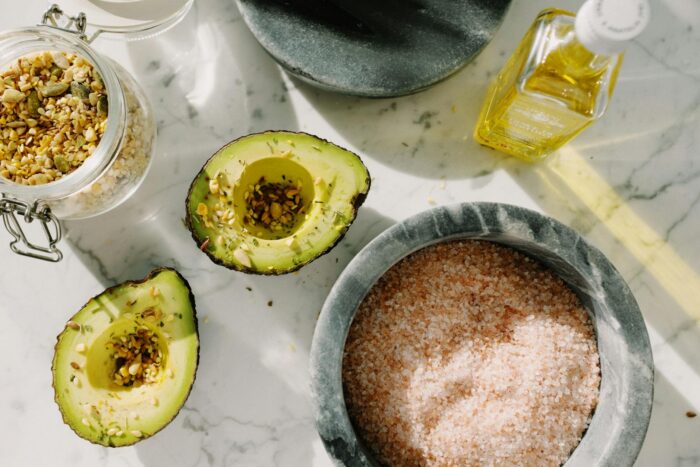
Monounsaturated fats are found in olive oil and olives, canola oil, nuts, avocado and also chicken. It is these fatty acids that give the “Mediterranean diet” its reputation — this eating pattern is associated with a lower risk of cardiovascular disease, and researchers agree on this.
For anyone who trains, their effect on antioxidants, insulin sensitivity and body fat is of interest. In one study, participants who swapped some of their saturated fats for monounsaturated fats lost weight in four weeks — even though calorie intake and physical activity stayed the same. That is good to keep in mind when a cutting phase is approaching. In short: monounsaturated fats offer practically nothing but benefits.
Polyunsaturated fats consist of omega-3 and omega-6
Polyunsaturated fats in the form of omega-3 are found mainly in fatty fish (salmon, mackerel, herring, Baltic herring, sardines). Omega-6 is abundant in canola, sunflower and corn oil, in sesame and flax seeds, and in walnuts.
The most important ones are considered to be alpha-linolenic acid (ALA, from the omega-3 family) and linoleic acid (from the omega-6 family) — both are vital and must come from food. The body in turn makes EPA and DHA from ALA, and you can also get enough of them from oily fish. These fatty acids are essential for repairing cell damage, for the brain, for the immune system and for much more.
Throughout human evolution, omega-3 and omega-6 have been roughly in balance. Today, however, we eat on average 10–20 times more omega-6 than omega-3 — industrially produced food and most ordinary oils and meat products favor it. The result is a chronic tendency toward inflammation, accompanied by a higher risk of cancer, stroke and heart attack. The simplest fix: eat fish regularly or take fish oil as a supplement. Omega-3-enriched eggs and meat products are also available, but they are usually relatively expensive (an important detail when you consider how much meat and how many eggs the average bodybuilder eats).
The scientific evidence for the benefits of omega-3 is impressive: lower disease risk, better skin, a stronger skeleton, fewer joint complaints, better cognitive function. Fish oil is one of the few supplements whose hype is actually justified and is backed by a large number of studies.
Intense strength training makes the body briefly more prone to inflammation — especially if your diet is already rich in omega-6. One researcher recommends that athletes add 1–2 grams of omega-3 fats a day, with EPA and DHA in a 2:1 ratio.
But what about fat burning, which fish oil is so often associated with? A recent study followed four groups for twelve weeks: sunflower oil without training, fish oil without training, sunflower oil with training and fish oil with training. In the non-training group, fish oil improved the quality of blood fats but did not change the amount of body fat. In the training group, on the other hand, fish oil reduced body fat compared with the sunflower oil group — 1.2% and 0.1%, respectively.
The conclusion is simple: fish oil is not a magic fat burner. A noticeable effect appears only if you train as well. Researchers are not yet quite in agreement about why this is so.
Practical tips for trainees
- Which foods keep you feeling good is individual. The possible testosterone effect of a high fat intake (40% of total calories) is often overshadowed by how easy it makes it to overshoot your “calorie budget.” A sensible starting point is 20–30% of total calories. If you fall below 20%, keep a close eye on your fatty acid composition so that you don’t run short of the essential fatty acids.
- Saturated fats are not as harmful as was believed for years — but they are not as beneficial as monounsaturated fats and omega-3 either. CLA and MCT are interesting, but in practice it is hard to get enough of them into your diet.
- You should limit your intake of trans fats. They hide in many ready-made foods — read the labels.
- Pay attention to the ratio of omega-6 to omega-3. Reduce the former, increase the latter. If you don’t eat fish regularly, add fish oil as a supplement.
FAQ
What is the difference between saturated and unsaturated fat?
Saturated fats are solid at room temperature (butter, coconut oil, animal fat) and push both sides of cholesterol — HDL as well as LDL — upward. Unsaturated fats are liquid at room temperature (olive oil, rapeseed oil, fish oil) and generally have a more favorable effect on your cholesterol profile. Your diet needs both, but the share of unsaturated fats should be larger.
How much omega-3 should I get per day?
For the average person, eating oily fish a couple of times a week is enough. For active strength trainees, some researchers recommend an additional 1–2 grams of EPA + DHA as a supplement, in a 2:1 ratio, to balance the short-term risk of inflammation that comes with training.
Should I avoid fat while dieting?
No. Fat is energy-dense (9 kcal/g), so it is easy to overeat, but a completely fat-free diet takes away the essential fatty acids and the fat-soluble vitamins (A, D, E, K). Keep your intake at 20–30% of total calories and put the emphasis on monounsaturated and omega-3 fats.
Translated from Body magazine; Author: Martin Berkhan
Author: Greta
Source: Turg.Fitness.ee
Come and train! ArtGym




